Search This Blog

Tuesday, April 29, 2014

Perpetuation has changed forms


Of course language is for communication.  In the first days of language, it was for face-to-face communication.  Then, people saw that simply making marks for money transacted was a good way of keeping people from changing what they agreed to.  Later, marks for representing geographical landmark words and words for boundaries and measurements were devised.  Before long, a system emerged that represented what people wanted to perpetuate.  Kings, for example, wanted to tout their spoils in war, and those who knew how to write wanted to keep a list of kings and sometimes their accomplishments for posterity.

Not too far down the line from property records and annals of kings came the keepers of stories.  People wanted to record their myths (used in a literary sense), so they wrote them down.  But, more and more tasks were put into writing as cultures flourished for long periods of time.  However, at the root of every written system was the face-to-face communication.

Now, however, face-to-face communication is beginning to disappear.  Virtual communication has begun replacing face-to-face.  With virtual communication, the need for writing stories or observable information for posterity or for back-up of a real conversation is dying.  People can record their virtual communication in several different forms.  Thus, the need for making marks on a page is dying.  The other forms are more efficient, faster, and are more exact.

Making the marks and making sense of those marks (writing and reading) have lasted a very long time - about 5000 years, but since their need has become unnecessary, their perpetuation has also become unnecessary.  It's really that simple.  Adios, farewell, goodbye to an old friend who has served us well.  It was a good run.  But, it's time to move on.

Sunday, April 27, 2014

I feel summer comin' on


Good and slow,
Pure and sweet,
Something past
From days gone by.

Definitely American Honey!

Wednesday, April 23, 2014

The next future

I've been hearing about electric cars for years.  I have read of the experiments.  I have seen the tests of fully electric and hybrids.  I have been waiting... until now.  Now let the hoopla begin.  The fully electric car is practical, safe, and synced with your cell phone for convenient functionality.  Charge stations exist nearly everywhere.

Tesla S

I knew the time would arrive if I would just have the patience.  And do I like it because it is a new toy, a new gadget to play with?  Hardly!  It is the next stage in transportation because it is a gateway vehicle to another way to travel.  The kinks will be worked out on existing roadways.  But the fully electric idea makes the car run digitally - from a computer, from a cell phone, from the car itself.  A self-sufficient car controllable from remote means.

Nissan Leaf

This is the stuff of science fiction.  Well, not this car exactly.  But about the fourth generation from now, it will prompt advances in roadway construction, such as the totally drivable road without having people steer the car.  The road will have electronic signals built into blocks the road is built with and will communicate with the car's electronic signals.  It's really not science fiction because this type of road has already begun its experimental stage. And, it opens the way for engines in vehicles without wheels.  Usually people are thinking about backpack travel when they think of wheeless vehicle travel. But Tesla has already experimented with above ground movement using electro-magnetic propulsion.

Nissan Leaf

A car driven and controlled electronically and digitally is only one way the world is entering a very visual stage in its history.  And, of course, everything digital can have an associated file for transmission to a cloud storage source.  Call it Big Brother if you like, but it is a significant advancement in transportation for what it allows to happen next.  I'm almost due for my next car purchase.  It will almost certainly be an electric car.

Monday, April 21, 2014

Unbelievable but typical


Someone showed me a reading list for their daughter's sophomore year from a home school association. The person said the teacher was a "classical education" teacher and wanted her students to be able to pick up any piece of literature and be able to read it  in her students' futures.  The teacher said it was the best approach for college preparation.
,
I had to show my disbelief that such a teacher still existed, but after recovering from that, I had to comment on about the 18 novels on the list.  Oh, yes - 18... in a year.  Complete with a major written composition (literary criticism) after each novel.  Well, here's the deal.  A classical education prepares a student for a classical world, which the year 2014 doesn't belong to nor did any year after the invention of the computer and its connection to the internet.

College preparedness these days doesn't necessarily include knowing how to critique a fictional story, ancient or contemporary or anywhere in between.  The University of Phoenix' online college, which probably represents most of the online world of private universities, explicitly states that their curriculum is built around asking businesses what they want out of a graduate.  Being able to pick up any piece of literature and read it was not a priority on that list.  In fact, writing a literary criticism expertly wasn't either.  Presenting graphs and charts and meaningful talking points in a meeting, however, was.

I exaggerated a little to say that I was in disbelief that such a teacher still existed.  I hear about them too often.  I rather think that teacher is a typical English teacher.  I also think the University of Phoenix is on the right track for preparing students for the future.  The reality is about to be that reading and writing are going to bite the dust. If a graduate picks any field in science, the field will be about the iconic use of the alphabet, not reading.  If technology is chosen, it will be all about working on monitors or in 3D as the medical field exemplifies with MRI and laparoscopic (robotic) surgeries. Choosing engineering will be all about numbers, charts and graphs, of course.  And, math? Well, there are letters, but not for reading - for showing variation.  And the letters are not always from the English alphabet.

Wow. 18 novels... 18 compositions. Not even the discipline of doing that will prepare you for anything I know of in the year 2016 (the year of graduation for the student I saw the list for).

Friday, April 18, 2014

It's time


Earth 2.0

It was only a matter of time.  But, the time has come.  Knowledge is always first.  Pursuit will be soon to follow.  These are exciting times.  The link below contains the explanation.

http://www.space.com/25531-new-earth-size-planet-could-have-water-video.html

Now it is much more believable that reading and writing are relics from a world not dependent on telescopes, infrared detection, computer simulations, 3D graphic representations, and other ways to present information.  But our world is dependent on all these things and will increasingly store, transmit, and present in only visual modes with the aid of identifying symbols and tags.

Time is quickly disappearing for reading and writing to serve a useful function... only a short 2 1/2 more years now until the two will decisively be relegated to the rear view mirror.

Wednesday, April 16, 2014

+ x t

Intersections are everywhere around us.  Everyday I pass through at least 20 of them.  Usually they are the same ones, the ones around the area I live.  Sometimes, I go to a place where I pass 20 intersections in just one trip.  And, if I leave town, I get to to experience new and different intersections than the ones in my daily routine.

With people it is the same.  There are those whose lives I intersect everyday, those whose lives I intersect weekly, and those whose acquaintances I make only occasionally or only once.  Some people say the intersections are by divine appointment, others say intersections are completely random, still others have some existential combination of the two possibilities.

It seems that to some extent we choose the intersections we have on a routine basis.  At times, though, it is clear that outside forces make our paths cross with other people.  Opportunities are presented to us daily that are unplanned and planned.  The planned intersections comprise our daily routines for the most part although we plan trips and vacations (the occasional or singular intersections).  The unplanned ones comprise the occasional and singular intersections for the most part

As we construct our lives as adults, we know our personalities well.  So, we plan the intersections that are compatible, or compatible enough, for us to enjoy, risk, have adventure, achieve, and experience many other activities within the limits of our personalities.  Rarely, we are subjected to intersections beyond any control, but we keep these to a minimum if at all possible.

So, I'm not much of a believer in the divine appointment idea for daily activities, maybe for the rare ones, but not for most.  We are all control freaks when it comes to establishing routines that match our personalities so that we can have maximal enjoyment of our lives.  And, for those intersections that have happened that we didn't control and that have dropped from our routines, there are three choices for us.  We can discard them, treat them as part of our normal experience, or consider them sacred.  Sacred ones are few, but I am thankful to have had them.

Sunday, April 13, 2014

Recall


I watched a TV program to its conclusion and left the TV on unintentionally.  I got up to make a sandwich, and when I returned to the living room, the next program had already begun.  A local prominent speaker was in the middle of one of his advice-giving speeches.  I don't normally watch this program, but I thought I would just listen for a minute to see if I should listen further this time.

He spoke of the importance of communication. I couldn't agree with him more about that.  The next thing he said was one of those ideas that got a lot of air play about 30 years ago when it was being investigated more scientifically for the first time, but he must have quit listening after that point because the investigation has continued and the newer information is quite different from the advice he was giving.  He continued to say that communication was important and that men in particular needed to learn that.  He said that men didn't communicate well how they feel or what they are thinking.

If the speaker had paid attention to more recent investigation, he would have known that his advice didn't represent an accurate picture.  Men talk.  They talk frequently, on subjects of interest to them and of interest to others, and reciprocate when asked about personal matters.  They talk to women, they talk to men, and they listen as well.  There's really not a communication problem that men have to work through.  I hated that a lot of people heard inaccurate information from an advice-giver that people seemingly like and follow.

Generalization of a concept is not the best thing to do most of the time.  And, pop culture psychology is not something that should be disseminated or adhered to as if it is the gospel truth.  Research is finer-grained about men's communication patterns than the generalizations made of them 30 years ago, and people, like this speaker, merely want to share their unrefined gist of the research to sound as if they are well versed on a topic geared to half his audience.  But the actual research is usually too detailed for people who want only the bottom line to spew out for impressing people of their grand amount of knowledge.

A little lesson from the car manufacturers is in order for this person.  R-E-C-A-L-L.

Saturday, April 12, 2014

Successful

I don't often go to see a movie on opening day, but today I made an exception for Draft Day.  It was good for several reasons.  I had wanted to see draft day strategy.  I wasn't disappointed on that account.  The plot was simple, but had several points of suspense built in.  I wasn't disappointed on that account either.  But, the movie had a subplot that I hadn't heard about and that I really enjoyed.  Kevin Costner's character didn't want to lose the woman he loved.  It was a great parallel subplot to the main plot.  He didn't want to lose in his job, in the competition of football, or in expressing his love for the woman he loved. He succeeded with relish on all three arenas.

I am jealous of Costner's character.  He succeeded in making himself a premier general manager.  He succeeded in having a team that could win the Superbowl.  He succeeded in restoring the relationship he most coveted in life.  Yep, I'm more than jealous.  Succeeding in life is a very sweet feeling, but more than a feeling when speaking of love.   Life is hardly worth it if love is absent.  Costner's character was a lucky man to have someone who believed in him.  She made him successful, and he worked hard to keep her at his side.  His world turned more pleasantly with her.


Thursday, April 10, 2014

Tired of simplest terms

Three times in the last two weeks, I have asked for an explanation to something.  Each of these three times I received an attempt at an answer, but the person giving it was so limited in both knowledge and words to use for description that the person became frustrated.  I marveled at the inability of these people to explain something.

The question was asked to employees who were supposed to have been trained by a company to give explanations of how cell phones work.  But, the company either didn't give the workings of data transmission or didn't give the trainees the vocabulary to work with.  Eventually, in the questioning of the employee, the person couldn't make the right connections of one idea to another.  The person's knowledge was compartmentalized.  The meanings of particular terms, like gigabyte, data transmission, and resident on device were fuzzy for the person as well.

The whole reason people talk is to communicate ideas.  If that end is missing then the means (the vocabulary) is lacking.  I have to ask myself what in the world is going on in the mind of people who can't explain something.  In an unrelated matter, a person called me for directions but couldn't tell me her own location in order for me to help her easily.  It's tempting to relate all this to whether or not I get the right food in my sack at a fast-food restaurant after placing the order at the speaker. About 50% of the time something has been changed or omitted.  But the problem may be in lack of life experience, unfamiliarity with input to an ordering system, or inability to transfer the meaning of an order to a screen for someone at a different area of the restaurant to read rather than a direct communication problem.

Part of the problem lies in the socialization process of young people.  It is a well known phenomenon that teenagers learn their initial introduction to adult vocabulary from their peers.  If that becomes the extent of the person's experience with communication (often the case), the communication process is truncated and the person will struggle when posed with questions that lead to ideas outside of their experience and consciousness (theory of mind).

I relish the times when communication happens on a level above the one described.  But it is certainly not as common an experience as I would like it to be.  I am relegated to speaking on life's simplest terms.

Wednesday, April 09, 2014

Beyond the tree tops


Everyday I pass a house that fronts the service road of the highway I drive on. The construction is out of the 1970s, and it's in need of a lot of repair. Behind the house is the rest of the property, what looks like about 10 acres covered with a forest.  The forest is thick and appears overgrown with low-lying shrubbery, making it look shabby, uneven, unkempt.

That's about all a person can see from the highway. But, if one is on the service road, or if one has to drive slowly on the highway, then (s)he can see beyond the house sitting in front of the forest. Slightly above the tree line, the tops of some very nice houses, the million dollar variety, can be seen.  Turrets appear on these houses, double chimneys, peaked roofs covering two stories, and gables.  A whole housing addition full of brand new million dollar houses lies hidden behind the shabby, overgrown forest enticing people to come and see more.

Forensic sciences in general, and forensic linguistics in particular, act in much the same way.  Speech at regular speed doesn't allow a view of what's behind it, what it might be hiding.  Many times speech is verbose, repetitive, containing fillers, and passive constructions to hide meaning - what one might call overgrown.  It contains informalities, expletives, and idiomatic expressions that appear inexact; they're decoys  But, if a person looks beyond the words, a truer image of the meaning of the words appears - elaborate constructions to dress up the truth, to hide accuracy, to report what didn't happen.

Facades of beauty house rotten things so much of the time.  Forensics bring out what is hidden.  It's a dirty job, but somebody has to do it.


Sunday, April 06, 2014

Making it worthwhile

My favorite song tonight at ACM awards was sung by Dierks and Sheryl Crow...  Absolutely.


I certainly do.

Saturday, April 05, 2014

Time for a joker

It's quiet right now.  In less than 8 hours it will be raining, and in about 24 hours the wind will be howling through the chimney flue and at the back door.  The weather forecast is pretty accurate these days.  Details are missing, like amounts of rainfall or intensity of barometric pressure, but I know to count on something if rain is forecast at 100% coverage.

I can't really see around the corners on the journey ahead of me, but there is some accuracy in what happens if I chart the future based on  the patterns we know about. In 8 hours when it's raining, I will be working, and in 24 hours the pace of work will pick up, blowing through faster than in the past.

What I enjoy more than knowing the patterns, though, are the wild card factors that don't appear in the patterns.  It's not in the usual cards, it's the wild card.  I love those when they happen.  They're not often; that's why they're not a part of the pattern.  Generally, the changes they bring are pleasant.  It's about time for one of those jokers.

Thursday, April 03, 2014

Beyond that


Civilization has come a long way.  Ancient humans knew quite a bit about their immediate environment.  But, when they looked to the heavens, it was an amazement to them.  They really didn't know what was out there or how to put in perspective what they saw.  The Mayans, and the Babylonians before them, were very well versed in the movement of planets and the various constellations, but beyond tracking movement, they didn't know much.  The makers of Stone Henge and some of the other stone monuments around the world knew about length of days and associated that to the time of year, especially the two solstices.  But, they didn't really know how to view the heavens.

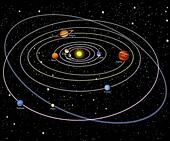
Compare that to modern knowledge and perspective.  There are 8 planets, an asteroid belt, moons revolving around most planets, a Kuiper Belt containing icy planetisimals, such as Pluto, and an Oort Cloud, which has two parts, an inner disc around the Kuiper Belt and an outer circle that defines the cosmograph of the solar system.  From the sun to the outer limits of the Oort Cloud is about 1 light year.


If I travel beyond the Oort cloud another 5 light years, I come to Alpha Centauri the nearest star to Earth's sun.  Astronomers have found another 4 stars in the Alpha Centauri field since originally finding and identifying Alpha Centauri.  Those other four stars have planets revolving around them.  Of course, there are many more solar (stellar) systems in the Milky Way Galaxy, between 100 and 200 billion of them, all of them in the 100,000 light year diameter of the galaxy.

Beyond that are billions and billions of more galaxies, with diameters up to 25 times that of the Milky Way.  All of them contain billions and billions of stars, many of them with planets, which have moons.


So, when I read documents from the ancient past, I know to read them with the perspective they had of the heavens, which was very, very, very, very limited.  We still have much to learn about our skies, but we know infinitely more than the documents coming from generations before the 1600s C.E.  Ancient documents were intended for people with the same understanding as they themselves, not for people of the future who know infinitely more.  If I understand that, then ancient documents don't impede future progress or hold me back from doing what is right for me in a modern period of civilization.

Tuesday, April 01, 2014

Against the grain


The last 5 years I have worked against the grain. That means I have worked at a time when others are off.  I have worked in a field that tries to improve what is typically available.  I have worked with a company that would end the way things have been done for the last 500 years.  And I am working now to innovate a realm that has not listened to the experts in its field for over 60 years.  Yes, against the grain I would say.

My personality is well-suited for working this way.  When I was only 8, my third grade teacher told my mother that I always seemed to take the opposite viewpoint.  In college I took some of the least taken courses like the history of China, the history of Rome, history of the English language, and the introduction to linguistics. When I was in my 20s my mother told me I was a contrarian because of the type of reading I would spend time with, such as Qabala.  In my 30s I sided with the evidence that Shakespeare hadn't written the world class plays attributed to him.  I now believe in the properties of logic that show that language and math are manifestations of one and the same system of order our brains depend on.  The list goes on...

While I enjoy a good debate, I relish the time I spend with like-minded people and those who are compatible with my personality.  And if someone is compatible, it means they too are working against the grain in some fashion or another, like not settling for what 75% of people settle on for their own education, or what even another 18% of people settle for in receiving formal training, or even what another 5% try in advancing their educations one more level from the 18%.  They settle for what only 3% push on to receive.  They do things like disagree with the way things are and see the things that are coming. They can work within a system already in place in order to drive that system to a new place.

I have come to accept my role in society, the stripes on my zebra coat that won't be changed.  It's a comfortable place to be,  I like being there and with those who "get" what this role is about.  Everyone recognizes it's not the same grain.

Monday, March 31, 2014

Marking

One of the ways to describe what happens in a language is to notice markers in language.  In English, the nouns are marked.  Nouns don't occur in English without marking it as singular or plural, general, specific, unmeasured, or abstract.  So, if I want to use the name of something, I have choices to make.  The first choice is to mark the word as plural or singular, which is done in a millionth of a second.  The next choice is to mark the name with specificity or not (a/an or the) followed by the choice of abstract or concrete, measured or unmeasured, both in about a hundred thousandth of a second.

We decided to move tables today.                             
We decided to move a table today.                           
We decided to move the table today. 

 I want coffee this morning.
 I want a coffee this morning.
I want the coffee I had yesterday.

Sometimes marking happens as a word in front of a noun.  Sometimes marking happens as a last letter in the word, a suffix.  Sometimes words are marked by word order.  For example, nouns appear both before and after a verb.  The one before causes the action when using active voice.  The one after receives the action. Thus, word order distinguishes between a subject noun and an object noun.

Volcanoes pour lava onto the ground below them.

Other types of words are marked as well so that English can be well understood by millions of listeners, but this part of the naming process of English is used as an example.

I know that my life has markers in its different compartments, too. I was brought up in a very strict and religious home.  That compartment of my life remains to this day because it has always been one of the possible categories for me in life.  However, I have chosen to mark it in different ways as I have traveled through my experiences.  The marking is one of the ways I communicate who I am to others.  Education is another compartment which I have marked.  Treatment of others, work ethic, view of rule-keeping - I have marked each of these categories for myself in different ways.

Love is no different.  I have marked this category in ways for others to understand as well.  One of the ways was by having children for posterity. But the most significant way was to designate one person as the one for whom my heart beats, life's one true love.  One of these was marked early in my life, one late, but marked nonetheless.  And the markings were made so that I could communicate who I am and what I mean so that anyone who sees me knows what the markings mean.  I didn't create the marking system, but I learned how to use it well and deliberately.

Saturday, March 29, 2014

It's not hidden

The question of how a language is learned has been studied for several millennia.  It's an ancient question.  For that reason it ought to be clear what the process is for learning a new language.  But, that is not the case.  Well, if you believe Rosetta Stone, you think it's clear (or Berlitz, Pimsleur, Living Language, or the name of a 100 other companies).

But if it's true that a person can learn a language in a matter of a few months rather easily, then when I look around at all the countries of the world, I should see a great number of bilingual, trilingual people.  I do see a few pockets of proof of this theory.  Swiss denizens, South African, Ukranian, and a few others do learn 2 or more languages just from growing up in a multilingual environment.  But most people in the world don't.  Why not? It's so easy, right?


Upon further study by modern scholars, variables enter into the equation when learning a language.  One's age when learning a language, for example, yields different results.  One's purpose for learning matters.  The method used sometimes facilitates or impedes learning a language.  Other factors also enter into the picture, such as educational background, opportunity for use, and societal status of each language.  All these factors should make the learning process transparent and easy because methods could and have been made to take into account all of the factors affecting language learning.

But, even if there were a hundred factors in learning language, it should be easy by now, given the thousands of years people have been learning and speaking other languages. Modern people have left it to the schools rather than language scientists to teach languages to people. The schools have used various models for teaching languages, but it still takes place in an artificial environment with the accompaniment of textbooks.  In light of all the years of practice and all the years of research, schools have not changed their approach, regardless of model.  In addition, businesses which have specialized in training people in language have adopted the schools' various models as their approaches.

Evidently, these models are flawed.  It's still a daunting task to learn a language. The research has been done, however, and the process is a known process.  It's not hidden.  It's just that foreign language departments, schools, and businesses are not listening or looking to the available language science.  Wouldn't it be nice for people of nations to speak to each other regardless of language.  They could.  Easily. So be it.

Friday, March 28, 2014

Again

I was talking to a friend today who mentioned that he had started again three times in the same business.  He spoke of the first time as merely having a passing interest in a business that wasn't really what he liked doing, but he participated in the financing of the business so as to have partial ownership.  The others involved in the ownership decided to abandon ship nearly a year later, so he had to start again. This time he was with a friend and former coworker of his wife who ran the business.  In a moment of personal desperation from economic straits, the friend bailed.  So, he had to start again.  This time he is very personally involved and giving personal time, money and effort.  He was animated as he spoke of this third time and of all the plans he was excited to implement.

I admire people who can start again... and again and again.  That kind of tenacity is something I don't see often.  People more often are complacent or they retreat into the familiar and the comfortable when adversity arises.  I have had all three responses to life's circumstances.  I've refused to get involved due to complacency before.  The opportunity passed me by, but I learned from the experience.  I've retreated back to the familiar before when something adverse has occurred.  That helped me recover a little, but it didn't do much of anything to advance my desires and ambitions.  And I've gone for broke on a number of occasions.  Not very many of those occasions worked out for the best, but the impact on my personality, emotions, and stamina has made my character richer for the wear.

More coins in the pocket is certainly the reason for nearly all the occasions I gave it my all.  At some point, I hope, I will have a rich character and its corollary, coins in the pocket.  I just have to remember the formula - again... and again, and again.

Tuesday, March 25, 2014

A view like this


There is something sobering about seeing Earth in the distance from the Martian surface.  It takes the platitude of thinking outside the box to a new and higher level.  It is so abnormal to see the Earth at a distance that it makes you feel as if you are an alien looking in on the activities of humans.  "Those Earthlings need to have a view like this," you tell yourself.  "Then they wouldn't really be the way they are."

The rover Curiosity, transmitting from the moon, allows for such views.  That's what scientific inquiry does for any who would follow its principles.  It allows one to see the bigger picture,  to appreciate the wonder of accomplishment and the challenge of the yet unknown.   It causes a hundred different thoughts to pulse through your mind, to view something  from a really, really different vantage point.

I congratulate one who is now looking at Earth, marveling at her accomplishment, saying "Those Earthlings need to have a view like this."  Now the world is at your beck and call.  I know you will change what you see and touch the world to heal it.  I am always proud of you my Godgyfu.

Friday, March 21, 2014

Die with a smile

Some people do well as long as they know what the baseline is.  They need rules to follow so that they are sure they are accomplishing what they can keep up with.  This is not only true for religious people, but it is especially true for them.  They like to be able to put a check by their prayers 5 times a day or by the number of kindnesses they do for people.  That is the way they know they are good people, accomplishing the tenets of their faith.  But even without religion people seem to depend on all the rules of society to keep them locked into doing right things or being productive, acting responsibly.

I know why there are rules.  Don't murder someone seems like basic living to me, but some have a different psyche from mine, so they need the enforcement of murder penalties to deter them from murdering.  I also understand the idea of contracts.  People have a hard time living up to a contract when their living conditions change from the time the contract was signed.  What I don't understand is why people depend on so many rules and regulations for daily living.

Why do people want rules (even if they are self-imposed) to follow about which words they deem offensive and which they want to hear, for example?  I know a person who will not attend any movie because they contain expletives she has conditioned herself to believe are offensive.  It's the tone of voice, not the word that usually determines if a word is offensive or not.  Sometimes it is the subject, not the word that determines offensiveness.  In the 1500s and 1600s people would swear "by the rood."  In Edward DeVere's plays (Shakespearean plays), "'Zounds" was used quite a bit.  The first was swearing by the cross, the second  was an expression of disgust meaning "God's Wounds."  So some religious people at that time thought the subject was inappropriate. Ironically, the religious people of today think it's all right to swear by the Bible or by Heaven. Their prohibited subjects are sexual acts or body parts.  People are so fickle!

Or why do people want rules about role propriety?  In the workplace, people are slighted all the time just because they are not the "right" gender; sometimes they have the wrong color of pigment in their skin, tatoos or piercings on their skin, or their skin is too pale or too tanned (people make moral judgments using paleness or tanned skin, believe it or not).  Sometimes a bilingual person is slighted because one of the languages is not considered prestigious.  My goodness.  Just pick the right person with the right skills and everything else will take care of itself.

There are literally 100s of rules in a society that people want to follow.  I don't get it.  Have the number of rules it takes for people to live peaceably together and then enjoy the diversity and wonder of life.  Rules break us down, making us monotonous people who don't achieve our best.  Rules keep the mind restricted from thinking what is possible. Rules keep the workplace quiet and controlled (like sedation); they don't allow elements that help advance thought in a creative, dynamic, bustling, and vibrant environment.  Rules impede progress, dampen spirits, and restrict the enjoyment of what comes natural.

I'm sure I break 10 rules a day somewhere as I go through daily living.  But after I missed the one opportunity of lifetime 5 years ago, I have decided to skip all but the necessary rules and live more fully.  The road to the end is not as long as it used to be, so the remainder of the road is going to be much less filled with living out rules and much more filled with fulfilling lif'e's natural joys, being around compatible people, attending events that satisfy, and having proximity to those I trust.  I will then die with a smile on my lips, saying to others that life was worth it.
Thursday, March 20, 2014

Disappearing distinctions

A recent conversation I had was flowing nicely when it turned to the difference between wisdom and knowledge.  The Bible was cited about knowledge (of God) being the beginning of wisdom and then was added the adage, "The smart man knows what to say, but the wise man knows whether to say it or not."

I get the distinction.  But, the world has changed 100 times since the first words were coined around 1000 BCE.  The second adage is recent but was coined based on the 3000-year-old observation.  The modern person really doesn't view things in the same light. Perspectives are different.  Knowledge is power.  Knowledge gets you a job you wouldn't otherwise have.  Knowledge allows for promotions and prestige, respect and trust.  There's no difference between the smart man and the wise man because a prudent person will gain more knowledge in one of 10,000 different possible fields of interest in order to make his or her life better.  Companies offer training sessions for everything under the sun and give endorsements, licenses, certifications, and certificates for those sessions.  Universities offer a whole host of formal trainings from A.A. to M.D.

Yeah, it's a different world.  Wise and smart are distinctions from the east, not from the west.  Westerners draw their boundaries differently.  The age of scientific inquiry is for everyone, and everyone participates in order to get ahead.  And in the really, really modern world, formal training is not the end.  The internet makes it possible to find out about any tidbit of knowledge that has been written about anywhere in the world in any language of the world.  Learning never has to end and it is always current.

While it might be interesting to see how the ancient world made its distinctions in society, those distinctions have morphed into a seamless world, no such boundaries still exist.  Having knowledge and being smart are equivalent phrases, but so are having knowledge and being prudent or judicious.  As for me, I would rather live in a seamless world and appreciate the knowledge of an ancient culture for what it meant to them than to try to apply a 3000-year-old axiom to a modern world where the paradigm is so different that people no longer understand the old one without help.