The bigger patterns surrounding the questions of how people got here and how long have they been here fascinate me, I suppose because I don't accept very many of the answers that have been given to me in my life.
If I look to space, it seems plausible that another very advanced civilization from one of the billions of other planets around the Earth has visited and shared k nowledge of their existence with Earth's people. Seeding the Earth is plausible if the original premise is accepted.
If I stay on Earth for an answer, it seems that Earth through all of its phases of heating up and cooling down, forming land and breaking apart, and finally melting ice enough to allow civilization to flourish around the equator is what happened. Even though the last Ice Age diminished 13,000 years ago, it would appear that humans have been around in various places trying to find warmth to live for at least double that number, perhaps even 20 times that number.
One would think in all of those years that people would learn to live together in harmony. Pinker's book, The Better Angels of Our Nature, makes the claim that humans are becoming kinder and gentler a millennium at a time. He presents good evidence that that is true. I hope so. Progress is so slow, though. One would also think that people would figure out how to make friends, pick mates, compose laws, and deal with society's rule breakers in some compatible manner to them. Somehow, it seems that there is a ways to go in these areas also.
If I live long enough I will, perhaps, see that the origin of life on this planet will become clear and that people will decide to be honest, hopeful, realistic, and a little less crazy and malicious. Our children could make quantum leaps in lifestyle if this comes clear soon.
This poster represents the person that can see you as you are, your essence. Nearly everyone I know, sees me in terms of my age and weight and miles. If someone were to say the words or even one or two of these words to me, I would appreciate that person above all others and say the same. Souls would blend.
Steven Pinker is a cognitive scientist that has written extensively about the inner workings of the brain. Part of his findings deal with the ability of the brain to fill in what we selectively want to see, hear, smell and touch. In his book How the Mind Works, Pinker has a lengthy section about the eye's perception of what it is seeing. He compares the process to the eye seeing things as a checker board. The white squares are not seen, but the black ones are. Even though the picture is not complete, the mind fills in what is not seen venturing a guess at what is being seen.
A conversation with my mom about two years ago proves Pinker's point. She was driving on a street that she has driven on many, many times. She pulled to the stop sign, looked both ways, then began to accelerate into the intersection. A car whizzed by and nearly hit her. I told her that she was not expecting to see anything because she normally doesn't. So her vision was controlled by her expectation. Mother didn't buy the explanation, but the incident exactly illustrated Pinker's findings.
To illustrate further, I offer the video below. People think of Disney as a company for children, so they aren't really looking for sexual innuendos in the animated movies Disney produces. But our expectations control what we see.
The same is true about how we hear language. If we think someone is questionable, ignorant, or deceitful, then that's how the words are heard. If we think that someone is being honest and trustworthy, then that also is how we hear the words. Fortunately, forensic methods can overcome this "blindness." The field helps in judging truth value with accuracy. That's helpful on a number of fronts. It cuts through the chase in the legal and law enforcement arenas for sure. It keeps people from babbling dishonest statements at a rate of one every second because they know you understand the language they are using. It's just nice to have equalizing techniques at your disposal. It's like going into a battle with an equal number of weapons in your arsenal as what the enemy has.
Around the world are structures of stone that mystify the best archaeologists. The stones are huge, made of granite usually, and bear some shape that required power tools. Archaeologists have largely ignored the finds and have relegated them to anomalies that are as old as they appear to be. About 10 years ago, people began finding more and more stone structures besides the standard ones, such as Stonehenge and the statues of Easter Island.
Now amateurs and experts alike have amassed such a wealth of stone shapes that they are obligated to start offering explanations. Some of these stones are majestic because they are precisely carved like the perfectly round spheres, some 8 feet in diameter, and perfectly planed obelisks more than 30 feet high. Others are roughly carved but monumentally heavy statues of faces. Still others are found in out of the way places and require aerial observation to see them or educated guesses on how they would have been used. Some seem religious in nature while some are definitely aligned with constellations or planets for reasons unknown.
More than one researcher has now come away from the "ignorance is bliss" approach and has begun to consider that civilization sprung up on the Earth a really long time before currently established timetables. Some have gone so far as to hypothesize, seriously, that Earth had visitations from beings from the sky. Many more conservative scholars can't agree to radical theories such as these two, but still hint that civilization must have existed in some highly intelligent form before being wiped out by a catastrophic, global flood.
The most recent disappearance of the ice age some 11,000-13,0000 years ago remains a mile marker for archaeologists, and they pin events and human movement around those dates. They should. And, they should reconsider other milestones - genetic reduction of 70,000 years ago being one of them. What exactly happened that only a few genetic types of humans exist now, but that maybe as many as 12 types existed before the 70,000 year marker? The eruption of Mount Toba in the Peloponnesian Islands only 4000 years before is another marker. Were humans alive at that point? How did they survive when many other life forms didn't?
I look forward to the scientists and archaeological experts of tomorrow to bring us some informed ideas about the mysteries that elude us now. Their answers will give us a much greater clarity and give our civilization a quantum leap into the next stage.
Disney movies are highly metaphorical in nature. They are called parables by some because they have a lesson to teach. Their characters are not always human, but the characters all speak and have human conflicts, so in effect, they have the same approach as a parable in conveying a principle for life. These movies are called allegories by others because of they tell stories that have symbols in them.
Tomorrowland is one of the stories from the same mold as other Disney movies, but it isn't animated. The reason for that is that the story writers want the viewer to have a more realistic interpretation of the symbols than if these representations were placed in an animated film.
The symbols are good ones. The main character symbolizes the people who have the determination of Steve Jobs, Bill Gates, Mark Zuckerburg, Elon Musk, and the hundreds of other determined leaders who have not been content with the landscape of current reality and have offered something more. It gives the viewer hope that no matter what generation is trying to hand off the push to get better, that attempt will be successful because there are talented and willing young people to carry the torch. It's a hopeful movie.
It's also a movie of reality because the main character encounters obstacles from both he people who might hold the future for them and those who simply live in the present. Even the character who has experienced the same when he was young is hesitant to help someone in the next generation. That's reality, for sure.
Other symbols were used as well, such as the transmitter to recruit the next generation. It's good to show the type of person that is needed to answer the call. The archetypal villain is a great symbol of those who would pose the greatest setback to progress. He manipulates both truth and circumstances to create the sense of defeat. And the transportation used to transport the main character to Tomorrowland is a good symbol of the symbiotic relationship of the younger generation having to trust and depend on the older generation to provide a means for them to arrive at the city and the older generation having to trust that the younger generation will know what to do next "because they know how things work."
This is the kind of story that encourages people to do more, to do better, to reach higher, to go farther. I am a great believer in using the allegorical form of storytelling to encode what we want the next generation to do. I support Disney's great attempt to get the next generation off their rear-ends as they pass to adulthood.
The Disney movie Tomorrowland has many meritable qualities to it. Among them is the message about the resistance people have to what is coming in the next stage of civilization. Change itself morphs rather naturally, so to glimpse something in the future without the benefit of the morphing transition is to glimpse something rather jolting and abrupt.
The clip represents this abruptness so well. The main female character gets a glimpse of the future, but people try to keep her from getting to the world she has glimpsed. Fortunately, in the movie she makes it despite the best efforts of people in the present to keep her from making it to the future.
There is a great message here for those in the field of education from the bottom to the top - from kindergarten to doctoral programs: glimpse the future and try with every fiber of energy to overcome the forces that would keep you from bringing the world of tomorrow to the world of today. Most educators are much too like the robots who come to thwart the ones who are chosen to lead the way out of the present. The forces are strong against morphing. My hope and work is to help develop and help others to develop the way to get from today to tomorrow - that is George Clooney's character. Tomorrowland is a great allegory for the truth of morphing from status quo to a better way of life in the vein of Plato's allegory, The Cave. I stand with Plato and Disney. We're way behind schedule. It's time to morph.
Really, no one should have heard of Robert Ritchie. He was born in a small town of 3500 people at the top of the U.S. on the thumb part of the "mit" of Michigan, not too far north of Detroit. He wasn't monitored too well as a child although he wasn't the youngest of his family. At age 15 he decided to run away from his boring little town to Mt. Clemens, Michigan, a bigger town (about 20,000) to him with more opportunity (and less supervision). He found a job at a car wash, but it wasn't long before the local gang had him selling drugs from his car wash job. He was a nobody, washed up before life even started for him.
In high school things changed for him slightly. One can never tell where humble beginnings take a turn for the better. A neighborhood adult decided to do something about the rotten and dangerous living conditions and organized a rap group for interested kids. Robert had a great interest in that, so he joined. A little later he was DJing for basement parties. That's not the big times exactly, but it was Robert's start. He continued performing his rap music and befriending locals also interested in rap. It so happened that D-Nice, producer of Boogie Down Productions, was one of his local friends. He was invited to open for this group and meet a representative of Jive Records. This led to a record deal at his tender age of 17. But, this part is not where you know "the rest of the story." This part is still the humble beginnings part.
Jive decided to give Robert the boot because his lyrics were laced with such offensive words and images. A radio station in New York received the largest fine to date (1989) for playing his song Yo Da-Lin. A "7 years of famine" followed. He went through two other record labels who dropped him for lack of interest in his work. He made one of his romantic interests pregnant, so a son was born to him. He worked janitor jobs in order to pay for studio fees because he could not let his interest go. He learned how to play 5 different instruments so that he wouldn't have to hire others to play for him. Instead, he could mix the music himself. Days, weeks, months, and years were dark and turned darker with each one that passed.
But Robert had a date with destiny in Miami, Florida, in December 1998. He was invited by MTV to perform with many other artists on the show MTV Fashionably Loud. Jay-Z was also at the event and was upstaged by Robert. That was his magic moment. His music took off, his singles began selling, he began making the TV circuit.
The details of every phase of Robert's career show dogged determination on his part. He was always aware of the constant odds against him on the path he faced in order to get his music heard. He started early, never gave up, and was friendly to everyone he met. Eventually his network came through for him. Like nearly all the great musicians, his story is filled with failure and dark times. It wasn't a stroke of luck that made him famous, it was his incessant, unwavering belief that he would be successful or die trying.
Never heard of Robert Ritchie, five-time Grammy winner? Of course not. His nickname since age 17 has come from others noticing how he rocked the crowd he played to. At the time he was just a kid, so they called him Kid Rock. Now it makes sense.
More and more, brilliant people are coming to the conclusion that the past has a much more different existence than was known a mere 20 years ago. The television show America Unearthed begins every show by mentioning "the history we were all taught in schools is wrong." It cites many runes and artifacts as its evidence. Ancient Aliens is also a program that poses the question of whether ancient humans were able to build the monuments we find with the tools that are known to have existed. Recently, Planet Egypt raised the question of how many of the artifacts discovered over the years can really be made with the tools the Egyptians left behind.
Of particular interest in the most recent program was a core sample that seems to have been discarded after drilling it out of granite, the hardest rock known. The only known drilling material we know that the Egyptians had is copper. But cutting granite with copper is impossible. So, how was it done? No one knows. The striations on the granite indicate that the amount of pressure put on the drill to form the number of striations appearing is more than is possible with today's drills.
I love mysteries like this one. They show me that we don't really know what the past was like. We see backwards into time so dimly that it is almost not worth the time to speculate. Some day we will perhaps know, but not today. Time continues to hold its secrets despite our best efforts. And that is the gospel truth. The only way to have a clear picture is to have lived through something ourselves.
I think about that sometimes when it comes to events in my life. For those who were there, it's an open book, but for those who weren't, everything is hidden from public view. For those who knew me at one time and now look at my life and say they can't believe this event or that happened, then I say, "Stand back, look and respect, or look and disbelieve, but you can't know the real events since you were not there." That's a good thing, just like it is for society as we peer back into the ancient past.
I have never really been in the path of a hurricane on land or sea. I intend never to be on the water at any time during a hurricane, that is certain. I have been in the outer band range of hurricane winds and rain before. When various hurricanes have made landfall, I have watched their paths to the east or west through newscasts and wondered how they differ from other storms. But, today I'm sitting here in the middle of a hurricane that moved inland.
So, today I can tell you. There's nothing in the way of bursts of winds, lightning streaking across the length of the sky, or thunder sounding in the background like a drum roll for half an hour. Skies don't get dark, dark gray or purple. None of that.
The wind is constant, not turbulent like tornadic winds, but straightline winds about 40-50 MPH. They blow without stopping. The rain is just as constant. It lightens, then pours, lightens again, pours, alternatingly. It's been raining about 8 straight hours without stopping.
It's really pretty pleasant. There is a saying in English, "Into every life some rain must fall." Rain can fall from other types of storms, granted. But, when this is the kind of rain that falls into one's life, then bring it. Rain doesn't have to be bad or dreaded, nor do life's events. I've actually had one of these "hurricane rain events" in my life. It was really very pleasant. Things didn't get destroyed, it was a pleasant change of weather, change of pace, a needed rejuvenation. I didn't know how to categorize it at the time it happened.
So, let the good rain fall... and fall... and fall.
I remember all too well a conversation I had with someone my senior by 10 years over a grammatical issue. Her training was through an English degree. Mine was from linguistics. The topic was over the phrase than me, as in the sentence, He had a bigger ice cream cone than me.
Her position was that the phrase was not grammatically correct. That's because the phrase is an elliptical clause. The word than is a coordinating conjunction followed by the subject of a verb, but the verb is implied. In the sentence above, the elliptical clause is than I (had). So, the sentence should have been spoken as He had a bigger ice cream cone than I.
My position was that the phrase was grammatically correct. That's because the phrase contains two words and there is no ellipsis. The word than is a preposition, so it is followed by the object case pronoun me. Thus, the sentence in paragraph one is correct, He had a bigger ice cream cone than me.
The conversation happened about 15 years ago. At the time, the woman I was engaged in conversation with responded to my position, probably sarcastically, maybe graciously, "Well, others are not as malleable as you." That's not true any more. Dictionary.com presents the argument in a usage note even though it retains the notion of the traditional elliptical clause as the explanation for its occurrence in the officially listed definition.
The general rule is that the language has changed from a rule if a threshold of 75% has been reached for a use different from the traditional rule. I can't even remember the last time I heard thanI other than from an English teacher. That means the threshold rule should apply. I'm thinking the usage percentage of than me is more on the order of 95% acceptance as grammatically correct by American English speakers.
Dictionary.com should have already switched from presenting the argument in a usage note to putting the traditional explanation in a derivational note and including the current use in the definition.
Language is slow to change, generally, but once it has changed the only thing slower to change is the number of die-hards who won't change. And, although this blog is about language change, there is a principle here that applies across disciplinary lines from language behavior to human behavior. We're expected to change as we grow older. We grow in knowledge, so our experience informs our behavior. I find myself having little tolerance for adults over the age of 35 who have adopted wholesale what they were taught as children. Not only are rules to bring you (like a tutor) to a fuller understanding of life's principles, the world changes so that the rules we learned don't apply so much to a different world.
Long live those who pay attention to change as it happens and to change as experience informs them.
What gets marked in a language? That's a question people ask (most of the time subconsciously) when they learn a new language or analyze the one they natively speak. How people know when a noun is the recipient of the action of the verb, in English, is a matter of word order, the noun follows a verb. But in Spanish it requires the word a after a verb and before the noun it marks if the noun is a human or includes a human. Neither word order nor marking with additional words applies to ancient Latin and Greek, however. They marked receiving an action with a case ending on the noun.
Nouns that receive the action or that are the result of the action are marked a number of different ways in the languages of the world. And other parts of speech and functions of words get marked as well. It's just the efficient way the brain has been set up to recognize functions and aspects in a language.
The brain is efficient in marking our experiences in life as well so that we can categorize them according to their function and aspect. The events that happen to us are forgotten by default because there are so many of them. So, we have to make markers for the event to stick for one reason or another. Events that are pleasant are marked because we want to repeat them. Events that are painful are remembered because of their dire effects on us. There are other ways to mark events as well for our long term memories.
This Phillip Phillips song is a perfect non-scientific, very artful way of saying the same thing as the words above. I have many markings in my experiences as I do in the languages I know. And I will continue to have those markings. I'm not done... so, I extend this song.
Lady Antebellum sings the songs that I wish I had written. They represent what I think about and often how I think about them. She phrases the lyrics in beautiful symbolism sometimes and with vivid imagery at other times. In this song, she captures so well the indelible link that exists between the way life is and the hope a person carries that something will trump life's bends and breaks, that something will happen to stop life from moving beyond the point of those bows and cracks.
There's something about a song that makes it live longer than its own lifetime. It lives on in our hearts, the origin of heartstrings holding real events of two people deep in their minds, never to be forgotten, ever to be recreated.
I heard a speech today from someone who hasn't really ever studied psychology. But his opening setup for his speech was on what drives a person. I am assuming that he was talking of intrinsic motivation. He mentioned that people make decisions based on their driving force. He singled out one driving force of one individual and then went on to talk about how we all should adopt this one driving force.
That flies in the face of everything we know about the decision-making process. One of the best descriptions of decision-making is from the book by Gary Klein called Source of Power: How People Make Decisions. His book is based on ten years of observations and takes into consideration a great number of articles written by experts in psychology as he applied the principles found in these articles to his observations.
Another view of decision-making is given in this 3 1/2 video. It shows the affect of stress on decisions. Other views exist as well, but this is a good sample of the plethora of ideas that exist on the subject.
The bottom line is that someone's driving force for doing what one does is a misrepresentation of how people make decisions. Many factors contribute to decision-making not one driving force. And, the factors that contribute to making one decision are not necessarily the reasons for making the next decision. Even when a hierarchy of reasoning exists for decision-making, the hierarchy is flexible from one decision to the next and can change over time. \
So, the premise of the speech I heard today was erroneous, the examples, though moving, supported only one factor in a hierarchy on one occasion. That's too bad since one person's strong belief in what he spoke on wasted my time because of lack of knowledge. I try to limit the times that waste mine. But, today my decision to listen to this speech failed me. I need to make better decisions. There are a plethora of books on that topic you can be sure. Using Amazon's search engine for their site will give you a good picture of what's available on that topic.
When the chips are down has an obvious derivation from the world of gambling. But, the analogy is a good one. When a poker player doesn't have but a few chips, what does he do - continue to play or fold his cards and walk away from the table?
What I want people to remember about me is that I was in the game till the very end. Not till I folded, but till the game ended. I want Jesus' comment to Simon about the woman who brought her expensive perfume bottle, broke it open at his feet and then bathed his feet in it, to be true about me, Simon thought, "What a waste." Jesus said, "The thing she had, she did."
Myths get started sometimes, and they seem so true that they stay around. Popular notions, usually unsubstantiated, are very hard to change because of the sheer number of people that perceive it as truth. One such notion is that men don't talk to their spouses (surveys of women's remarks saying husbands were uncommunicative) because they can't express their feelings very well.
I believe some of the fodder for such a notion came from the psychology sector. In the 1980s and 1990s, some psychologists, particularly "Christian" psychologists, made an attempt to "fix" marriages according to the model of communication through expression of personal feelings. The research behind this model turns out to be flawed because the studies were almost all qualitative in nature and many were designed to yield the evidence to support the model. Subsequent linguistic studies, more quantitative in nature, produced different results presenting a much more complex picture of cross-sex communication.
In the 2000s, the idea of mapping communication ties (in fact, mapping of many ideas such as Facebook connections to track advertising in order to personalize it and mapping the effects of nerve trigger points to detect warning signs for various diseases) showed that communication is affected by a host of influences not merely by personal feelings. It also showed that a person's method of expression is not influenced soley by sex, but by influences of region, teen networks while growing up, behavioral modification trends during childhood, and many, many other forces.
So, in the movie Aloha, when one of the supporting male characters had trouble in his marriage due to non-communication with his spouse, I was non-plussed to say the least. It definitely showed how stereotypes are built on unsubstantiated, antiquated ideas and popular notions leading to years and years of erroneous thinking before discarding them. The general plot of the movie was entertaining, but ignoring the terrible weakness of one of the characters dampened the enjoyment of good entertainment.
The movie trailer at 1:14-1:28 shows one of the 4 episodes in which the minor character is uncommunicative. I get it. The character is an exaggeration (for humor's sake) of the type of man that doesn't communicate with anyone much less his wife. The bad thing is that the movie is a reflection of a society that tries to denigrate men's ability to express themselves adequately in intimate relationships by perpetuating the misguided notion that expression of personal feelings with one's partner is the only, or at least the principal, currency of good, sustainable marriages. That's simply not true. The world of cross-sex communication will be better off as soon as this ill-founded whim dies.
It was an average work day in 1977 for Walter Alvarez. He is an American geologist who was chiseling rock in Italy one very ordinary day, just trying to read the rock record of the Earth. Scientists had noticed for years that fossils and bones appeared everywhere in the Cretaceous strata of the Earth, but the number of bones and fossils diminish by about 75% in the Tertiary layer above the Cretaceous and change in type as well. How curious, Alvarez thought, so he had gone to these two geologic strata in Italy to investigate.
He did his usual chiseling and collecting and then sent off samples to the lab and awaited the results hoping there would be a clue to this apparent period of dying off on the Earth. He didn't know that his average work day in 1977 was his lucky day. It was the beginning of evidence that rewrote the world's history. It challenged the crux of Darwinism because of the amount of time evolution has to have in order to produce multiple forms of life. It challenged the geological theory of uniformitarianism because of the abrupt and fairly immediate effects that could be seen around the globe after a catastrophic event. It challenged religious ideas of creation because of the proof it offered of an event that predated written history, in fact all of human history.
What he discovered on this very ordinary day was something quite extraordinary, a layer of iridium in quantities that can only come from space and the layer in the Earth was evenly distributed, meaning that something had happened at this place in Italy and everywhere else on Earth, not merely in one place. Now, nearly all scientists believe or give credence to the extinction event that killed the dinosaurs and 75% of all the species of life on the Earth. Over the last 37 years, the meteor crater has been located that verifies the event and corollary theories of the impact's aftermath have shown more exactly why there is a change in the fossil record.
It was just a normal reporting day for Marco Cava as he combed through technology stories to bring to USA Today. He was merely reporting on the recent coding conference. But, this day he decided to report on a Google device that would really change the whole way information is brought to the average person. It was premiered as the Oculus Rift. And what a change to the world it promises to deliver.
Everyone has heard of and experimented with virtual technology. Sometimes the term virtual reality is used, but mostly only the word virtual is used, rightly so. Virtual reality is something that actually happens in real time, and people interact with the transmission because it is in 3D and people see each other as if they were in the same physical location. Holograms are the nearest description we have to virtual reality. The Oculus Rift will change all of that. Subsequent generations of this invention will allow things to happen from anywhere in 3D reality.
In a parallel story, Edward Baig reports from the same tech conference that GoPro will have on the market a type of camera that will take spherical pictures. It can also be mounted on the growing market of drones that is projected to be as commonplace as computers in the next 10 years.
Now, I'm thinking that if spherical pictures meet Oculus Rift, then... our world will be VERY different, to say the least. 2D screens will suddenly be 3D globes and resemble the 3D spherical planet we live on already.
This is the technology side of things. The education that exists today will be part of the 75% of life forms that will not survive this technological impact. There's a meteor coming that will change our lifestyle radically, as radically as the K-T boundary. Education will survive, but not anywhere close to its current form. Banking and currency will survive, just not as we know it today. Business will survive, but it will be completely changed in how it employs people.
Change usually occurs slowly and over time. Sixty-five million years ago the dinosaurs went to sleep one night, along with other species, thinking that they would exist another million years into the future. Little did they know the next day was their personal last and the last for their entire species. Tonight is an average night for us as well, but those who don't follow the tech world will find themselves in the same position that many 80-year-olds are in today. They don't know how to work a smart phone; they don't use email or other electronic message delivery systems; they don't trust Facebook because the government uses it to spy on people; they have no clue how to order from Ebay or Amazon (so they still go shopping, believe it or not); and they think the idea of a virtual world is ludicrous because it is detrimental to "real communication." Their fossils will not be a part of the geologic record of any year past 2030.
We ourselves could also wake up tomorrow (figuratively speaking, but not by much) and wonder what the big booming noise is, what the fires everywhere on the Earth are from, why the Earth is shaking, and what the reason for the tsunamis is as we drown in the crash of their waves, burn alive, or are blown to smitherines by the tremendous force of shock waves.
But if we look to the skies to see what is coming...
The science channel today was showing a special about the universe we live in. The topic of the show was finding other planets like Earth. As a part of the show, the commentator read that most stars in our universe are classified as red dwarves. That means they have a lower level of light than our sun, and they can't be seen in the night sky. Only stars as bright as our sun or brighter can be seen with the naked eye.
At that point, the picture showed the night sky as we see it with our own eyes. The commentator went on to say that the stars we see were in a 1:2 ratio with the stars that can't be seen, the red dwarves. Then, the screen changed to show the night sky as it would be seen if one could see the red dwarves. The number of stars tripled in the sky. It was a good visual for indicating how much of the universe goes unseen.
I'm thinking so much of what we do and think in a day's time goes without being seen. Sometimes it is a very good thing that what we think is not enacted, thus goes unseen. But, it's also lamentable that the good intentions that we have, the good actions - usually the little things - go unnoticed. I think if we could see the unnoticed actions and thoughts the ratio by which others could benefit and at least judge us by would triple. I suppose we just need to be a little more communicative, more revealing, so that people can know that we are good at our core.
I like being around for weather records There was something special about 1981. It was one of those extreme season years. In the summer of that year there were 70 days of 100 degrees or more. It was a pain to work outside in such heat. Fortunately, my main job was inside in that year. In 2011, 30 years later, I was lucky enough to be in the same area and when the summer posted 71 days of intense heat above 100 degrees. Who would have thought lightning would strike twice on that record. I remember both summers very well.
Last August was the wettest August on record out of 120 years' worth of record keeping. That was the precursor to a couple of other extremes this year. January was the second coldest month on average for cold temperatures (second to a 1929 record) and the wettest January ever. April was the wettest April, and May is on track to be the same. There have been 42 tornadoes this year, double that of last year, but only half as much as the record year, 1994, thankfully.
I like being around when history is made. It means you were there in the hardest (at least the most extreme) of times and survived, which makes one special in some way. These records in weather mirror the way life works. Seasons of life cycle around and some of them are really extreme, both highs and lows. I remember them. They are special because they make me a survivor. And they give character that speaks volumes about who I am.
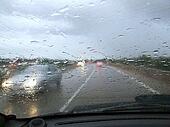
The rain had been a nuisance but it was tapering off for the moment. The windshield still collected a little rain against so I had to use the lowest intermittent rain setting on the wipers to clear it off. About every 15 seconds the rubber of the wipers made a small squeegee sound as it hugged the windshield, swiping off the rain.
I was thinking, as the rain would collect on the windshield, that it wasn't so hard to see through the rain before it was wiped clean. But, I couldn't turn the wipers completely off because about every 30 seconds or so the windshield was too blurry to see through.
That's about right. Not enough to merit the wipers on even the lowest intermittent setting, but too much to turn them off completely. And how like life that principle is when it comes to irritations, limitations, false starts, and failed plans... the rains of life. Not enough of them for them to impede completely because you can always see through them, but just enough where you can't ignore them because they cause accidents if your sight gets too blurry. There should be a proverb to this effect - something like, when rain begins to lighten, always have your wipers on low intermittent so you can avoid the accident that could easily happen as the heavier rains clear.
I absolutely hate the feeling when "smoke clears." If I could have at least had my wipers on low intermittent, I could have seen the water on the road that made me skid off of it. Ravishing was my word a few years ago, smoke is A Thousand Horses' word for the one who makes you better than your normal best.
"Accidents happen," people say. But not if your wipers are at least on low intermittent.
The movie Contact (from 1997) was so very good for several reasons. First, it was good entertainment. It certainly helped you escape from the day-to-day grind. Second, it had merit literarily. One of the more uncommon ways to write character development is to have a "crossover effect between two characters. The scientist and the man of the cloth in this film certainly followed lines of development that made their points of view trade places during the course of the movie. The conflict developed in the plot occurred with different characters, not just the two main characters. So, it was a more complex plot than merely having two characters or two forces that merely had many obstacles to overcome before one force beat the other or one character won over the other. Third, The climax was both the culmination and the catalyst for change at the same time. That is a really difficult feat. The culmination of the plot was the catalyst for two characters to completely change their points of view. Job well done. Other reasons exist to like this movie. It"s very symbolic of life, for one, and contains a good starting point to discuss religion versus science, for another.
The one scene that captures the essence of two principles close to my heart is the scene in which Jody Foster's character finally hears the signal from space she has constructed her whole professional work around. She had gone to great lengths to set up arrays of satellite dishes to listen to signals from space hoping against hope to be the first one to capture a message from extraterrestrial life. All of her efforts had failed. Immediately before the video begins, she is lying on the hood of her car at sunset with her earphones on, as she had done on hundreds of other occasions, listening to static while falling asleep.
This clip represents so much. First and foremost, it represents what our parents told us about our dreams, what Churchill is often quoted as saying to the British on some of their darkest days - never, never, never give up. That is one of life's greatest lessons. Second, it symbolizes what our preparation does for us in our chosen fields. We prepare, but often cannot use all of our preparation in our daily affairs. However, there will come a day - a moment in time when we realize that we have to summon our array of knowledge to accomplish a goal, to rise to an occasion, or like the main character here, swing into action to bring all of our training to bear on the moment we have been waiting for all of our lives.
It's a beautiful thing when such a moment happens in our lives. More than beautiful, really. It's magnificent and monumental. It's what we live for.