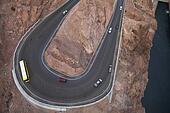
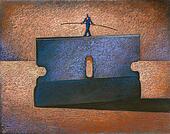
I really can't see around the corner of the block that I live on either literally or figuratively. I guess that is for my own good. I usually get mad when I get in my car, go down 12 houses to the corner and see all the cars parked on the street because the people don't want to park or walk up about a 30 degree incline of their driveways or when I see garbage carts lining the curbs on Mondays, or lament the condition of some of the yards around the corner because everyone on our street keeps their lawns in grand condition. And there are other things as well, like the retired man at the first house as you round the corner who sits in his yard every afternoon to watch everyone else's comings and goings.
Yes, it's a good thing I don't see what is around the corner most of the time. And in the figurative world, I would see some things that are necessary, that should happen on a regular basis, like the trash carts on the curb, but that I don't really like to see. I would see the immediate futures of my daughter and granddaughter. Those are events that are easy to handle as they happen but that would be hard to handle if I knew them ahead of time. Knowing the deaths of people in my world would not be pleasant. Seeing any setbacks that might occur would be hard to swallow. Watching the eventual outcomes of the efforts I am making today to make things better could be very defeating. Of course, seeing all the successes that happen in life would be sweet. But I don't know but that the effort that creates those successes would be affected if I knew ahead of time that they would pay off.
I really can't see around the corner of the block that I live on. I'm good with that. And I still have faith and hope that my greatest wish in life is somewhere around that corner.
The seasons change with little fanfare. It's normally just a day on the calendar. The first few days of a season are rarely different from the season that just ended. No, the change in weather happens slowly. The 20 degree day in February is greatly different from the 100 degree day of August. But, in between those two days is a gradual slide . 10 degree increments allow the change to happen in quite an unnoticeable way.
By October the 100 degrees of August has change into the 70-80 degree range. By December the range slides to 50-60. Most days in January are in the 40s. But then there's February. The several 20 degree days highlight the month, but most of the time the 30s are the rule. After that warmth begins to return.
Is nature a lesson in this for all to see? Well, if there is one, I suppose it would be that change is constant and expected. However, it also teaches that there are some extremes that we all have to deal with, and fortunately, they don't happen close together. The extremes see a lot of "edging" up or down before the extremes are experienced.
But perhaps the real lesson is the beauty that results during the extremes and the invisible process that causes that beauty in the interim. When grass is no longer green and the scene is rather barren, then come the beautiful layers of snow and ice to glisten in the sun. And the reverse is true as well which Bette Midler reminded us of in the lyrics to The Rose.
Just remember in the winter
Far beneath the bitter snow
Lies the seed that with the sun's warmth
In the Spring, becomes the rose.
This process has been in place for millions of years. I look forward to it each of the years of my existence as well.
What happens when children compete is that they learn their strengths and weaknesses. They see the results for themselves. They don't have to have the results explained to them. Competition is merely a fact of life. Competition begins early in life and continues until death. It's a matter of health. Competition is a honing technique. It makes us keen, lean, and more insightful. It merely keeps us alive sometimes, and gives us advantages over those who would harm us at other times.
Because competition is natural in both socialization and specialization of the species, many parents and organizations do an injustice to children to intervene and try to make the playing field level. It's not - it's naturally not. Learning about competition early allows for specialization. Forcing a leveling principle on children only perpetuates a lackadaisical mentality and leads to latent ability too long into adulthood hampering the competitive edge.
That edge is the name of the game for us to be our best, to go our farthest length, to live a satisfied life.
Psychologists refer to abstractions that people view as boundaries for themselves as constructs. Educators use the word paradigm for the set of expectations that are acceptable. Business coined the term box for the acceptable practices that guide them. I suppose it doesn't really matter which term you use as long as you understand that the boundaries people have drawn for themselves are imaginary and arbitrary.
That's not a newsflash. People have known this for at least a century. Philosophers have known it for longer than that. I guess the amazing thing is that people attach expectations and acceptance to boxes, paradigms, and constructs. While I fully understand the need for structure, order, and law, the arbitrary nature of making up more expectations for acceptance than is necessary bothers me tremendously.
People have too many boxes, each with rules, with which to accept others, too many paradigms within which to operate and about which to make protocols, too many constructs by which to keep the mind straightjacketed. I just want to shout, "Break out!" Enjoy the beauty life constantly shows us outside the box, across the boundaries of the constructs, on territory just outside the paradigms. ,
I had settled into bed. Ah-h-h, warm, dark, and cozy. My eyes closed, ready for drifting into that great slumberland. I noticed a flashing of light through closed lids, so my eyes opened once again to see what could be causing the flashes. They were coming from the window. Only lightning could be that bright.
Did I miss something on the weather forecast. It was predicted to be sunny and hot for the next 7 days with 5% chance of rain on a few of the days, but not tonight. The only storms showing on radar at 10:20 PM were about 2 hours south of town and were not moving my direction. I grabbed my phone from my nightstand and hit the app for the local news station's weather radar. Yep, there it was - a storm coming, and it was only a few minutes away.
One of my cars is so old that it has to be weather-proofed in rainy weather so the rain will not rush into it. Then comes the musty smell in the car and the amount of time for drying it out. I don't have time for that, so I had to leave the great comfort of warm, dark, and cozy to go weather-proof. A few expletives came to mind at this point.
20 minutes later I settled into bed again. Ah-h-h, warm, dark, and cozy. Finally, And again. You know, sometimes life just forces those unexpected, unpredicted, and uncomfortable surprises that prod us to do the mundane things that allow us to live a quality life. I've tried the alternative, especially with my health. It's really unpleasant and requires twice as much time to restore than to weather-proof. Definitely when I see signs that a little weather-proofing is needed, I get up from warm, dark, and cozy to handle the situation.
Once in a while I sit on my back patio musing about my life. Sometimes it is just to click through a few scenes in my mind of my current situation. Sometimes it is to look at the events of the last 5 years. Occasionally, I will go further back maybe 10 or 11 years. But it is a rarity to go back much past that. The reason is not that I can't remember that far back. It's that I don't want to recall events or years that represent a lot of pain.
Beyond 11 years ago, I was a very different person. I don't know how I was perceived exactly by others. I just know that I had undergone a decade and a half of loneliness and anger. It continued even after the watershed event of 11 years ago for another 5 years. After two decades of lonely living, I knew that something different had to happen.
I could still detail the times if I needed to. After all, it was during those times that my children were growing up. Many of those memories with them are good ones. I recount them if with my daughter, and she wants to reminisce. Otherwise, I really don't revisit the toxic 20-year period.
On my back patio, watching storms roll in or just musing about shapes in white clouds as they float by, I think often about the time after the 20 years of drought. I'll catch a whiff of the pleasant aroma of rain arriving in the wind just before it starts and flash to a time of sheer happiness. I'll hear words from songs from that time play in my mind and call up visuals of satisfaction and enjoyment. I'll sometimes catch a glimpse from my mind's eye of sacred places full of the most pleasant of memories.
That merges into scenes of a path away from the sacred places into the future where health has had to be dealt with and hard situations have arisen. The trip to the present isn't all grim, however. It includes episodes of laughing in the car wash and playful tickling with my granddaughter. Then I know all is well with the world, and I return to a livable reality.
I can rest at night and dream of the Elysian Fields.
Conversation analysis is an interesting study. It is usually lumped into the general category of discourse analysis, but its behavior is so very different from written discourse or prepared discourse if a person reads from a prepared, written statement that it deserves to be a field in its own right.
There are different ways to study conversation. One way is to chart the topics covered. Another way is to trace participant participation. Even a third way is to notice differences in same sex/cross sex exchanges. Other ways exist, but these three were the initial entrances into the field and, thus, the most explored.
One of my favorite ways for analyzing conversation is to notice the rules or etiquette regarding turn-taking in conversation. This approach has a number of studies written about it, but there are different combinations of ways to study this behavior, so the studies don't address all the possibilities. First, a person needs to know that conversation is built to communicate information. The person can either give it or ask for it, but information is exchanged. If the information is of interest to both parties, a topic or line of reasoning is followed to exchange the information both parties want to have. If the topic is not of interest to both, the imbalance causes a distortion to the ideas of turn-taking.
It's a little like the body. Its different parts work in harmony, but when one part doesn't function according to the rules of balance, disease breaks out and discomfort or pain are generally caused. Some people know when a topic is of interest or not to others and observe a jumping technique, that is, they jump to another topic that might interest both parties. Some people, on the other hand, don't seem to know or at least find a reason to ignore the signs of disinterest shown by the listener.
Yesterday, was one of those occasions that I try to avoid - a person who couldn't discern my limited interest in a topic of great interest to him. The minutes engaged in that conversation were miserable. At the first available opportunity, I extracted myself from the conversation.
It seems that on some occasions, the age and maturity of the person in the conversation determines the ability to judge the interest of the other person, but sometimes that is not the case at all. I would love to look at the conversations of about 100,000 people in various groupings and publish the study. But, that violates a point of etiquette when conducting conversations. Conversations are expected to be fully spontaneous and etiquette is negotiated by the parties enjoined. In research, an observer makes the conversation less spontaneous making the participants wary of just what rules the observer might be "judging" their conversation by. The participants would change their conversational topics, line of reasoning, or words used in the presence of a third party.
An extremely adverse reaction happened about two months ago when Facebook admitted to letting researchers evaluate the written conversations of some of its customers. The move violated the privacy of people. Although spoken conversation behavior is somewhat different from written "conversation" on Facebook, the principle of spontaneity being judged or evaluated by a third party was violated. The backlash from Facebook customers complaining loudly shows the influence if knowledge of a third party is in the mix of a conversation. This is known as the Observer's Paradox, and it is very difficult to avoid.
In the meantime, I'll stick with what the existing literature reveals about the idea of conversational etiquette. This means I'll avoid the people who have a talkative record. And, I'll keep observing the trademarks and indicators of why people don't always know when turn-taking has ceased and one-sided monologs have kicked in.
Song lyrics, like poetry, are works of beauty when they have at least two levels of understanding. The song American Honey is one of those works of beauty. The song works from a symbolic point of view very nicely.
She grew up on a side of the road. Where the church bells ring and strong love grows. She grew up good, she grew up slow, like American Honey.
A girl grows up in a really small town, one where, if you blink, you miss the town. The main road through town didn't go through the middle of it. It went around it since it was so small it wasn't worth stopping in. Oh, but there was magic there. The girl has those great small town morals that come from careful nurturing. She represents the American experience.
This American experience has the same comparative process as honey. Honey takes time. The bees follow a particular process of bringing back nectar to the hive, transferring the nectar to other bees, and those bees following the rest of the process to spread and fill the hive with honey. American honey then represents the average person's process of growing up. This is great nostalgia. The good old days for people are sweet as honey to the figurative palate.
Steady as a preacher, free as a weed, Couldn't wait to get goin', but wasn't quite ready to leave. So innocent, pure and sweet, American Honey.
The childhood experience is so uneven. The road to adulthood is sweet, pure, and innocent, yes, but also is a road filled with contrasts. One can be steady, yet wild as a weed, much like the saying "16 going on 30." The honey making process also contains a bit of uneven drama. The bees have to deal with a wild card, bacteria as they deposit and seal the honey they will eat in the honeycomb. Most of the sticky, digested nectar is, of course, stored successfully as pure, sweet honey although some of it falls to the bacteria.
Get caught in the race of this crazy life, Trying to be everything can make you lose your mind. I just wanna go back in time, To American Honey.
The present day is hard and tedious unlike those sweet, carefree childhood days. People, like the girl, love the thought of going back to those precious, formative years when life tasted good. As for honey, eventually, bees get caught up in doing the same thing time and time again - flying to the flowers to collect nectar, going through the process of converting the nectar to honey, storing it in a honeycomb, then eating it and starting all over again.
The chorus echoes the sentiment containing the message of the poem.
There's a wild, wild whisper blowin' in the wind, Callin' out my name like a long lost friend. Oh, I miss those days as the years go by, Oh, nothing's sweeter than summertime And American Honey.
It also is the point where a person knows for sure that the composer has combined the two processes of making honey and being raised in a youthful, carefree, simple atmosphere. The whisper in the wind is the nostalgia that takes one back to those wonderful, playful days of childhood and the instinctual call of the bee to start the nectar gathering process. The result of remembering is a sweet summer. For the bee, it is the time of the year for productive gathering of nectar. What beautiful symbolism compared to literal honey.
The song's melody is slow and rhythmic, very nostalgically written like a breeze blowing through one's hair. Both words and music take a person's mind back to the uncomplicated sweet things of life.
Now that's the symbolic level. There is the literal level, of course, the obvious level. A woman nurtured from birth that is to have such an appeal that she becomes a man's honey, sweet to the memory every time a person recalls those memorable times. The whisper "callin' my name" has hypnotic power to draw the memory back with every thought to the time when the two were together. What beautiful literality compared to symbolic honey.
The key line for both symbolic and literal levels of interpretation is: Oh, I miss those days as the years go by.
Nostalgia is good. It keeps us centered. Roots are important for tempering what happens in our present and for guiding what ventures are pursued in our future. And while nostalgia is good, the present is where we live. So, I want to add a new stanza (mine, not Lady Antebellum's of course)
Oh congrats on today, what the future brought you, It was built on the past as you made your way through Although it's new, it's sweet too It's American Honey.
My two-year-old granddaughter has lots of play time, so it is interesting to see what she does with her time. She loves the outdoors, so some of her time is spent in exploring the outdoors. She has all kinds of toys, but doesn't spend a lot of time with the toys. She has role playing objects like tables, kitchens, small tables and chairs, tea sets, houses with families, and access to part of a study. This she loves. She will have make-believe tea parties, invite me to eat plastic foods after she "cooks" in the kitchen, ask me to play house with her family in the giant house, and play on my computer in the study.
Some of her time is spent with stories and games. Now, by stories and games I don't mean books and table games. Leap Frog has books with mostly pictures, but a small amount of text. The book has an accompanying bear "reader." When the reader is place on any part of the text, an eye in the reader sees the text and, through a small speaker, reads it aloud to my granddaughter. But, also on the page with the text are pictures of animals, character, and other objects. Placing the reader on the objects also allows the reader to give extra information to the text. She spends a full 10% of her time with these books.
She spends another 10% of her time with a computer built for a two-year-old. It has a screen the size of an e-tablet. It takes pictures and has a scaled down version of photoshop. It has games. It allows her to accumulate reward points. It tells short and simple stories with animated characters. It teaches music appreciation and music reading. It has an art feature, so she can learn to "paint." It has a few more features, but she doesn't spend much time on those.
Only very occasionally does she read a book or ask to have one of the adults in her life read to her. Even when forced to listen to a book once in a while, she fidgets to go elsewhere before the reading is over. I certainly don't begrudge her. Reading and writing are really, really becoming relics of a day gone by.
2017 is the end of the ten-year war between the role of reading and writing and the forms of technology that will liberate people from the tedious, slow process required to read and write. A clear winner for part of the replacement of the two stalwarts of the past is in place.
Other methods and formats will quickly follow. I can choose to read or write because I was born in the old world before 2007. But, those born after that will not need reading and writing to function in society, nor to present for projects to get degrees in college. And eventually not even to obtain advanced degrees. Fortunately, a few schools like the Harmony Schools of Science around the state and the University of Texas system's STEM schools understand this shift. Their students demonstrate their understanding of subject matter with projects using Ipads mainly, but with manipulatives and other graphic demonstrations as well. Kudos, kudos, kudos to those who lead the way into the new era the world is experiencing!
Interesting, really. I watched a current version of Brain Games and saw a program in which the program's originators began the segment with a reference to Women are from Venus, Men are from Mars. The reference was to springboard into the segment that promulgated the idea that women's brains and men's brains are wired differently. The segment continued with a simple test of the idea to show that men are more focused than women and that women are more descriptive than men. This was followed by a game with a team of two women against a team of two men. The questions each team had to answer depicted men answering questions requiring focus and the women answering questions requiring description. It was hardly an experiment... more like an activity illustrating the result of an experiment.
The test and game were based on the premise that evolution played a part in designing the way men and women think. People evolved in a way that caused men to be the hunter of the pair and the women to be the gatherer of the pair. So, men had to be focused, allowing no distractions, in order to track and slay their prey. Women had to gather from places that had to be described, then had to describe what they did (prepared) with the berries (or whatever) they had gathered.
This premise has been around for a while in the field of psychology, about 75 years. Thus, it's not a conclusion that can be dismissed out of hand. It could be true. The mitigating factor against this theory, however, is that not enough time has passed for men and women to have developed these kinds of features. At the very earliest, people with enough mental acumen to describe or to focus need more than the 300,000 years allotted to them to change from Neanderthal to homo homo sapien. No other mammal or vertebrate has developed along the lines of conscious role development that enriches speech in the case of women and filters out speech in the case of men.
Psychologists would like to leave the subject in the realm of how the mind developed over time without regard to speech, but when they bring in how the brain describes an idea or how the brain blocks speech from happening, then speech is involved more than implicitly. And, the reason psychologists don't want speech involved is so that they can leave out the linguistic theories that tend to mitigate the approaches taken by psychology. Linguists and philologists since Lev Vygotsky in the 1920s have been publishing books about speech and thought. Evolution is not a part of the development of the relationship between speech and thought.
So to watch a show on Brain Games based on an old and impartially supported theory of language is disappointing. I understand that TV is about putting science into terms and formats that take scholarly ideas and make entertaining and profitable episodes for a TV format to inform the public. I just wish the ideas TV executives select would be the well established ideas, ones with less debatable evidence, truly illustrating a truth or at least trend.
Psychology and psycholinguistics are often at odds. Linguists start with what is seen and heard - language - and move to mental causation, whereas psychologists start with possible mental causation and show how that surfaces in language. The results are different, naturally, because the starting points are from opposite ends.
The documentary Journey to 10000 BC charts the existence of civilization in North America. It pieces together dates from artifacts found and fossil bones dug up in the various parts of the United States. The story that emerges shows a rather nomadic group of people that followed herds of animals for the food they lived on. They seemed to have lived in a non-iced corridor of Canada and the U.S. until the ice melted from the last Ice Age, and then they lived in regions around Clovis, New Mexico. Later in time by about 4000 years, more of the same kind of artifacts surface in Georgia and Virginia.
That's just in the United States. Archaeology all over the world depicts pictures of civilization that existed during this same period of time. The time table represented by new evidence is very hard to reconcile with both the story taught in World History in public schools and universities and even harder to reconcile to the early history given in the sacred book of Genesis. But underwater cities that were above water until the end of the ice age circa 21,000 till 10,000 BCE, are now submerged because ice from the ice sheets melted and raised the ocean levels, and they are begging to tell their stories.
As archaeologists continue to discover artifacts from very ancient times, a revision of our world's history will be updated and incorporated into the learning material of future generations. The conflict with Genesis on the other hand will be handled in one of two ways. Either the first 11 chapters of Genesis will be relegated to metaphoric interpretation or it will separate itself completely from the science that archaeologists use, therefore, forcing the issue of believing science or believing the Bible, not both.
Knowing what we do about the universe, and predicting what will be found over the next 500 years, I think there will have to be a day of reckoning with those who hold to merely a world of humans since 4000 BCE. I would love to see the picture of civilization that those who live 500 years from now will see. But, I am having to settle for the snail-paced revisionist theories that will surface over the next 30-40 years.
Tonight the moon was shining brightly at about 9 PM about 1/3 of the way on its decline to the horizon. No, it wasn't a full moon, only a crescent moon. But it's hard to see a crescent moon without seeing the Earth's shadow covering about 3/4 of the moon's surface and the sun's light reflecting brightly from the 1/4 for me to notice from Earth. I can still see some of the moon's features that aren't covered.
As beautiful as that is, and as much as that leaves me in awe, it makes my mind wander to what must be on the dark, cold side of the moon. I know it is merely more of the same. But what about those rumors of alien encampments there? True or not true? It's intriguing to think about, but pictures of such bases look like doctored photos. It does allow me to think of possibilities, though. What if the rumors contained truth? That would change a few things I think. Suddenly, Star Trek is not myth and fiction. It's an interesting, even though fleeting, thought.
If they are there, I would love to be a part of the team communicating with them. I'm not sure they use language like we use it. If it's a form of telepathic communication, I want to see that in action. What a beautifully transparent method of "talking," which leads me to want to know about their culture. How would people work together with such transparent thought play?
We're not there yet. Someday,yes. All I have to say is "Bring it!" It's time for us humans to make a quantum leap.
Today was one of those rare days in July that didn't mimic the dog days of summer being in the 100s. It was an anomaly in the weather, only 78 degrees, 22 degrees below what normally happens. In statistics these anomalies are called outliers because they lie outside the averages, the trendlines, the areas where 90% of other items unlike them lie.
I think our lives are lived in much the same way. We count on most of our events to lie along a trendline, to be an average day, or to fall close to where 90% of them fall. The word special is another word for anomaly, a much more common word. It's a word I don't hear in abundance, nor should I since it is saved for occasions that are not normal.
Anomalies like this one in July come about every 7 years or so in a weather cycle. One has to wait a while for them, but they're nice when they happen. If weather cycles also hold true for life cycles, I should be due one of those special years sometime in the next 3 years. I love being around when the weather cycle doesn't follow the dog days of summer routine. And I am going to love one of the next three years when one of them turns special.
The mind is designed to work off of predictions that it makes from available information. It will receive a certain amount of stimuli and project how to fill out the rest of the information that is going to be received. When the information is received, the mind converts that information into what is expected whether or not that information matches what is actual. Steven Pinker aptly demonstrates this in his book How the Mind Works by talking about how the eye takes in stimuli for the brain to convert to the right colors and shapes. The brain will analyze a more or less checkerboard scan of the stimuli and interpret what has been seen based on a projection of what was seen rather than what was actually seen. That's why people have wrecks sometimes. They look in a certain direction not expecting to see anything. A car is coming, but since the brain didn't expect to see it, it tells the interpreter that nothing is coming. A wreck occurs.
Language operates in much the same fashion. People use words in predictable pattern sets much of the time. So, people become accustomed to hearing certain sets of words together. When a word out of the norm is used, many times people fill in the out of norm word with the word they were expecting. If the word is too different from what the original speaker said, the original speaker will correct the listener's word, and an argument ensues on what word was used. This happens a great number of times between people who have been friends a long time or who have been married or together a long time.
I have a high appreciation of those who bring fresh perspectives of life to me. They fill in life in such a different way than the way I have come to expect life to happen. We all have a habit of seeing life like we want it and predict it to be. Different perspectives are needed to jolt us into a new way of seeing things sometimes. I relish the moments of being in the company of people who offer that different perspective to me. They stretch me and make my life so much more enriched than it would otherwise have been.
In case you thought the previous blog was an idea from never never land...
Yeah, Facebook, Twitter, Playlists, GPS, and warnings of collision that speak to you as you drive. A transparent, holographic-like speedometer above the steering wheel. It's on the car lot right now. If I were a betting man on what value reading and writing have, I would begin to bet on what is and what is coming, not on what used to be.
It is unclear exactly to what extent cell phone communication will change the modes of communication, particularly written communication. Weird Al Yankovic created a spoof on some of the extent writing has been affected. But, the more sophisticated the cell phones become, the more written communication will be affected. I see signs along the highways all the time about the hazard of texting and driving. No problem. I simply touch the microphone symbol on my phone and speak into it. Text immediately appears on the screen. All I have to do is press send. Now will that have an affect on writing? At what point will speaking become the preferred method of delivery, not writing. Probably when someone contacts you and you hear their voice in real time and you can see their symbol or their holograph. And that is not 25 years away. It's happening noncommercially already. The reason Yankovic's spoof is funny at all is that writing has already been affected, albeit not so much as to make people think the affectation is here to stay.
But it is. Yankovic's next video could be about writing crimes, not merely word crimes.
This is a big day for one little girl. She has won my heart. She is so full of confidence in her abilities, so exuberant in her conversations. Every picture you ever see of her contains her trademark smile denoting her carefree spirit and love of life. Her positive perspective on life is such a mirror image of her mother that it is hard to see one without seeing the other.
Six is a big number for young ones. It is the year doors start to swing open, the beginning of independence. First grade starts, circle of friends increase, formal learning begins to incubate in receptive children. No one is more receptive than this little lady who has won my heart. Welcome to this big world you are now becoming aware of. Have a fantastic birthday today!!!
Whenever I go walking with my two-year-old granddaughter, we have no plan about where we are going to walk. Sometimes she wants to go around the block to look at houses and their attendant shrubs and flowers. Sometimes she just wants to be outside for a while and not walk out of the cul-de-sac. And sometimes, she wants to walk in the nature area, throw rocks in the creek, watch ducks in the nearby pond, or walk the length of the creek to the point it crosses a major road. It's different each time. She picks wild buttercups or dandelions along the way and gives them to me. She stops to look more closely at potato bugs, ants, dragonflies, and grasshoppers. She has learned the sounds of frogs croaking and owls hooting. She likes to try to find them when she hears them, usually without success, though.
She loves going walking, and I love going with her. It's a new adventure each time. Even though it is the same scenery that we walk in, we see it differently each time. We take different routes, we find new logs or dams that kids have made in the creek. We'll wait different intervals to go on our walks, stay different lengths of time, or go at different times of day. But we always enjoy our walking time.
I have been around a person for two years now that likes to have A LOT of structure in her life. She needs and relies on rules to regulate her days. She has to know where all the boundaries and limits are and is rather judgmental about others who don't follow the rules she keeps or the structures she has put in place. It's not fun to be around her. I can feel the straightjacket being put on the minute I am in her presence. It's so unlike the imaginative, exploratory walks with my granddaughter that I cringe to put the two experiences in juxtaposition to each other. Any time, any day, I would stroll the neighborhood or nature area seeing again what is in my environment than to enter the world of the regulated life.
I know there are rules in life. They keep order on the boundaries between people. But when it comes to enjoying life, I want to see the possibilities, follow the rabbit trails, see what's behind bushes, watch little waterfalls, pursue interests requiring rigor and interests requiring only presence, and note beauty wherever it occurs.
Strata is an English word that shows how meanings change over the years. Romans used the word (in Latin, of course) to mean blankets or materials to cover yourself with when sleeping. Both the derivative Spanish word and English word changed the idea of blanket somewhere around the year 1600 into a layer of something - skin, plant life, and below the surface of the earth. However, the derivative language French multiplied the meaning of the word. Latin was still in ecclesiastical use in the 1600s in France, Spain, and England, so it was still being used dynamically as a language.
Over time, words become unstable and begin to change. So, strata, meaning blanket, lost the semantic domain of keeping something or someone warm as a cover. In France it came to mean a coating on an object and some place soft to lay a baby. In England and Spain strata was left with merely the size and shape of a blanket, but not its function, which allowed people to use it as a layer of something. And, where do you find layers of things? Why, yes, in your body, on the ground, and under the ground.
I had an interesting conversation with my mother not long ago. She was noting some of the great changes that had taken place in my life. While she was lamenting them as unnecessary, I was allowing for the changes as a dynamic part of growth in my life. To me, words like strata have a lot in common with humans as they become older. Both are allowed to take on a life of their own by adapting to the world around them. Sometimes they add more to themselves, sometimes they shed their original essence, but rarely do they stay the same. Maybe there were those who lamented the change in the word strata. But, I rather think the change happened subtly and gradually - without note - and differently, depending on the language. While there is merit to consistency in life, some values mature and become altered with that maturity.
The story is told of William Waldorf Astor about a time when he was traveling around Philadelphia, couldn't make it into the city and couldn't find a hotel to stay in between smaller towns. Finally, he entered a decent sized town and chanced upon a hotel. He had been traveling with his wife, it was 1 in the morning, and rain, lightning, and thunder had followed them for most of the night.
The young man at the desk informed Astor, who was just an elderly man to him since he didn't know Waldorf, that three conventions were in town and there were no rooms available. Then, the young man said, "But I live in the hotel and you can stay with me in my room. It's not a suite or anything, but I don't think you and your wife should have to go back out into the rain at 1 in the morning." Astor declined and turned to go when the young man said, "Don't worry about me. You can have my room." Astor replied, "You are exactly the kind of man that should run a hotel for me." The two had a laugh, the Astors stayed the night in the young man's room and left the next morning.
Two years later, the young man received a letter in the mail inviting him to New York to meet the elderly man he had helped in the storm. Enclosed were round-trip tickets. When the two met on 5th Avenue and 36th street, the older man introduced himself, pointed to a brand new building, and said, "I have built this building for you." Of course, the young man thought the older man was joking because he didn't recognize the name of William Waldorf Astor until he looked on the top of the building and saw the hotel's name Waldorf Astoria and on the door saw his name as General Manager. George Boldt from that moment on was the best operator of the best hotel in New York City.
An ancient Hebrew teacher/philosopher taught, "Cast your bread upon the waters and it will return to you."
George Boldt would agree 1000 times over. I suspect every living adult has this story to tell in one fashion or another. It's a very trustworthy saying, true in thought and in experience.