Search This Blog

Friday, July 31, 2015

A decade reflection


I'm sitting by dim lamp light at a table in a mountain cabin far away from the 100 degree weather of my hometown.  I can hear the stream babbling by the cabin just 20 yards from the front door.  Windows are open letting in the fresh mountain air that makes for good sleeping.  The canyon I'm staying in is quiet.  It's blue moon night, so I can really say that I was away in the mountains once, in  a blue moon.  The sides of the mountains on either side of the cabin are invisible because the darkness outside is so black.

I like being comfortable, relaxed, hidden, unbidden, and off the beaten path.  Many people call it being off the grid.  I wouldn't since I have internet access, but at least I don't access the internet unless I want to.  It's not a necessity here.

My mind certainly clears when here.  The last time I was here was 10 years ago.  The English saying is "What a difference a year makes."  Now if I extend that by ten times - what an immense difference 10 years makes.  So, I have taken the time to review the last ten years while I have been here.  The decade started in a desert area and ended in a metropolitan area.  I am gainfully employed for only half the amount of time now than I was 10 years ago.  My outlook on life has changed fairly radically.  I had a middle of the road kind of philosophy that swerved to the left on most issues.  My beliefs about religion, politics, and work day issues have mostly changed by almost 180 degrees.

The saying is that the only constant in the world is change.  It's true.  Raise any issue, such as marriage, raising teenagers, managing money, working, or vacationing, and I can tell you what a departure my words would be now compared to 10 years ago.  Things solidified for me a little over 5 years ago.  It hasn't been the same since.  I have a good life, an acceptable life - not always what I have wanted, but what I can live with.  The last 10 years could have been better, but they could certainly have been worse.  The thing I wanted most in life didn't happen during this period, but wanting something and getting it are two different matters.

I need to live in both the literal and figurative place where waking up each morning is worth it.  I have reached that place.  And sitting here by dim lamp light at a mountain cabin table far away from 100 degree weather drives home these thoughts.

Foreign events


I have passed this road no less than a couple of hundred times.  I have passed it so often that I know how to pronounce its name by heart.  Finally, I drove down the road to see what this Wat was all about.  The spire is symbolic to the Buddhists for the reverence that should be shown to the deity, the higher power.  The design of the temple courtyard and the temple itself is conducive to conveying a humble spirit, a decent journey in life, and reaching as close as possible to Nirvana.


So be it.  Such is Buddhism.  Any concept I have of Buddhism is only from what I have read, not from experience.  So, my limited knowledge is not enough to make me an authority on Buddhist beliefs at all.  It seems like a really strange religion.  Its tenets are foreign to the American way of thinking mainly because its eastern flavor of seeking takes time, seems to lack direction, and takes away from the pursuit of making a living or becoming happy because of its total neglect of anything material.  The words Wat Buddharatanaram  are indicative of how far away from American idealism this religion is since they are written in a way that is unmistakably NOT English.

I ponder the things that have happened in life more than I should, trying to analyze them, thus to understand them.  Many events defy my understanding.  They are as foreign as the near-eastern words are from English.  I don’t stand for them.  I didn’t train to accept them.  They don’t represent me in any way.  Yet they happen.  I can’t control their happening or the way they happen.  Anymore, I just refer to such events as my Buddharatanaram events or moments.  They make me a more accepting person to refer to them that way.  I sure don’t understand them, but I have to live in the same country that they are in.

Saturday, July 25, 2015

The logic behind the motive behind the words


It's one thing to look at words and see what was said.  It's quite another to look at words and see why something was said.

If someone were to say, "I enjoyed the trip. Nothing really happened other than I was a little cold most of the time," and then subsequently you came into knowledge that during the entire trip snow covered the ground, the cabin had only a wood stove in the main living area, and each night for two weeks the temperature fell below 32 degrees.  It would be easy to see that what was said was either an understatement about weather conditions or that the speaker wanted to emphasize enjoying the trip even against nature's odds of trying to spoil it.

Why someone would say something this way is not so clear.  This is the domain of pragmatics where context is important.  For example, the words might be a part of a joke, so that understatement (a little cold) contributes to the humor being created.  Or, the speaker is trying to spare the listener's feelings because the listener had paid for the speaker's trip.  Or, the speaker is trying to brag about her or his prowess in extreme conditions.  Or, the person speaking didn't want to ridicule the poor living conditions the listener has to endure regularly due to the listener's inability to pay for a better way of life.

But, given a context, why did someone use the word, "enjoy" if that were really not the case?  Why would someone say, "Nothing really happened," if something happened "most of the time?"  If the context is plain, it helps to understand the motive, but to ask why someone would use a circuitous way of speaking would yield information other than motive.  Perhaps a person's style is round-about because of a self-esteem problem.  Circuitous speaking means that a person has room for error in speaking since she or he is not assertive enough to speak with certainty.  Perhaps a person thinks that minimizing the conditions enhances the emotions (s)he feels about the trip.  Or perhaps the person wanted to lie about how (s)he felt about the trip for whatever reason by enhancing enjoyment and diminishing the cold.

The word choices definitely had a reason for being chosen.  Establishing context is the first step in understanding the reason.  Focusing on the semantics also helps to narrow in on the motive of the speaker.  But the word choices are indicators of something more exact, the bedrock that produces motive, the logic behind the motive.   One has to consider why "nothing really happened" instead of "nothing happened?"  Does the word really strengthen the statement of fact?  Or is the speaker hedging?  The only thing that happened was in the speaker's mind, not in the real world.  Why make a general statement, "Nothing really happened," and then negate, maybe refine, the statement with "other than" unless the speaker wants to highlight a negative quality?  Why use the words, "the trip," which is inclusive of the whole time, then say that something was not enjoyable "most of the time" except to further highlight the negative quality of the trip?

The answers of course tell you about the personality of the speaker and the pattern of logic he has used.  And that information is the well guarded secret most people want to keep from listeners.

Thursday, July 23, 2015

Sorting through facts

I was speaking with a young adult tonight who mentioned in the course of the conversation that he had quit school very early in life.  By the time he was 15, he wanted to return to school, but it was too late for him.  So, he has paid for it with hard work the rest of his life.


He's not alone by any stretch of the imagination.  Most young adults in the U.S. don't really like school well enough to choose more education after high school.  Roughly 25% of young adults didn't really like education enough to finish high school, and about a third of that crowd decided to drop from school before that.  The National Center for Education Statistics has a lot to say about education buried in the numbers it has compiled for over 50 years.

I feel for my young friend who is working so hard to make ends meet.  But, he has made the best of life.  Really, he has done quite well over the last 3 years.  He is in business for himself and seems pretty happy with his family of 6.  On both of those counts he has much on his educated counterparts.  He works hard, but he plays hard and holds family time at a premium.  In addition, he is currently learning to read and write in a second language. 

I really don't know what the quality of life is for the vast majority of people without much formal training.  But, if the people in that category are as industrious and resourceful as the man I spoke with, I think that I will gladly trust what comes for the last part of my life.  I can sleep with that.

A narrow line of vision

Sometimes I am reminded of an event that I was a part of by someone who has a clear memory of it.  I try really hard to remember the details of the event, but usually to no avail.  What has happened?  Has my brain deteriorated?  Is someone trying to plant a memory for an event that never happened?


Sometimes, if it's one of my family, the memory difference or gap is merely a matter of perspective or maturity at the time.  But at other times, it seems that anything could have happened because truly I have no memory of that event.

Tonight one such mention was made of an experience my son had.  I was with him at the time of the event that had been brought up.  I didn't think that the experience happened in the way that was being told.  I was there, though.  I should have known.  It's possible that the person telling of the event totally confused two events and told the wrong one, or that we snapshot the event from different aspects and so, in the retelling, only one aspect showed through.  Maybe my memory of the aspect of the experience and the other person's perspective of the aspect could both be true.

Our judgment is only as good as our information - at least that is how the saying goes.  But what if our judgment is wholly colored by the aspect our memories snapshot.  That changes the whole game.  And, if that's true, then all of life in our memories is not reality as a whole, but merely a slice of much more robust reality. 

That makes me a little more understanding.  And I also realize how arrogant I was when I was younger.  My how youth is wasted on the young.

Tuesday, July 21, 2015

A trip through languageland

I received a call from my friend and scholar buddy today.  It's always a pleasure to speak to him.  We mainly talked about, as we do each time he calls, his endeavors in his field - his conferences, papers, courses, etc.  So we talked today about those and his newest project.

Recently, I heard that one of the professors at a local theological seminary had dubbed my friend the best Greek scholar in the area.  Hmmm, I thought.  The next time we speak, I'll just check out whether I can keep up with him in a discussion or not.  Today was this next time.


We talked about his newest project and his upcoming class in the Fall semester.  In particular, we talked a while about the discourse structure of the Greek works he was teaching.  Nice.  I always learn a thing or two from such conversations.  Once in a while, I get to throw in something so that it looks like I have a contribution to make.  We differ mostly differ in the online tools we use and in the authorities that have been in our backgrounds.  But, we mainly enjoy comparing notes from our different approaches to language.

By the time we finished, we had touched on the nature of tone in indigenous African languages, the Hasa language, the Pame/Xixuay language, Greek, Spanish, and English.  It was a nice little trip... and, I didn't fare so poorly I'm glad to report.

Monday, July 20, 2015

Now, where are you?

In the middle of the desert, it's a little hard to do some of the basic things - walk for any distance, drink water, cook a meal, and orient yourself as to where you are headed.

People don't live in the desert for those reasons.  People live where there is food and water aplenty, they can easily get to places they need to go for shopping, work, and play, and can establish themselves in their work and avocations.   I have to admit that I have ended up in a place where all of the ingredients for living a full and more-than-adequate life exist everywhere around me.

But, being here is paradoxical like being alone in a crowd or being thirsty in the middle of the ocean.  Why, you say?  I'm in the middle of the desert where it's a little hard to do basic things...


Sunday, July 19, 2015

Really?


Something's going on.  I just don't know what it is.  I hear various theories of what it is, but information is sketchy.

Fact 1: In 1989, a man named Bob Lazar had an interview with a reporter in L.A. in which he spoke of reverse engineering an actual UFO at Area 51.  He was really lighthearted about what he did, seeming not to care about ramifications for revealing such classified information.   25years later the same reporter interviewed Lazar again, but this time Lazar was not so indifferent to the ripple effect of his actions.  He was hesitant and said he regretted revealing the information he had recounted.  Over the last 25 years, every record of his college experience and work record had been expunged.  It's almost as if he never existed.  Now, people just relegate Lazar to the looney bin.


Fact 2: One of the pieces of evidence Lazar offered in his original interview was that the UFO he worked on was powered by Element 115.  He even gave the physics of how it worked.  Was that unusual?  Well... that element didn't exist, and officially still doesn't exist.  In 2006, scientists began to theorize about the element, but only started experimenting enough to know that it could exist.  They called it Upupentium.  How did Lazar know nearly two decades ahead of the idea that Element 115 existed?  Was he that good of a physicist?  Of course, there's no record of his college career, so we don't know.

It's intriguing.  The next thing you know, I'll be hearing about an alien base of operations on the dark side of the moon.  Oh, wait.  There  is that rumor already.


Friday, July 17, 2015

Eschewing the typical

August: Osage County

The film is worth watching.  It is very good at showing about how every family rolls.  The characters are stereotypes of the kind of people one would find in every family.

The clip below I particularly like because it hits home personally.  I have to deal with the same scenario on a recurring basis.  The son shows how loving he truly is.  His mother comes in and spoils it all by castigating him.  The conversation following the incident between the dad and mom, starting at 2:40 is the one I could have any given day.  It's so sad in a way.  But it's also so typical.


I have a daughter I love very much.  She shows how loving she can be regularly.  But, she receives castigation on a regular basis.  It would be good for me to have one of those "fat, Irish ass" moments with the perpetrator.

I totally can identify with the line saying, "I don't understand this meanness."  I react by longing to be around someone who is cheerful and encouraging.   I better understand these two attributes.

Monday, July 06, 2015

Changing what you see


If you change the way you see the world, then you change the things you see.

It's a pretty incredible world that is available now.  Many can't see what is being offered.  That's more than a shame.  Google Glasses are old news.  The next generation of computing is now seamless with the real world.  It will change the things a person sees - guaranteed.  I plan for my granddaughter to be educated only in places that offer what is available now so that her future is not on the streets regretting what other children with parents of foresight provided for them.

Those in the field of education should demand to lead, to take this technology to the children and young adults who will take the seamless world of reality and irrealis to a whole quantum height above the world now.

The norm has been for education to lag about 10-15 years behind what technology has offered.  It was fortunate that most people were in the same boat.  But this time is different.  Education will not be turning out what the business world has to have and has to offer if it lags behind.  And that will make education irrelevant.  It almost is already. The work force has dwindled.  Fewer people are working full time hours.  College graduates aren't working in their career fields.  It is up to educational leaders, especially those who are experts in their field, to totally ignore the voices that tell them that schools are okay, change is gradual, schools will change with the times or that the school is already on the leading edge.  It's different this time.

The educational application is shown in the video below from 11:15-14:15.  It's simply astounding.  Those who possess the skills of this kind of learning will indeed lead, change, affect, and innovate for all others on the Earth.


Five years in virtual time is the same as 25 years of real time.  Schools will be divided in 5 years.  The ones who prepared will lead.  The ones who plodded will exist no more.

Sunday, July 05, 2015

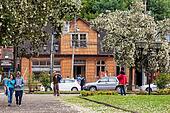
The town square


Town Square is usually a term to denote a one block area with a city courthouse in it from the 1920s through the 1950s, and around the four opposing sides of the street are lines of store fronts decreptoit from age.  Town Square doesn't conjure up ideas like upscale, trendy, ungodly rich, or opulent.

Within a radius of 20 minutes from my house are 4 town squares.  The closest is 8 minutes away.  It fits the usual concept and is called historic Oak Street.  It has restaurants and novelty stores down a street that ends at a courthouse.  The buildings and houses are really old even though they have been restored.


Another town square is about 10 minutes away and follows the same pattern, the historic section of Main St. with old houses and restored brick buildings containing well established businesses and restaurants with a couple of novelty shops thrown in.

About 15 minutes away is a third town square, but this one is modern.  The oldest shop is a little over 10 years old.  It is located on a major thoroughfare, so it is heavily trafficked. It is a shopping center with 20 different eating places and double that number of places to shop.  It's called a town center.

The town square 20 minutes away is much different from the other three.  It is actually called Town Square.  At its center is a courthouse, but it is fairly new about 20 years old.  Unlike the historic sections, honeycombed modern streets weave in and around stores - all kinds of stores.  But, they all have one thing in common.  Let me explain.


In a recent visit to this square, I ate in a Mexican food restaurant.  I split the food in the meal with another person, but I paid $40 for the one dish, $3.50 for teas, $8.99 for the appetizer, plus the obligatory tip of 20%.  I do have to say we were waited on hand and foot though.  We walked across the street to an apparel store.  T-shirts started at $125.  Polo shirts began at $189, and some of the silk shirts and other rare fabrics placed the shirts at above $350.

The ladies' store across the street had the same kind of offerings.  I didn't try the jewelry store, but the costume jewelry store had the prices of a jewelry store selling the normal stock of diamonds.  The cars in the two parking garages and designated parking areas bore the labels Audi, Infiniti, Lexus, Mercedes, Cadillac, and BMW.  A person can stay the night in the Hilton in the square if need be.  Businesses vary from Central Market and Whole Foods to Brighton, Sephora's, Soma's and Malouf's.  There are two fountain areas with trees and benches (miniature parks) where live music plays during the summer months fairly often.


I come often to this town square.  I particularly like eating at the Cheesecake Factory there and a hamburger place called Snuffer's.  I browse and occasionally buy a shirt from Brooks Brothers and another locally owned men's wear shop.  I have to do business there to register my cars and frequently use the postal services in the square.  Investment bankers have offices there if a person wants that service.

It's really refreshing to go there.  People are overly nice and easy-going.  The many stores and park areas are relaxing.  And I probably need to mention that this town square is different in another way.  Of all the towns and cities in the U.S,, this town square belongs to the 6th wealthiest city in the entire country.  I love going to my historic Oak and Main streets closer to my house to eat and shop on occasion.  I even like catching a movie and meal at the town center a quarter hour away.  But, there is nothing like the movie, shirt, or dinner from the Town Square just a short 20 minute journey down the road where the concepts of upscale, trendy, ungodly rich, and opulent are the norm.

Monday, June 29, 2015

Evidence says we're better

The bigger patterns surrounding the questions of how people got here and how long have they been here fascinate me, I suppose because I don't accept very many of the answers that have been given to me in my life.

If I look to space, it seems plausible that another very advanced civilization from one of the billions of other planets around the Earth has visited and shared k nowledge of their existence with Earth's people.  Seeding the Earth is plausible if the original premise is accepted.

If I stay on Earth for an answer, it seems that Earth through all of its phases of heating up and cooling down, forming land and breaking apart, and finally melting ice enough to allow civilization to flourish around the equator is what happened.  Even though the last Ice Age diminished 13,000 years ago, it would appear that humans have been around in various places trying to find warmth to live for at least double that number, perhaps even 20 times that number.

One would think in all of those years that people would learn to live together in harmony.  Pinker's book, The Better Angels of Our Nature, makes the claim that humans are becoming kinder and gentler a millennium at a time.  He presents good evidence that that is true.  I hope so.  Progress is so slow, though.  One would also think that people would figure out how to make friends, pick mates, compose laws, and deal with society's rule breakers in some compatible manner to them.  Somehow, it seems that there is a ways to go in these areas also.


If I live long enough I will, perhaps, see that the origin of life on this planet will become clear and that people will decide to be honest, hopeful, realistic, and a little less crazy and malicious.  Our children could make quantum leaps in  lifestyle if this comes clear soon.

Seeing you exactly


This poster represents the person that can see you as you are, your essence.  Nearly everyone I know, sees me in terms of my age and weight and miles.  If someone were to say the words or even one or two of these words to me, I would appreciate that person above all others and say the same.  Souls would blend.


Sunday, June 28, 2015

We mainly just guess

Steven Pinker is a cognitive scientist that has written extensively about the inner workings of the brain.  Part of his findings deal with the ability of the brain to fill in what we selectively want to see, hear, smell and touch.  In his book How the Mind Works, Pinker has a lengthy section about the eye's perception of what it is seeing.  He compares the process to the eye seeing things as a checker board.  The white squares are not seen, but the black ones are.  Even though the picture is not complete, the mind fills in what is not seen venturing a guess at what is being seen.

A conversation with my mom about two years ago proves Pinker's point.  She was driving on a street that she has driven on many, many times.  She pulled to the stop sign, looked both ways, then began to accelerate into the intersection.  A car whizzed by and nearly hit her.  I told her that she was not expecting to see anything because she normally doesn't.  So her vision was controlled by her expectation.  Mother didn't buy the explanation, but the incident exactly  illustrated Pinker's findings.

To illustrate further, I offer the video below.  People think of Disney as a company for children, so they aren't really looking for sexual innuendos in the animated movies Disney produces.  But our expectations control what we see.


The  same is true about how we hear language.   If we think someone is questionable, ignorant, or deceitful, then that's how the words are heard.  If we think that someone is being honest and trustworthy, then that also is how we hear the words.  Fortunately, forensic methods can overcome this "blindness."  The field helps in judging truth value with accuracy.  That's helpful on a number of fronts.  It cuts through the chase in the legal and law enforcement arenas for sure.  It keeps people from babbling dishonest statements at a rate of one every second because they know you understand the language they are using.  It's just nice to have equalizing techniques at your disposal.  It's like going into a battle with an equal number of weapons in your arsenal as what the enemy has.

Friday, June 26, 2015

We'll know more soon


Around the world are structures of stone that mystify the best archaeologists.  The stones are huge, made of granite usually, and bear some shape that required power tools.  Archaeologists have largely ignored the finds and have relegated them to anomalies that are as old as they appear to be.  About 10 years ago, people began finding more and more stone structures besides the standard ones, such as Stonehenge and the statues of Easter Island.

Now amateurs and experts alike have amassed such a wealth of stone shapes that they are obligated to start offering explanations.  Some of these stones are majestic because they are precisely carved like the perfectly round spheres, some 8 feet in diameter, and perfectly planed obelisks more than 30 feet high.  Others are roughly carved but monumentally heavy statues of faces.  Still others are found in out of the way places and require aerial observation to see them or educated guesses on how they would have been used.  Some seem religious in nature while some are definitely aligned with constellations or planets for reasons unknown.


More than one researcher has now come away from the "ignorance is bliss" approach and has begun to consider that civilization sprung up on the Earth a really long time before currently established timetables.  Some have gone so far as to hypothesize, seriously, that Earth had visitations from beings from the sky.  Many more conservative  scholars can't agree to radical theories such as these two, but still hint that civilization must have existed in some highly intelligent form before being wiped out by a catastrophic, global flood.

The most recent disappearance of the ice age some 11,000-13,0000 years ago remains a mile marker for archaeologists, and they pin events and human movement around those dates.  They should.  And, they should reconsider other milestones - genetic reduction of 70,000 years ago being one of them.  What exactly happened that only a few genetic types of humans exist now, but that maybe as many as 12 types existed before the 70,000 year marker?  The eruption of Mount Toba in the Peloponnesian Islands only 4000 years before is another marker.  Were humans alive at that point?  How did they survive when many other life forms didn't?

I look forward to the scientists and archaeological experts of tomorrow to bring us some informed ideas about the mysteries that elude us now.  Their answers will give us a much greater clarity and give our civilization a quantum leap into the next stage.


Thursday, June 25, 2015

It's about going farther

Disney movies are highly metaphorical in nature.  They are called parables by some because they have a lesson to teach.  Their characters are not always human, but the characters all speak and have human conflicts, so in effect, they have the same approach as a parable in conveying a principle for life.  These movies are called allegories by others because of they tell stories that have symbols in them.

Tomorrowland  is one of the stories from the same mold as other Disney movies, but it isn't animated.  The reason for that is that the story writers want the viewer to have a more realistic interpretation of the symbols than if these representations were placed in an animated film.


The symbols are good ones.  The main character symbolizes the people who have the determination of Steve Jobs, Bill Gates, Mark Zuckerburg, Elon Musk, and the hundreds of other determined leaders who have not been content with the landscape of current reality and have offered something more.  It gives the viewer hope that no matter what generation is trying to hand off the push to get better, that attempt will be successful because there are talented and willing young people to carry the torch.  It's a hopeful movie.

It's also a movie of reality because the main character encounters obstacles from both he people who might hold the future for them and those who simply live in the present.  Even the character who has experienced the same when he was young is hesitant to help someone in the next generation.  That's reality, for sure. 

Other symbols were used as well, such as the transmitter to recruit the next generation.  It's good to show the type of person that is needed to answer the call.  The archetypal villain is a great symbol of those who would pose the greatest setback to progress.  He manipulates both truth and circumstances to create the sense of defeat.  And the transportation used to transport the main character to Tomorrowland is a good symbol of the symbiotic relationship of the younger generation having to trust and depend on the older generation to provide a means for them to arrive at the city and the older generation having to trust that the younger generation will know what to do next "because they know how things work."

This is the kind of story that encourages people to do more, to do better, to reach higher, to go farther.  I am a great believer in using the allegorical form of storytelling to encode what we want the next generation to do.  I support Disney's great attempt to get the next generation off their rear-ends as they pass to adulthood.

Wednesday, June 24, 2015

Despite their best efforts

The Disney movie Tomorrowland has many meritable qualities to it.  Among them is the message about the resistance people have to what is coming in the next stage of civilization.  Change itself morphs rather naturally, so to glimpse something in the future without the benefit of the morphing transition is to glimpse something rather jolting and abrupt.

The clip represents this abruptness so well.  The main female character gets a glimpse of the future, but people try to keep her from getting to the world she has glimpsed.  Fortunately, in the movie she makes it despite the best efforts of people in the present to keep her from making it to the future.


There is a great message here for those in the field of education from the bottom to the top - from kindergarten to doctoral programs: glimpse the future and try with every fiber of energy to overcome the forces that would keep you from bringing the world of tomorrow to the world of today.  Most educators are much too like the robots who come to thwart the ones who are chosen to lead the way out of the present.  The forces are strong against morphing.  My hope and work is to help develop and help others to develop the way to get from today to tomorrow - that is George Clooney's character.

Tomorrowland is a great allegory for the truth of morphing from status quo to a better way of life in the vein of Plato's allegory, The Cave.  I stand with Plato and Disney.  We're way behind schedule. It's time to morph.

Tuesday, June 23, 2015

A date with destiny


Really, no one should have heard of Robert Ritchie.  He was born in a small town of 3500 people at the top of the U.S. on the thumb part of the "mit" of Michigan, not too far north of Detroit.  He wasn't monitored too well as a child although he wasn't the youngest of his family.  At age 15 he decided to run away from his boring little town to Mt. Clemens, Michigan, a bigger town (about 20,000) to him with more opportunity (and less supervision).  He found a job at a car wash, but it wasn't long before the local gang had him selling drugs from his car wash job.  He was a nobody, washed up before life even started for him.

In high school things changed for him slightly.  One can never tell where humble beginnings take a turn for the better.  A neighborhood adult decided to do something about the rotten and dangerous living conditions and organized a rap group for interested kids.  Robert had a great interest in that, so he joined.  A little later he was DJing for basement parties.  That's not the big times exactly, but it was Robert's start.  He continued performing his rap music and befriending locals also interested in rap.  It so happened that D-Nice, producer of Boogie Down Productions, was one of his local friends.  He was invited to open for this group and meet a representative of  Jive Records.  This led to a record deal at his tender age of 17.  But, this part is not where you know "the rest of the story."  This part is still the humble beginnings part.

Jive decided to give Robert the boot because his lyrics were laced with such offensive words and images.  A radio station in New York received the largest fine to date (1989) for playing his song Yo Da-Lin. A "7 years of famine" followed. He went through two other record labels who dropped him for lack of interest in his work.  He made one of his romantic interests pregnant, so a son was born to him.  He worked janitor jobs in order to pay for studio fees because he could not let his interest go. He learned how to play 5 different instruments so that he wouldn't have to hire others to play for him.  Instead, he could mix the music himself.  Days, weeks, months, and years were dark and turned darker with each one that passed.

But Robert had a date with destiny in Miami, Florida, in December 1998.  He was invited by MTV to perform with many other artists on the show MTV Fashionably Loud.  Jay-Z was also at the event and was upstaged by Robert.  That was his magic moment.  His music took off, his singles began selling, he began making the TV circuit.

The details of every phase of Robert's career show dogged determination on his part.  He was always aware of the constant odds against him on the path he faced in order to get his music heard.  He started early, never gave up, and was friendly to everyone he met.  Eventually his network came through for him.  Like nearly all the great musicians, his story is filled with failure and dark times.  It wasn't a stroke of luck that made him famous, it was his incessant, unwavering belief that he would be successful or die trying.

Never heard of Robert Ritchie, five-time Grammy winner?  Of course not.  His nickname since age 17 has come from others noticing how he rocked the crowd he played to.  At the time he was just a kid, so they called him Kid Rock.  Now it makes sense.


Saturday, June 20, 2015

You can't know


More and more, brilliant people are coming to the conclusion that the past has a much more different existence than was known a mere 20 years ago.  The television show America Unearthed begins every show by mentioning "the history we were all taught in schools is wrong."  It cites many runes and artifacts as its evidence.  Ancient Aliens is also a program that poses the question of whether ancient humans were able to build the monuments we find with the tools that are known to have existed.  Recently, Planet Egypt raised the question of how many of the artifacts discovered over the years can really be made with the tools the Egyptians left behind.

Of particular interest in the most recent program was a core sample that seems to have been discarded after drilling it out of granite, the hardest rock known.  The only known drilling material we know that the Egyptians had is copper.  But cutting granite with copper is impossible.  So, how was it done?  No one knows.  The striations on the granite indicate that the amount of pressure put on the drill to form the number of striations appearing is more than is possible with today's drills.

I love mysteries like this one.  They show me that we don't really know what the past was like.  We see backwards into time so dimly that it is almost not worth the time to speculate.  Some day we will perhaps know, but not today.  Time continues to hold its secrets despite our best efforts.  And that is the gospel truth.  The only way to have a clear picture is to have lived through something ourselves.

I think about that sometimes when it comes to events in my life.  For those who were there, it's an open book, but for those who weren't, everything is hidden from public view.  For those who knew me at one time and now look at my life and say they can't believe this event or that happened, then I say, "Stand back, look and respect, or look and disbelieve, but you can't know the real events since you were not there."  That's a good thing, just like it is for society as we peer back into the ancient past.

Wednesday, June 17, 2015

In the path

I have never really been in the path of a hurricane on land or sea.  I intend never to be on the water at any time during a hurricane, that is certain.   I have been in the outer band range of hurricane winds and rain before.  When various hurricanes have made landfall, I have watched their paths to the east or west through newscasts and wondered how they differ from other storms.  But, today I'm sitting here in the middle of a hurricane that moved inland.

So, today I can tell you.  There's nothing in the way of bursts of winds, lightning streaking  across the length of the sky, or thunder sounding in the background like a drum  roll for half an hour.   Skies don't get dark, dark gray or purple.  None of that.

The wind is constant, not turbulent like tornadic winds, but straightline winds about 40-50 MPH. They blow without stopping.  The rain is just as constant.  It lightens, then pours, lightens again, pours, alternatingly.  It's been raining about 8 straight hours without stopping.


It's really pretty pleasant.  There is a saying in English, "Into every life some rain must fall."  Rain can fall from other types of storms, granted.  But, when this is the kind of rain that falls into one's life, then bring it.  Rain doesn't have to be bad or dreaded, nor do life's events.  I've actually had one of these "hurricane rain events" in my life.  It was really very pleasant.  Things didn't get destroyed, it was a pleasant change of weather, change of pace, a needed rejuvenation.  I didn't know how to categorize it at the time it happened.

So, let the good rain fall... and fall... and fall.