Search This Blog

Tuesday, September 30, 2014

Thin air and leaving trails

I love mountain trails.  I could actually live in the mountains with no regrets.  The air is thin, granted. But that forces me to be in better physical condition than I otherwise would be.  The people are just as thin (in population), but that forces me to choose the thinking habits in my own mind better.  I can see all around me from the mountain peaks, even the shorter peaks.  Getting there requires going through some thickly forested areas, but the view from the top is stunning and clear.  I can see the whole picture.  In the forests it seems like there are some patterns, but they break off - the trail bends behind the trees - and the patterns have to be guessed at.

Beyond this, there is not a road for the masses of cars to come to the peaks.  Just little trails.  There aren't that many that want to breathe thin air, and be guessing in the forests up to the peak.  Usually, the trail is wider at the foot of the mountain and narrows the closer to the peak it gets. 

I wish I could talk to educators who deal with the masses, who make plans for the masses, who teach ideas that could define people, but that are handled in such uniform ways as to dilute the information for the youth they care so much for.  Could we teach some basics that allow the ability to walk and then turn people loose on the trails they seek?  People like to find trails that lead to peaks.  It's just that many peaks exist, and some like to travel to far peaks, others to closer peaks, still others who hang around the closest peaks.

Teachers don't have the knowledge of all the trails to all the peaks, but they do have the knowledge of the survival skills, the fundamentals, needed.  However, these skills are not learned passively but actively.  Youth need to be given information, yes, but more importantly, they need practice at gathering actual wood and starting actual fires.  They should hunt actual animals, snakes, fish, and pick berries to put in their actual stomachs so they will know what the trails are like that lead to the peaks around them.  They have to sit around fires and sleep under the actual stars at night.  They have to get used to actual distances in order to build stamina on the trails that lead to thin air at the peaks.

I love mountain trails.  And while all of the above is true, there is one kind of mountain peak that requires people to find their own ways to get to the top.  The best, but the most difficult trails of all are the ones that people leave behind them, the ones they forge.  I'm thinking that there might be a few more people like Bill Gates, Steve Jobs, Mark Zuckerburg, and Elon Musk if the practice for survival skills were more in abundance.  It would be easier to follow small trails that disappear, and so leave the opportunity to leave one behind, if the survival skill to follow trails were taught before people left for going on their journeys.

I look forward to the day when Muriel Strode's statement is commonplace:

 Do not go where the path may lead, go instead where there is no path and leave a trail

(from her poem, "Wind-wafted Wild Flowers," 1903)

Wednesday, September 24, 2014

Lacking the last word

I can describe the setting - I was there - didn't want to be there, but there nonetheless.  As it turned out, I was actually thankful I was there
.

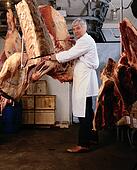
It was a normal day.  I had gone to school and come to work for the evening.  My first job that evening at the little mom and pop grocery store was to stack the 1 lb. blocks of butter in the corner of the freezer.  The freezer wasn't that big, probably 20 feet by 15 feet.  Sides of beef hung from the meat hooks that lined the length of it.  At the time four or five sides were hanging on the 8 hooks available.  Sundry other items were in the freezer also like frozen dinners and ice cream.

So, I was stacking...  Unexpectedly, the freezer door opened.  I heard someone say something outside the door.  Then, I saw the cashier from the front of the store being pushed into the freezer.  Also at her back was the barrel of a sawed-off shotgun.  As soon as the door shut, she put her forefinger to her lips to tell me not to make any noise.  The door opened again, then the butcher was shoved inside.  I knew there was one more person in the store, the head cashier.


About a minute later, he came stumbling in because they pushed him very hard with the barrel of the gun after pistol-whipping him.  We all heard something like an ice pick being put through the handle of the door so that we couldn't open it from the inside.  The cashier told us all that we were supposed to wait 10 minutes before trying to get out.  I guess, the thieves didn't trust us since they secured the door from the outside.

That was the second time I had feared for my life.  I don't think the thieves knew I was there since I had been working in the freezer, but I really thought that after they had pushed the head cashier into the vault, they would step in and mow us all down.  I experienced mortal fear at that moment.

A few times in my life I have been minding my own business, doing what I was supposed to be doing.  All of a sudden, I didn't want to be there, but I was nonetheless.  For the times that I now know what the ending of the situation was, I can say, as it has turned out, that I am glad I was there.


But, there are those times... the ones where I don't have the last word of how things will turn out... that make me uneasy...  I fear the outcome will not be what I want it to be...


Monday, September 22, 2014

Matter of orientation

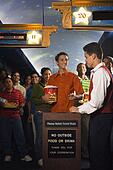
The young man took my tickets to see the movie and said, "Thank you.  Theater 2 is on the right."  I migrated to the snack counter, ordered popcorn and a drink, then turned to my right.  Theaters 9-14 were on the right.

Didn't he just say the theater was on the right? I thought to myself.

Then I realized that we were facing each other as I handed him the tickets.  The young man's right was my left.  Yes, indeed, the theater was on his right, my left.

Perspective is one of those very important realizations in living.  Orientation is probably a synonym to perspective, though not always.  In this case, it is.  I forget sometimes that I am not the only one on this Earth.  Some people are facing a different and, sometimes, opposite direction.  Talking to my sister the other day, I told her that some political view we were discussing was a view of rabid Tea Party members.  She replied, "Don't be too harsh.  I am one of those Tea Party people."


I can't help but trace my actions as I look at my personal history.  Yes, I have changed my orientation almost completely from the one I had when I graduated college.  Life's experiences were in front of me then.  Now they're not.  The theater room used to be on my right.  Now, after treading through life, the theater room is on my left.  I'm not disoriented.  I reversed my orientation. 

At the theater, I ended up in the right theater when I changed my original orientation from when I faced the ticket taker.  I think the outcome will be the same when I finally make my way to life's destination.

Tuesday, September 16, 2014

A crystal ball view


I would love to gaze into a crystal ball and catch a glimpse of my life 10 years from now.  I hope I would see a great quality of life - traveling to various regions of the U.S., enjoying my progeny, engaging in meaningful and productive projects.  I hope I wouldn't see a pain-wracked body - stuck at home, unable to visit the homes of children and grandchildren, aloof from the society surrounding me.

In ten years, technology will be farther down the road.  Communication should be one of the easiest endeavors on the Earth.  Videos will dominate the type of communication being sent.  Television will be much more interactive than it is now and will only be watched through apps that stream the programming one wants to see.  Transportation for personal needs will be almost fully electric.  Smart houses will represent about 40-50% of the housing market.

Ten years will bring great innovations in medicine as well.  Genetic manipulation will begin creeping into treatments for diseases that originate from gene order.  Diseases that are generated by cellular proliferation will be controlled.  Diabetes and heart disease will begin to disappear because nutrition and complications from lack of nutrition will have an almost 0 balance, meaning that diet and habitual unhealthy intake will offset each other.

And yes, dreams once held will have been realized.  That will be worth experiencing on the way through the ten-year period.  I should be one happy man a decade from now.

Sunday, September 14, 2014

Work away

I whipped around the corner from the main street of the housing addition onto my own street.  It was clear of cars on the curb.  Every car was in its driveway.  The air carried no noise from any of the yards facing the street and no sight of human movement from the lawns, in front or back of the houses.  Late Sunday afternoons don't represent a great hub of activity in the neighborhood.

I was glad, though, for all of the inaction.  I needed to relax after a full day's work.  At least it was a good tired, relief after successful effort.  Good food and favorite drink topped off the beginning to an evening that rejuvenated depleted energy.

I won't say that these days are ones of stepping in high cotton, but but are days of momentary relaxation, pockets of rejuvenation.  I'll take them.


Thursday, September 11, 2014

Charting life


Establishing a baseline is a necessity in charting progress.  Baselines help in  finding averages, deviations, anomalies, and outliers.  All four of these yield useful information.

As I evaluate my life, I find all four of these in the decades I have lived.  I find behavior that is average.  That helps people know how I will act in given situations.  Deviations, anomalies, and outliers are also present.  Usually, I see them as I enter a new phase in my life.  They are outlying points at first, but then those points become the new normal.

But there is one example of a deviation (at about the 4th standard deviation level) that is my one wish in life since it appeared.  I have highlighted it because the time represents such life-filled vitality and enjoyment, watching it, hoping it will slide down the deviation scale into the field of normal.  I have faith!

Wednesday, September 10, 2014

All I can say

This is about what you would expect from the academic establishment.

In July, Anne Mangen of Stravanger University in Norway published, along with her research team, a study of people reading a fictional story from a paperback book and from a kindle.  Her results were that the group using paperback books remembered less about sequence of plot than the people using Kindles.  She performed a similar experiment last year with 10th graders who read from an iPad and from a .pdf document.  The .pdf readers scored higher on a test.

Manger was at least a true scholar in offering conclusions by saying the studies "suggest" that paper or the imitation of paper, in the study using .pdf documents, help people perform better on tests and provide a better mental framework for remembering sequence in particular.

This is an attempt to try to reverse what is happening in reality.  Manger acknowledges that other studies show a tremendous decline in the number of people reading books.  She is trying to stem the tide of this trend.

It's not going to happen!

Here's reality.  The new world requires interactivity.  Reality is not answering questions on a test.  It's interacting with your environment as you learn.  Disney learned this several years ago.  They launched ABCmouse.com and have young children ages 2-5 learning on an iPad all kinds of things because they interact with the tablet.  Learning is not compartmentalized, i.e. read something first, then write answers over what is read.  Children in STEM schools know this too.  Project based learning allows the brain to more lastingly learn (to form synapses along dendrites for long term organization and storage, to use technical jargon) even if the amount of time to "learn" or register understanding takes longer.  Learning is integrated into projects and interactive with the environment.

A study like Menger's also ignores what has recently occurred and what is about to occur.  The Apple watch is just the beginning of something huge.  Icons and apps on your wrist to give you real time interaction in a format handier than your cell phone, quicker than your cell phone, and with improved Siri speaking your results to you will make both books and Kindles archaic almost immediately.  The next wave of technology using 3D holographic information delivery will seal the coffins for paperbacks and Kindles alike.  After that comes artificial intelligence.  At that time, nothing resembling paperbacks will be the way to learn information or enjoy a story.


I knew the academic world would have a contingency of die-hards wanting to stem the tide to a world that is a quantum leap from the world they lived in most of their lives.


All I can say is, "Prepare your coffins."

Monday, September 08, 2014

The gift of expression

The experiment went like this.

You will have someone to teach who doesn't know your language.  Your job is to teach him your language, 1 on 1.  You will be with this person one time a week for five weeks for two hour sessions. Make a prediction of how much English this person will know.

OK.  I will be able to talk to the person in much the same way as I would talk to a child who has had one year of formal schooling.  (S)he should be able to take directions, find his or her way around the environment, and tell someone else what is happening to him or her. 

Really? 10 hours and the langauge capability of a 2nd grader?  People say you are amibitious or arrogant to think you could give a person the same skill in communication as someone who has been raised with a language for 7 years.

We'll see.  How can anyone give the gift of language to someone so easily?  Of course, it's really not so easy.  The ability to give language quickly would have been years and years in the making.

OK.  T-10 sessions and counting.  Time's a wasting.

Sunday, September 07, 2014

Flip off that switch


There I was, sitting on a 20-year-old couch.  All the lights in the house were turned off.  They were only turned on after the sun had completely set, then turned off around 10:00 PM so that the other person could get 8 hours of sleep.  The air conditioner was set on 82 so that it wouldn’t turn on unless it was needed.  82 degrees was the point where it was needed.   A ceiling fan overhead spun with a clicking noise.  The only phone in use in the house was a land line.  Portable phones like the ones popular in the 1980s were placed at 3 locations in the house.

A TV was in the room, but turned on only for an hour in the morning to catch the news for the day.  For the rest of the day until evening, the TV was set on a symphonic music station.  In the evening we watched the news again and 2 hours worth of Waltons reruns on the Hallmark station.  Occasionally the channel was turned to the Inspire channel for a movie.  Together we watched one of those on Labor Day.  The story happened immediately following World War II where the storyline traced a woman who had to find her fiancĂ© because of amnesia.  The love story was in black and white.


 There was enough conversation to make the day pass without feeling lonesome, but there were many pockets of silence also.   Computer use to accomplish work, banking, or any other online function was out of the question since no internet existed in the house or anywhere nearby.  My cell phone, luckily, did bring me the internet, but typing and banking took twice as long because of the tiny screen.

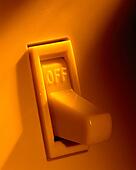
Everything in the setting was a result of a rigid belief in extreme frugality and extreme adherence to routine and religious piety.  No television programs could be watched that had the remotest possibility of “cursing” being used in it.  Only 3 channels were watched as a result of that belief.  Outside, the weather was bright, sunny, and 95 degrees.  Inside, only light filtering through window blinds lighted the areas of the living room.   Lights in the kitchen were permitted during cooking times, but not before or after.  Bathroom lights shone only while the room was in use.  The same was true for bedrooms. If I left a light on behind me as I left a hallway or room, I was reminded within two steps of leaving the area that I needed to turn back to flip off the switch.


One’s religious values were scrutinized in this place.  A couple of times I was chastised for some of my interpretations of the Bible.  Once I was told that I wasn’t following the example practiced by Christians in the Bible.  Another time I was questioned about whether or not I was reading the Bible.  I was probed to see if I still used the particular phrases of my childhood religious denomination.  I failed this test miserably because I refused to use them even though I knew what they are.
 
Yes, I had to check the date several times a day to make sure I had not become a time traveler and landed in the era of the austerity of the 1950s or 1960s.  No, it was 2014.  My only word for this experience is unbelievable.

I sat on that 20-year-old couch for a little over a week.  The shrouded, insular existence created by the other person was a result of nostalgia, mistrust of people and modern technology, selective memory of events from the good ol’ days, and a rabid belief in the divine inspiration and literal interpretation of the Bible.  Just unbelievable.  I will definitely buy a t-shirt that says I survived this environment. on the back I will have printed, " Unbelievable!!!"


Saturday, September 06, 2014

It's the big one, y'all

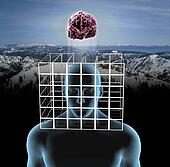
Math and language, in the electric impulse stage in the brain, are driven by the same logic.  The evidence for this is from the way math and English behave.  However, most of the brain studies are trying to determine what people are thinking by identifying areas of the brain that contain electrical impulses when formulating thoughts of math or language.  That is helpful as a first foray into the study of the brain, but it tells nothing about what is being thought, what is similar in thought, or even what triggers a thought.

     
Gary Lynch’s work is a refreshing break from this direction of study because he has been trying to find out how thought is registered and remembered.  His work has been ongoing for the last 30 years and will serve as a first step in working with electric impulses.  Once we know how a thought is registered as a memory, the next step is to analyze the stages between stimulus and recall.  After that,the similarities of thought behavior can be observed.

Observations into what you ask? Into the pathways of operations of logic.  Finding what causes the various behaviors determining one’s thought.  Here’s an example of thought behavior.  The use of the adverb in English is mostly not a word order governed item.  The subject/verb/object order is definitely an ordered item for understanding the correct semantics.  The same logic applies in math.  Addition is not an ordered item but subtraction is; multiplication isn’t, but division is.  The same logic underlying the reason for not ordering the placement of adverbs and addends and ordering the operations of subject/verb/object and multiplication seem to hint at what the future of language holds.


In the big scheme of things, math is considered efficient, eloquent.  Language is considered imprecise, ambiguous.  (I know that some say that language is precise, but the fact that the words ambiguity, nebulous, and fuzzy can apply to an expression hint that language is otherwise.  Also the redundancies built into constructions such as subject/verb agreement and two aspects such as perfective and progressive conveying the same idea tell me that language is not precise).  When communication passes the threshold of 70% for being visual in nature, needing only words to identify a category type (like the names of buttons or names of an axis on a graph), then efficiency and eloquence will be heightened necessities.  The logic used for math is already the same as the one used for English, so logic will help in organizing language use to make it more precise, less ambiguous.

The catalyst for this change is imminent, within my lifetime.  I may be 80 when 3D, holographic, visual communication will be the rule rather than the exception as the principal way for communication, but at that point, the logic for math and language will be closer than they ever have been.  When it happens, I will celebrate that the slow, antiquated, inefficient, inadequate, and fuzzy nature of reading and writing has morphed into a smoother, more efficient, more precise method of expression.  Spoken language as well will tend to pare itself into a more efficient way of expression.  I suspect it will trend toward consolidation into one language, whichever one is deemed most efficient (fewest sounds, fewest redundancies, most component oriented, etc.)
.
The brain seeks the most efficient way to accomplish its tasks.  It will do the same with the two lines of logic – numbers and words.  I know regular people are ready for efficiency in language.  Business is also driven by efficiency, so I know they will be accepting.  Others, who are slower in accepting what is happening in the real world rather than an artificial world will have their boat swamped. 
I remember so well Mayor Nagan giving a press conference two days before Hurricane Katrina made landfall in New Orleans.  He told the people listening to the sound of his voice that New Orleans had always known that there might be a time when “the big one” would hit the city and cause a great catastrophe.  Then he added a comment about Katrina, “This is the big one.”  Many ignored his words, thinking he was overly dramatic, so they didn’t evacuate.  Many lives were lost as a result.


Those who are not realists about the disappearance of reading and writing, as we know its use, need to be given the same warning.  This is the big change that will transform the way business is conducted.  If you don’t evacuate, well, your future will be directly affected. 

Wednesday, August 27, 2014

The corner

I really can't see around the corner of the block that I live on either literally or figuratively.  I guess that is for my own good.  I usually get mad when I get in my car, go down 12 houses to the corner and see all the cars parked on the street because the people don't want to park or walk up about a 30 degree incline of their driveways or when I see garbage carts lining the curbs on Mondays, or lament the condition of some of the yards around the corner because everyone on our street keeps their lawns in grand condition.  And there are other things as well, like the retired man at the first house as you round the corner who sits in his yard every afternoon to watch everyone else's comings and goings.

Yes, it's a good thing I don't see what is around the corner most of the time.  And in the figurative world, I would see some things that are necessary, that should happen on a regular basis, like the trash carts on the curb, but that I don't really like to see.  I would see the immediate futures of my daughter and granddaughter. Those are events that are easy to handle as they happen but that would be hard to handle if I knew them ahead of time. Knowing the deaths of people in my world would not be pleasant.  Seeing any setbacks that might occur would be hard to swallow.  Watching the eventual outcomes of the efforts I am making today to make things better could be very defeating.  Of course, seeing all the successes that happen in life would be sweet. But I don't know but that the effort that creates those successes would be affected if I knew ahead of time that they would pay off.

I really can't see around the corner of the block that I live on.  I'm good with that.  And I still have faith and hope that my greatest wish in life is somewhere around that corner.

Monday, August 25, 2014

Seasonal lessons

The seasons change with little fanfare.  It's normally just a day on the calendar.  The first few days of a season are rarely different from the season that just ended.  No, the change in weather happens slowly.  The 20 degree day in February is greatly different from the 100 degree day of August.  But, in between those two days is a gradual slide .  10 degree increments allow the change to happen in quite an unnoticeable way. 

By October the 100 degrees of August has change into the 70-80 degree range.  By December the range slides to 50-60.  Most days in January are in the 40s.  But then there's February.  The several 20 degree days highlight the month, but most of the time the 30s are the rule.  After that warmth begins to return.

Is nature a lesson in this for all to see?  Well, if there is one, I suppose it would be that change is constant and expected.  However, it also teaches that there are some extremes that we all have to deal with, and fortunately, they don't happen close together.  The extremes see a lot of "edging" up or down before the extremes are experienced.
But perhaps the real lesson is the beauty that results during the extremes and the invisible process that causes that beauty in the interim.  When grass is no longer green and the scene is rather barren, then come the beautiful layers of snow and ice to glisten in the sun.  And the reverse is true as well which  Bette Midler reminded us of in the lyrics to The Rose.

Just remember in the winter
Far beneath the bitter snow
Lies the seed that with the sun's warmth
In the Spring, becomes the rose.


This process has been in place for millions of years.  I look forward to it each of the years of my existence as well.

Friday, August 22, 2014

The razor's edge


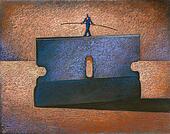
What happens when children compete is that they learn their strengths and weaknesses.  They see the results for themselves.  They don't have to have the results explained to them.  Competition is merely a fact of life.  Competition begins early in life and continues until death.  It's a matter of health.  Competition is a honing technique.  It makes us keen, lean, and more insightful.  It merely keeps us alive sometimes, and gives us advantages over those who would harm us at other times.


Because competition is natural in both socialization and specialization of the species, many parents and organizations do  an injustice to children to intervene and try to make the playing field level.  It's not - it's naturally not.  Learning about competition early allows for specialization.  Forcing a leveling principle on children only perpetuates a lackadaisical mentality and leads to latent ability too long into adulthood hampering the competitive edge.


That edge is the name of the game for us to be our best, to go our farthest length, to live a satisfied life.

Thursday, August 21, 2014

Across the borders

Psychologists refer to abstractions that people view as boundaries for themselves as constructs.  Educators use the word paradigm for the set of expectations that are acceptable.  Business coined the term box for the acceptable practices that guide them.  I suppose it doesn't really matter which term you use as long as you understand that the boundaries people have drawn for themselves are imaginary and arbitrary.

That's not a newsflash.  People have known this for at least a century.  Philosophers have known it for longer than that.  I guess the amazing thing is that people attach expectations and acceptance to boxes, paradigms, and constructs.  While I fully understand the need for structure, order, and law, the arbitrary nature of making up more expectations for acceptance than is necessary bothers me tremendously.

People have too many boxes, each with rules, with which to accept others, too many paradigms within which to operate and about which to make protocols, too many constructs by which to keep the mind straightjacketed.  I just want to shout, "Break out!"   Enjoy the beauty life constantly shows us outside the box, across the boundaries of the constructs, on territory just outside the paradigms.                                                             ,                                                                                                                                      

Wednesday, August 20, 2014

Time to weather-proof


I had settled into bed.  Ah-h-h, warm, dark, and cozy.  My eyes closed, ready for drifting into that great slumberland.  I noticed a flashing of light through closed lids, so my eyes opened once again to see what could be causing the flashes.  They were coming from the window.  Only lightning could be that bright.

Did I miss something on the weather forecast.  It was predicted to be sunny and hot for the next 7 days with 5% chance of rain on a few of the days, but not tonight.  The only storms showing on radar at 10:20 PM were about 2 hours south of town and were not moving my direction.  I grabbed my phone from my nightstand and hit the app for the local news station's weather radar.  Yep, there it was - a storm coming, and it was only a few minutes away.

One of my cars is so old that it has to be weather-proofed in rainy weather so the rain will not rush into it. Then comes the musty smell in the car and the amount of time for drying it out.  I don't have time for that, so I had to leave the great comfort of warm, dark, and cozy to go weather-proof.  A few expletives came to mind at this point.

20 minutes later I settled into bed again.  Ah-h-h, warm, dark, and cozy.  Finally,  And again.  You know, sometimes life just forces those unexpected, unpredicted, and uncomfortable surprises that prod us to do the mundane things that allow us to live a quality life.  I've tried the alternative, especially with my health.  It's really unpleasant and requires twice as much time to restore than to weather-proof.  Definitely when I see signs that a little weather-proofing is needed, I get up from warm, dark, and cozy to handle the situation.

Sunday, August 17, 2014

Elysium, at least now

Once in a while I sit on my back patio musing about my life.  Sometimes it is just to click through a few scenes in my mind of my current situation.  Sometimes it is to look at the events of the last 5 years.  Occasionally, I will go further back maybe 10 or 11 years.  But it is a rarity to go back much past that.  The reason is not that I can't remember that far back.  It's that I don't want to recall events or years that represent a lot of pain.


Beyond 11 years ago, I was a very different person.  I don't know how I was perceived exactly by others.  I just know that I had undergone a decade and a half of loneliness and anger.  It continued even after the watershed event of 11 years ago for another 5 years.  After two decades of lonely living, I knew that something different had to happen.


I could still detail the times if I needed to.  After all, it was during those times that my children were growing up.  Many of those memories with them are good ones.  I recount them if with my daughter, and she wants to reminisce.  Otherwise, I really don't revisit the toxic 20-year period.


On my back patio, watching storms roll in or just musing about shapes in white clouds as they float by, I think often about the time after the 20 years of drought.  I'll catch a whiff of the pleasant aroma of rain arriving in the wind just before it starts and flash to a time of sheer happiness.  I'll hear words from songs from that time play in my mind and call up visuals of satisfaction and enjoyment.  I'll sometimes catch a glimpse from my mind's eye of sacred places full of the most pleasant of memories.


That merges into scenes of a path away from the sacred places into the future where health has had to be dealt with and hard situations have arisen.  The trip to the present isn't all grim, however.  It includes episodes of laughing in the car wash and playful tickling with my granddaughter.  Then I know all is well with the world, and I return to a livable reality.


I can rest at night and dream of the Elysian Fields.


Monday, August 11, 2014

Talking etiquette


Conversation analysis is an interesting study.  It is usually lumped into the general category of discourse analysis, but its behavior is so very different from written discourse or prepared discourse if a person reads from a prepared, written statement that it deserves to be a field in its own right.

There are different ways to study conversation.  One way is to chart the topics covered.  Another way is to trace participant participation.  Even a third way is to notice differences in same sex/cross sex exchanges.  Other ways exist, but these three were the initial entrances into the field and, thus, the most explored.

One of my favorite ways for analyzing conversation is to notice the rules or etiquette regarding turn-taking in conversation.  This approach has a number of studies written about it, but there are different combinations of ways to study this behavior, so the studies don't address all the possibilities.  First, a person needs to know that conversation is built to communicate information.  The person can either give it or ask for it, but information is exchanged.  If the information is of interest to both parties, a topic or line of reasoning is followed to exchange the information both parties want to have.  If the topic is not of interest to both, the imbalance causes a distortion to the ideas of turn-taking.

It's a little like the body.  Its different parts work in harmony, but when one part doesn't function according to the rules of balance, disease breaks out and discomfort or pain are generally caused.  Some people know when a topic is of interest or not to others and observe a jumping technique, that is, they jump to another topic that might interest both parties.  Some people, on the other hand, don't seem to know or at least find a reason to ignore the signs of disinterest shown by the listener.


Yesterday, was one of those occasions that I try to avoid - a person who couldn't discern my limited interest in a topic of great interest to him.  The minutes engaged in that conversation were miserable.  At the first available opportunity, I extracted myself from the conversation.

It seems that on some occasions, the age and maturity of the person in the conversation determines the ability to judge the interest of the other person, but sometimes that is not the case at all.  I would love to look at the conversations of about 100,000 people in various groupings and publish the study.  But, that violates a point of etiquette when conducting conversations.  Conversations are expected to be fully spontaneous and etiquette is negotiated by the parties enjoined.  In research, an observer makes the conversation less spontaneous making the participants wary of just what rules the observer might be "judging" their conversation by.  The participants would change their conversational topics, line of reasoning, or words used in the presence of a third party.


An extremely adverse reaction happened about two months ago when Facebook admitted to letting researchers evaluate the written conversations of some of its customers.  The move violated the privacy of people.  Although spoken conversation behavior is somewhat different from written "conversation" on Facebook, the principle of spontaneity being judged or evaluated by a third party was violated.  The backlash from Facebook customers complaining loudly shows the influence if knowledge of a third party is in the mix of a conversation.  This is known as the Observer's Paradox, and it is very difficult to avoid.

In the meantime, I'll stick with what the existing literature reveals about the idea of conversational etiquette.  This means I'll avoid the people who have a talkative record.  And, I'll keep observing the trademarks and indicators of why  people don't always know when turn-taking has ceased and one-sided monologs have kicked in.

Friday, August 08, 2014

Pure sweetness


Song lyrics, like poetry, are works of beauty when they have at least two levels of understanding.  The song American Honey is one of those works of beauty.  The song works from a symbolic point of view very nicely.

She grew up on a side of the road.
Where the church bells ring and strong love grows.
She grew up good, she grew up slow,
like American Honey.

A girl grows up in a really small town, one where, if you blink, you miss the town.  The main road through town didn't go through the middle of it.  It went around it since it was so small it wasn't worth stopping in.  Oh, but there was magic there.  The girl has those great small town morals that come from careful nurturing.  She represents the American experience.

This American experience has the same comparative process as honey.  Honey takes time.  The bees follow a particular process of bringing back nectar to the hive, transferring the nectar to other bees, and those bees following the rest of the process to spread and fill the hive with honey.  American honey then represents the average person's process of growing up.  This is great nostalgia.  The good old days for people are sweet as honey to the figurative palate.

Steady as a preacher, free as a weed,
Couldn't wait to get goin', but wasn't quite ready to leave.
So innocent, pure and sweet,
American Honey.

The childhood experience is so uneven.  The road to adulthood is sweet, pure, and innocent, yes, but also is a road filled with contrasts.  One can be steady, yet wild as a weed, much like the saying "16 going on 30."  The honey making process also contains a bit of uneven drama. The bees have to deal with a wild card, bacteria as they deposit and seal the honey they will eat in the honeycomb.  Most of the sticky, digested nectar is, of course, stored successfully as pure, sweet honey although some of it falls to the bacteria.

Get caught in the race of this crazy life,
Trying to be everything can make you lose your mind.
I just wanna go back in time,
To American Honey.

The present day is hard and tedious unlike those sweet, carefree childhood days.  People, like the girl, love the thought of going back to those precious, formative years when life tasted good.  As for honey, eventually, bees get caught up in doing the same thing time and time again - flying to the flowers to collect nectar, going through the process of converting the nectar to honey, storing it in a honeycomb, then eating it and starting all over again.

The chorus echoes the sentiment containing the message of the poem.

There's a wild, wild whisper blowin' in the wind,
Callin' out my name like a long lost friend.
Oh, I miss those days as the years go by,
Oh, nothing's sweeter than summertime
And American Honey.

It also is the point where a person knows for sure that the composer has combined the two processes of making honey and being raised in a youthful, carefree, simple atmosphere.  The whisper in the wind is the nostalgia that takes one back to those wonderful, playful days of childhood and the instinctual call of the bee to start the nectar gathering process.  The result of remembering is a sweet summer.  For the bee, it is the time of the year for productive gathering of nectar.  What beautiful symbolism compared to literal honey.

The song's melody is slow and rhythmic, very nostalgically written like a breeze blowing through one's hair.  Both words and music take a person's mind back to the uncomplicated sweet things of life.

Now that's the symbolic level.  There is the literal level, of course, the obvious level.  A woman nurtured from birth that is to have such an appeal that she becomes a man's honey, sweet to the memory every time a person recalls those memorable times.  The whisper "callin' my name" has hypnotic power to draw the memory back with every thought to the time when the two were together.  What beautiful literality compared to symbolic honey.

The key line for both symbolic and literal levels of interpretation is:
Oh, I miss those days as the years go by.

Nostalgia is good.  It keeps us centered.  Roots are important for tempering what happens in our present and for guiding what ventures are pursued in our future.  And while nostalgia is good, the present is where we live.  So, I want to add a new stanza (mine, not Lady Antebellum's of course)

Oh congrats on today, what the future brought you,
It was built on the past as you made your way through
Although it's new, it's sweet too
It's American Honey.

Thursday, August 07, 2014

What's ahead on the path


My two-year-old granddaughter has lots of play time, so it is interesting to see what she does with her time.  She loves the outdoors, so some of her time is spent in exploring the outdoors.  She has all kinds of toys, but doesn't spend a lot of time with the toys.  She has role playing objects like tables, kitchens, small tables and chairs, tea sets, houses with families, and access to part of a study.  This she loves.  She will have make-believe tea parties, invite me to eat plastic foods after she "cooks" in the kitchen, ask me to play house with her family in the giant house, and play on my computer in the study.

Some of her time is spent with stories and games. Now, by stories and games I don't mean books and table games.  Leap Frog has books with mostly pictures, but a small amount of text.  The book has an accompanying bear "reader."  When the reader is place on any part of the text, an eye in the reader sees the text and, through a small speaker, reads it aloud to my granddaughter.  But, also on the page with the text are pictures of animals, character, and other objects.  Placing the reader on the objects also allows the reader to give extra information to the text.  She spends a full 10% of her time with these books.

She spends another 10% of her time with a computer built for a two-year-old.  It has a screen the size of an e-tablet.  It takes pictures and has a scaled down version of photoshop.  It has games. It allows her to accumulate reward points.  It tells short and simple stories with animated characters.  It teaches music appreciation and music reading.  It has an art feature, so she can learn to "paint."  It has a few more features, but she doesn't spend much time on those.

Only very occasionally does she read a book or ask to have one of the adults in her life read to her.  Even when forced to listen to a book once in a while, she fidgets to go elsewhere before the reading is over.  I certainly don't begrudge her.  Reading and writing are really, really becoming relics of a day gone by.

2017 is the end of the ten-year war between the role of reading and writing and the forms of technology that will liberate people from the tedious, slow process required to read and write.  A clear winner for part of the replacement of the two stalwarts of the past is in place.


Other methods and formats will quickly follow.  I can choose to read or write because I was born in the old world before 2007.  But, those born after that will not need reading and writing to function in society, nor to present for projects to get degrees in college.  And eventually not even to obtain advanced degrees.  Fortunately, a few schools like the Harmony Schools of Science around the state and the University of Texas system's STEM schools understand this shift.  Their students demonstrate their understanding of subject matter with projects using Ipads mainly, but with manipulatives and other graphic demonstrations as well.  Kudos, kudos, kudos to those who lead the way into the new era the world is experiencing!

Wednesday, August 06, 2014

Starting points

Interesting, really. I watched a current version of Brain Games and saw a program in which the program's originators began the segment with a reference to Women are from Venus, Men are from Mars.  The reference was to springboard into the segment that promulgated the idea that women's brains and men's brains are wired differently.  The segment continued with a simple test of the idea to show that men are more focused than women and that women are more descriptive than men.  This was followed by a game with a team of two women against a team of two men.  The questions each team had to answer depicted men answering questions requiring focus and the women answering questions requiring description.  It was hardly an experiment... more like an activity illustrating the result of an experiment.

The test and game were based on the premise that evolution played a part in designing the way men and women think. People evolved in a way that caused men to be the hunter of the pair and the women to be the gatherer of the pair.  So, men had to be focused, allowing no distractions, in order to track and slay their prey.  Women had to gather from places that had to be described, then had to describe what they did (prepared) with the berries (or whatever) they had gathered.

This premise has been around for a while in the field of psychology, about 75 years.  Thus, it's not a conclusion that can be dismissed out of hand.  It could be true.  The mitigating factor against this theory, however, is that not enough time has passed for men and women to have developed these kinds of features.  At the very earliest, people with enough mental acumen to describe or to focus need more than the 300,000 years allotted to them to change from Neanderthal to homo homo sapien.  No other mammal or vertebrate has developed along the lines of conscious role development that enriches speech in the case of women and filters out speech in the case of men.

Psychologists would like to leave the subject in the realm of how the mind developed over time without regard to speech, but when they bring in how the brain describes an idea or how the brain blocks speech from happening, then speech is involved more than implicitly.  And, the reason psychologists don't want speech involved is so that they can leave out the linguistic theories that tend to mitigate the approaches taken by psychology.  Linguists and philologists since Lev Vygotsky in the 1920s have been publishing books about speech and thought.  Evolution is not a part of the development of the relationship between speech and thought.

So to watch a show on Brain Games based on an old and impartially supported theory of language is disappointing.  I understand that TV is about putting science into terms and formats that take scholarly ideas and make entertaining and profitable episodes for a TV format to inform the public.  I just wish the ideas TV executives select would be the well established ideas, ones with less debatable evidence, truly illustrating a truth or at least trend.

Psychology and psycholinguistics are often at odds.  Linguists start with what is seen and heard - language - and move to mental causation, whereas psychologists start with possible mental causation and show how that surfaces in language.  The results are different, naturally, because the starting points are from opposite ends.