Search This Blog

Sunday, October 26, 2008

Families and scatter plots


I've been trying to get a handle on how families interact with each other for a while now. I have very often wondered how someone like Dobson could gather data on what "strong" families do. I'm still looking for the "strong" family.

It seems there is a general principle in life that says that the longer something stays on the earth, the more it weakens or unravels. As I observe all kinds of families I would say that I could chart the characteristics, all right, but that those charactersitics would be plotted on a scatter graph, not in a closed set called "strong." The families I see in my world are all so very different, even the ones who share common beliefs. I see people in a church for instance, who have great individual faith, but have few common interests with their spouses. I see people at work who believe in spending time developing the ideals of the "company" but who never mention their spouses at work, or they mention them in negative contexts. I see pillars of the community who spend a waking hour, maybe 2, at home with their families during the week. I see religious teachers who go to a meal out with their families and say about 50 words the whole time they are in the restaurant.
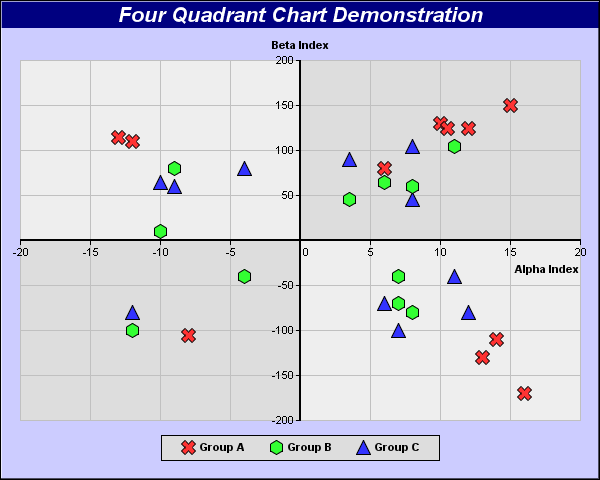

Then I look at the families in which the parents' children are old enough to have their own young children and who have their own adult lives going on. Where are the joyful times with grandchildren? I see few of them. Where are the visits when fathers and sons-in-law sit and talk about life in general or interests they have whether or not the interests are in common? When are the visits taking place between mothers and daughters-in-law that create the familial bonds? Where are the grandchildren who see their grandparents willingly? I'm thinking life has a way of unraveling.

A coworker of mine recently had several calls from her family on a given day at the end of which (and repeated a week later) the statement was made, "I've had it with my dysfunctional family!" Of course, that's why we all have an empty spot to fill with the Great Teacher's values, one of which is the need to be rescued from the general principles of life. But at least I know better than to look around for families that have "strong" characteristics. I just know how to interact within the family bonds I was born into and within the family bonds I established or that were born to me and invite the Good Master in for the rescue if life goes long enough for the family bonds to unravel.

Monday, October 20, 2008

When the season calls for it


A creek rippled by at the foot of 30' drop from the balcony of the cabin I stayed in. You could hear it in the quiet moments of the day and during the night. Not far from the cabin a dry tributary joined with the creek. It was about 15' across where it connected. It looked inviting, so I decided to take a walk up the dry creek bed to see where it would lead. The bed wandered uphill in a winding fashion, but it was fairly flat so walking was easy. The tributary narrowed the farther uphill I walked. About 100 yards up, the bed was only a small jump across. It suddenly bent almost 90 degrees and went curvingly up the side of mountain. It was dry there too all the way till it vanished out of sight. The width up the mountain could not have been more than 2' across.


I stopped to muse what the vision might mean. It was just a dry creek bed, but I could not help but think that the scene had a deeper meaning for me. I stared back down the mountain at the path I had taken to come uphill this far trying to see a message, but to no avail. I retraced my steps continuing in thought. Thoughts began trickling into my conscious awareness, "Tributaries bring reinforcement water to the stream below it. Tributaries help drain the mountain of unnecessary water. Tributaries are seasonal, swelling for use when they are needed."


It was this last point that my mind stuck on. There was my message. I don't know that my life is as dry as the stream bed, but the scene begged for the meaning of the tributary's seasonal nature. Finally, the thought formed. In due time, when the season calls for it, once again you will be able to offer something of value to the greater whole or to someone who needs it.


My message was clear. I could leave the scene behind. I had a tip for living from nature itself for which I was thankful.

Sunday, October 19, 2008

A definite occasion for mouthwash


I suppose I have some opinions of what should happen in a class whether it be an English class, a linguistics class, a foreign language class, or a Bible class. Here's the list: start with a premise or principle, capsule the direction of the next # of minutes, put in place the ideas that form the direction, back up the ideas with experience or research or facts, elaborate on the ideas with stories (anecdotal data) or experimental data to match. If conjecture is made, then know where the areas of the conjecture are weak and allow for some debate since the conjecture is not completely fleshed out.

A month ago I was invited to go to a class because "it allowed for discussion, and it contained ideas that were not orthodox." The person who invited me is a good friend and really believed I would enjoy it. So, I went. Nearly everything that happened in the class did not fit the list created above. Naturally, I felt that it had been a waste of time. But out of deference to my friend, I went a second time. This time it was worse.

Anyone can moderate a class if all the person does is spew one notion after another. We all have notions, sometimes well founded, sometimes ill founded. Name a subject, people have opinions or notions. But, if I go to a "class," I have this expectation that it should be for learning, not for listening to someone spew notions. I won't go back. This class is not for learning. As good a listener as I want to be for others, the circumstance for my listening is not going to be in a "class" in which learning should take place.

I realize that others have different ideas of what a "class" should entail. So, I will let the experience of the last couple of classes fall under that category - a difference in definition of terms. The "teacher's" definition for a "class" was just different from mine. His list of characteristics would not match the list I gave in the first paragraph at all. I'll just chalk it up to a misjudgment on my part for choosing to attend. But it sure leaves a bad taste in the mouth. That's what mouthwash is for.

Saturday, September 27, 2008

Not enough tears

I heard a speaker recently speak on a subject that was painful to listen to. He spoke eloquently of this subject, so eloquently that many cried in the audience. But, the points he was trying to make caused many to go to the emotional core of their being to hear of the injustice being perpetrated by one person on another. It was P-A-I-N-F-U-L to hear. People filled with selfish interests abusing others or betraying trusts with others.

Then I thought of all the behaviors in life that cause pain. Children who ignore their parents' careful upbringing turning to lifestyles that lead them astray and into places of correction to their behavior cause endless streams of tears and grief. Spouses who call their mates and declare that love is over, nevermind that 4 children will be affected, stun the listening mate at first, but very soon tears follow by the gallon. Grandparents adopt grandchildren because their own children bottom out under the strain of society and are washed away to sea, and the grand parents will be 78 when the youngest grandchild graduates from high school.

Sadness, badness, cruelty and injustice everywhere. I say EVERYWHERE - every corner of the world. Tears are falling every moment of the day and night. One would think, judging from the sheer amount of pain inflicted by one person on another, that tears would run dry. They don't. And, when I think of the sadness and pain, I think more people should cry. There are enough tears being shed in one sense because people weep as a result of their pain. But, in a sense, not enough people cry.

Why are we such a cruel lot, we humans? WAKE UP PEOPLE! Cry for somebody. And then, act loudly against all that person's cruelty and injustice. One person at a time. One tear at a time.

Sunday, September 07, 2008

A drain or necessary step?


Group dynamics are interesting to say the least. This morning a person was adamant about diagreeing with someone in a setting of about 15 people. The leader of the group was very polite to the person who voiced disagreement. We had to spend about 10 minutes of time trying to find ground on which some agreement could be found. It didn't happen, so it was a waste of 10 minutes. The group leader, as a consequence, didn't get to end at a place he wanted to. The people in the class could feel the crunch of time, so they didn't discuss as much.

One perspective is that one person decided he would rob everyone of a needed 10 minutes. Another, kinder perspective is that the person needed to be able to say something so that he could benefit from the rest of the group's time together. Groups are always energy-sucking events. It sometimes makes one wonder if the energy drain is worth it. In a country in which individual freedom is valued, I guess position-taking is a ritual that doesn't have so many ethical rules governing it.

Sunday, August 24, 2008

Patchwork strangeness


In studying the ideas about the Son of Man, I have run across some very interesting material. It's found in the pseudipigraphical books of the Old Testament. Some call this period of time the intertestamental period. There seems to have been an evolution for the Son of Man.

In Ezekiel, for example, the son of man refers to humans. In Daniel, the son of man seems to be a heavenly creature. That image appears to be the same in 1 Enoch as well a 2 Esdras. When Jesus uses the term, he uses it to refer to himself. If not, then he is referring to some other being to follow him, even another messiah. Most people interpret Jesus' words to mean that he is referring to himself.

Then, there is the use in Revelation. One would think that John, who is a believer and follower of Jesus, would take the term to mean Jesus. Instead, it seems to follow the Daniel, 1 Enoch, 2 Esdras usage. Now that's passing strange. Unless, of course, the apostle John did not write the Revelation, which I tend to be leaning toward the more I read the book.

Sunday, August 17, 2008

A pixel in the big picture


The Great Teacher said we shouldn't worry about what may happen tomorrow. Each day has its own set of problems. We can't add an inch to the height we are given in life. Our father clothes the birds and flowers in more splendor than King Solomon could clothe himself with all his riches, so we shouldn't be asking what we are going to eat, drink , and wear.


OK. Well and good. I guess I need to gauge my trust level here. It might not register so high. But, this year will definitely put this frame of sayings to the test. In a way I do worry about how the place that I work during the day will consider the kind of work I do after-hours. One could construe them to be in conflict with each other. I prefer to consider the after-hours work as an investment in future return rather than a conflict of interest. It's all in perception. I think this will come to a head on September 26th. That's when the intersection of the two work places will occur. Do I worry about it? According to the above, the Maker of situations can work out people's perceptions as well as feeding birds and clothing flowers. I just need to approach the date in September with an understanding that the big picture can easily be handled if I merely trust that it will be.

Saturday, August 16, 2008

Ying and Yang


Sometimes I look at the mountains and see sheer, unadulterated beauty and truth. At other times I see the result of the collision of earth's plates causing one plate to pleat, the other to be lost beneath the earth. I guess that represents the two sides of me. One side very analytical, rather detached, objective.
The other side realizes what is breath-taking, splendid, ethereal.
One side doesn't rob the other side. If anything, one side enhances the other. That should be true of all humans - having two sides. Spending time with someone else helps us not just to notice the two sides of an individual, but to see how the two sides enhance a fuller character.

Monday, August 11, 2008

Musing about what I don't know anything about


Last night I was putting together a module for a class and had to deal with the Sumerian culture. Anytime I deal with a culture before the scientific revolution, I am taken aback by the sheer amount of ignorance that was in the people's lives and how much of their belief in the unknown was notional and fabricated. Of course, they didn't know better.

I know that someday, the people of another future time will look on us the same way. What we call science today will be taken for granted as known fact for centuries and as commonly known as our knowledge about the sun around which we rotate. They will look at us and wonder how we existed in such ignorance.

Yesterday I was studying a part of the New Testament that few people read anymore. I was struck by its coherence and parallelism, but I also knew that many just dip in and read a stretch of verses once in a while and miss the coherence and parallelism. Yet, they persist in some belief that the stretch of verses "taught" them even though the larger context and historical context might lead to a different understanding.

All of the above makes me know that the amount of knowledge I may have is small, temporary, and foundational for people living in some future society. That leads me away from feeling smug. It leads me right into feeling humble, sometimes insignificant. It makes me want to live forever so that I can keep up with the knowledge curve, keep up with the leading edge of discovery.

But, I know that I will not live forever in the environment I want to stay in. But, that does show my ignorance. I will live forever in an environment I have no knowledge of, but trust that it is so much different, so much more splendid, so much more filled with knowledge that I might as well die now because it may be another 5000 years before people on earth attain to the knowledge of an inkling available in the eternal world. I think I just talked myself out of staying around here forever.

Sunday, August 03, 2008

Battles are fought ahead of the field of battle


It's nice to look up and see friends all around. Often the journey in life is rough or lifeless. It's those echoes of friendliness that rocket out of the darkness when life does get rough or lifeless that make one know that Someone Else knew the you needed the smile, the prayer, the call, the note, the ironic play of events.

Tonight I just need to recognize that the Creator can come from deep in the cosmos to my little life with just the right sequence of friends' encouragement to carry on. When's the last time someone who hasn't called in 6 months rings your number just to say hi. When's the last time a meal with someone you haven't seen in about a year wants to pray blessings over you after dinner. When's the last time you were driving down the road and an out-of-town friend calls out of the blue and is traveling the opposite direction just 15 minutes away. So, you stop on the road and visit. All that happened in a span of 24 hours.

But, the Maker of coincidences knew that needed to happen because just a short 72 hours later the dark clouds gathered to rain. But, the rain didn't drown you or make you lose your way because you had had friends that lifted your spirits so serendipitously just hours before.

The beast with the number 666 can't paint the picture bad enough when the One who arrays himself against the number, who also wears a victor's crown, has already bolstered your spirits 3 1/2 days ahead of time.

Sunday, July 13, 2008

A bit of a sad scene

Last week I was in an upscale restaurant in a city of at least 300,000. I was eating alone because I was traveling, but I decided to notice the groups around me and their interaction. I was in the restaurant about an hour, so I go to see most of the conversations of the people around me. Directly in front of me was a table of 4 young women who appeared to be from a nearby university. One table over to my right was a couple in their mid-30s I would say. Close to them was another couple probably in their 50s. Behind them was a table of 3 couples. To my left was a table of two men sitting across from each other. Behind them was a table of 4 women. And near to them was another couple. I switched on my observation mode.


The three young university women talked without interruption the whole time I was there as did the two men who were engaged in lively conversation between friends. The table of 3 couples had at least one conversation going, sometimes two at all times. The table of 4 women didn't seem to have any pauses in their conversations either. Well, you noticed. What about the tables of the couples. They were pretty quiet tables. Conversation was intermittent, even sporadic at the 50s couple table. They found it hard, it seemed, to keep conversation sustained. The couple closest to the two men seemed to have the least trouble. But, their tones and gestures seemed serious most of the time.


This illustration bears out another point of opposites in cross-gender conversation. When men talk, they seem to talk of events surrounding them in the outside world. The topic of weather in many men's conversations is a point in case. They talk about their relation to their work or career, their ambitions, their analysis of politics or religion or any other issue that is common between the participants. Women, on the other hand, seem to talk about lives of the people around them. What happens in an event takes second place to how something happens or the after-effect of an event on people's lives. What people say and feel about something is important. With men, what people do is important. It bears analysis. Some people say the difference in conversational topics revolves around the internal, the personal, the notional for women, while for men, conversational topics revolve around the external, the competitive, the analytical.

Now back to the tables around me in the restaurant. The all-men, all-women tables had no trouble talking because they are all operating from the same norms. The multiple couples table had no trouble because the couples could splinter at any time between men and women to 3 men and 3 women if the topic selected was of lesser interest to one of the groups. But, the couples tables had trouble. The topic brought up by the men bore the stamp of male conversational rules: the external, the analytical, which is of less interest to the woman who brought topics of things personal, internally connected to people in the topics. Partners appeared bored out their skulls when the other was talking. Couples left in silence. Mixed or same-sex groups left chattering away.

I was a bit saddened by the scene. Are people not willing to notice others' norms and make that adaptation? It's enough to make a person regurgitate.

Saturday, July 12, 2008

Scrambled intetentions


A second difference in the codes of gender speaking is that when men speak, they expect to have the floor. Thus, if a man begins to speak and someone else talks over him and prevails, he loses face among the participants in the conversation. If a man interrupts another man, he had better become the speaker to hold the floor, or again, he loses face. So, usually men are quiet unless it is clearly his turn to speak or unless he knows he can wrest the floor and win it.


Women have a totally different norm going on. Because of the minimal response, women feel as if they can speak simultaneously with other women. It is a way of aligning themselves so as to not to be overtly hostile. In fact, women who do not engage in the minimal response are perceived as hostile or antagonistic. So, it is important to align themselves with the speaker. If for some reason, a woman is silent during another speaker's turn, she shows her alignment by building on the last woman's utterance. She might begin her turn by saying, "To add to ____'s idea," ....


So, woman talks to man. He listens like he is supposed to. No minimal response. When he speaks, he takes the floor. In the woman's view, there is no alignment taking place. That means hostility or antagonism. Now, whatever gets said is perceived as a remark that in unaligned with the woman's utterance. The woman may try to respond minimally while the man is talking. He sees the gesture as a woman trying to interrupt, to take the floor from him. According to his rules, that is losing face. According to a woman's rules it is showing alignment. The conversation turns for the worse.


One can better determine how cross-gender conversations become scrambled in a hurry. The codes, norms, or rules are different, even opposite. So the participants in the conversation don't get caught up in the content of the conversation, but let the unspoken rules dictate the underlying meaning of the conversation. That's when the automatic rules learned in our peer groups take over. But, the rules are different and misunderstandings run rampant. That's when the "You said this, but meant that," conversation takes over. Ah, the end is near.

Saturday, June 28, 2008

Norms, codes, and discontent


Turn-taking is one of those rules that differs in interpretation by the gender you are. "Rules" are really the norms established by socialization with your peers. So, when learning conversational norms, socialization happens. When people violate established societal norms for conversation, then stigmas are assigned to that person, such as "Oh no, here comes the guy that never shuts up," or "you don't want to talk with him - he never says more than two words." Somewhere in the middle is the norm. We all learn the norm when we socialize through the years. This also means that the peer group teaches us the norm, not the adult population. If you're a deep adult, you have probably noticed that the norms are slightly different for you than they are for people 20 or more years younger than you.

Since socialization occurs from peers, then another observation needs to be made. Girls are socialized by girls, boys by boys. As young people approach puberty, socialization takes on greater importance. One reason is that young people begin striving for independence from parents, even in the way they talk. However, boys hang around boys and girls around girls until mid-to-late adolescence. The socialization process, then, is left to the same sex peer group.

Therein lies the rub. The norms, or rules, for girls differ from the norms for boys. These norms are not easily shaken and continue into adulthood. These norms actually reach codified status for many adults because norms from childhood tend to become codes in nearly all areas of life, like religious values or beliefs, work ethic, role-orientation of culture. So, when a boy meets a girl or a girl meets a boy, the norms for engaging in conversation are different.

Building off of the previous blog, a great illustration can be seen. Turn-taking among girls requires that another girl show her interest in the conversation by giving minimal responses as the conversation continues. Words such as uh-huh, yes, right are sprinkled throughout the turn of the speaker by the listener. Boys, on the other hand, say nothing while another speaker has the floor because one of the norms in boys' conversations is not to take the floor away from the speaker. The minimal response is considered an attempt to take the floor away since it is a way to agree with someone and to then continue building on the conversation. Imagine what happens when boy meets girl. Girls would come away from the conversation saying, "he's not a good conversatinalist because he just sits there." Boys would come away from the conversation saying, "I hate talking with her because she interrupts all the time." This continues into adulthood. Women say, "He just sits there. It's like talking to a brick wall." Men say, "Talking with her is useless. She won't listen and tries to take the floor constantly." Different norms have been mentioned even as a cause for divorce by some.

Norms become codes. Codes become expectations. Expectations breed discontent. Discontent leads to separation or warfare. Thus we have language as a part of the greater "Gender Wars." One would think that understanding the other gender's point of view would uncomplicate matters. But the truth is stated in the first 4 sentences of this paragraph for most, so understanding gets nowhere. I'll write more on this matter in three blogs from this one.

Sunday, June 22, 2008

Rules for (word) engagement


Turn-taking is one of the rules of conversation. When a conversation is a purely friendly, casual conversation. The turn-taking is fairly equal in two areas: number of turns for each conversant and number of words by each conversant. What happens when the balance is broken? If one conversant asks for something to be elaborated, then the conversation is still a friendly one, but even the elaboration would have its limits in number of words. Then the conversation returns to the balance it had before the elaboration happened. If one person is taking a dominant position in either the number of turns or the number of words, then the conversation is not friendly any longer. The person on the short end of the stick has tuned out. Interest lags, and if a convenient way of escape lies at hand, the person takes the way of escape. If not, then the person "appears" to listen, but in reality the mind's wheels are turning to get out of the conversation.


Once in a while, one comes across another who is asocialized in turn-taking. The asocialized person misses all the cues of the other conversant tuning out and really has no concept of the "rules" of turn-taking. Asocialized people are avoided like the plague. Word gets around about them. Causes for asocialization in conversation abound, but the next time you get stuck talking with such an asocialized person, just interrupt (you don't have to worry about being rude. They're asocialized remember. They wouldn't recognize rude if it bit them.) and make the way of escape for yourself. Don't wait for the person to draw breath. It is not going to happen.


I hear that women sometimes say that talking to a mate is like talking to a brick wall. That's another subject altogether. Men and women have different rules to converse by and cross-gender speech is a special field (ignored largely by psychologists). When you add intimacy to the cross-gender equation for happy talking, then it's like Einstein's theories of relativity. There's the general theory of relativity, then there's the special theory of relativity. That's a whole blog by itself. Which might be next if I can find the time.

Saturday, June 21, 2008

Looking through layers in time


There is nothing like a little drive time through the rolling foothills to notice that the earth has been around a long time. A really long, long, long time. Roads cut throught the sides of these hills expose the ages of the rocks showing layer upon layer. I don't have the layers memorized, but I can appreciate how long the layers have to be on the surface, then undergo some atmospheric change, then get buried for a new surface to be layered on top, then that surface gets buried with time, and so on. It takes my mind a little while to go back in time with each of the layers. It would take thousands of years for the what's on the surface, maybe tens of thousands of years. If I look at the lowest layer it could represent hundreds of thousands, maybe a million years.

Then I look at my own few decades of life here on the earth. It seems that If the earth could sneeze for the same one second that I sneeze, my life would be over. The ancients on the earth liked to use the analogy of life being a vapor and then gone. When I'm gone, my bones return to dust, get buried with the rest of the surface for that ten thousand year era, then continue to compress with each ensuing surface of the crust and get further down in the layers. If people did go extinct somewhere in thefuture, then whoever might see the earth after that would never know that billions and billions of the species of humans filled this teeming earth.

There's a great poem called Ozymandias that expresses the sentiment I just mused about in prose form. Its text is below.

I met a traveller from an antique land
Who said: "Two vast and trunkless legs of stone
Stand in the desert. Near them on the sand,
Half sunk, a shattered visage lies, whose frown
And wrinkled lip and sneer of cold command
Tell that its sculptor well those passions read
Which yet survive, stamped on these lifeless things,
The hand that mocked them and the heart that fed.
And on the pedestal these words appear:
`My name is Ozymandias, King of Kings:
Look on my works, ye mighty, and despair!
'Nothing beside remains. Round the decay
Of that colossal wreck, boundless and bare,
The lone and level sands stretch far away.
(Percy Shelley, 1818)

Thoughts like these don't argue well for a creator. Why should someone care when years from now, my remains will not really speak from the dust. They'll be part of a layer of earth buried 100,000 years down. Then again, that could be why there is an after-life. We don't have to remain buried 100,000 years down. Some part of us lives on past the sands revealing a colossal wreck. And that appeals to my thirsty soul.

Thursday, May 22, 2008

Slaking the unseen thirst


But those who drink the water that I will give them will never be thirsty again. The water that I will give them will become in them a spring which will provide them with life-giving water and give them eternal life.

(John 4.14)


I mentioned at the first of the year that I would be revisiting this verse from time to time throughout the year. So, it's time for a visit.

The Great Teacher gave a great kernel of truth in this saying. Many say the life-giving water is his message. Some say it is the Comforter he said would stand beside us in life. But there might be something a little more. The "water" from the Teacher would become a spring providing a never-ending life. It seems implied to me that the spring is a never-ending source. It might be important, then, because the never-ending life comes from the never-ending source.

A sort of dilemma arises since there is nothing "never-ending" about us humans' lives on the earth. What would be never-ending in such a world in which everything ends? Something invisible, like the soul, is a usual answer here. That is something we cannot see. So is the never-ending source. The line of logic is that our soul, which is unseen, is fed by a never-ending source, also unseen, which gives a never-ending life, which no one has ever seen. Talk about a leap of faith!

This mysterious water is supposedly more than a symbol in this passage, but you wouldn't call it something tangible. It would, however, allow someone never to be thirsty again, that is, fully satisfied. I don't know if that is true or not by observation. Are followers of the Teacher fully satisfied people? Has their invisible thirst been slaked? I think I should see satisfied followers. His water is enough. The restlessness in the soul should come to an end. I still see a lot of searching by followers. I still see that they shift about for fulfillment on the earth.

I think that if people can handle being satisfied about the unseen, what they should be the most restless about, then I should very definitely see satisfied people handling the tangible matters of life. There is not a thirst.

Sunday, May 18, 2008

Used


Going... going... go-o-o-ne!
The auctioneer loudly proclaimed.
Sold all right, but
The piece of furniture
was merely
a used piece of furniture.

And that's how it is.
Life as auctioneer
trades us around, and after
the first sale we
are only
a relic, a shape of what we've been used for.
by David Singleton

Sunday, May 11, 2008

I can see the future from here

We're going somewhere. I'm trying hard to put my finger on it. It's about to come clear. I'm trying to figure out why I'm so tortured lately about the way religion is organized. Something is out of kelter. I see books with titles such as "Why Men Hate Church." I hear on the radio about "why youth are opting out [of church]." I go to a church service and see many, many people leave without uttering a word to anyone on the way out. I see new churches of all kinds experiementing with various ways to organize. Some try the stip center approach. Some try the mega church approach. Some try the satelllite campus approach. Some try the TV approach.


Here's the deal. If I had grown up in 1930, I would have lived in a much more rural, isolated setting than today. I would have probably not driven to a gathering place, but walked or ridden a wagon or horse. I would have wanted to stay 3 or 4 hours with other believers and eaten a meal with them before returning to the house and my daily chores. I would have had only limited contact with those believers except on days like Wednesday and Sunday to interact with them. If I had a phone I would have more than likely been on a party line. People wrote letters to each other that the other parties would have received in about a week. Televsion? What television. Radio, yes, but very limited on how many stations were in the area. Iceboxes were big. Flying was experimentally done by the military mainly. Music was not "in a can" but remembered in the mind. People sang tunes actually from their lips, not just in mental assent.


Here's the other deal. If had grown up in the year 2008, I would have lived in an urban area, other people around me all the time. I would go to gathering places in my own car, probably not with parents, but by myself or with a friend or two. I can be anywhere I want to go probably in a 30 minute radius, and I have people to see, places to go, things to do, all of which can be accomplished in a matter of 30 minutes or less. I can see anyone, anytime in 30 minutes or lessor virtually on My Space or Facebook. I have a cell phone that also doubles as a camera and computer. I can text message, leave voicemail, or talk directly to a person. I can email if I want right from my phone. Handwritten letters are what I study in history class because I have 4 email accounts and a My Space account. Letters are boring. Television? That's old hat. The generation before me was known as the television generation. I don't have time to sit and watch boring serials. If I watch at all, it's to watch America's Next Top Model, Survivor, Deal or No deal, American Idol, or some reality show. Who needs the pie in the sky stuff or hypothetical TV. Satellite radio is much more efficient than regular radio and has a menu of more than 100 stations for whatever my mood is or whatever the occasion calls for. All my music is professionally sung and recorded. I can listen around the clock. Mostly I walk or jog with earbuds wired to an MP3 or MP4 player. Why sing when you can hear any kind of music sung professionally anytime, anywhere? Oh, and if I want to go outside a radius of 150 miles, I can hop on a commercial flight for about $100 one-way to most places in a 10-state area or anywhere in the world for about $1000.

Here's my deal. I go to work and get more emails than phone calls. I meet with vendors who have flown in from Austin or Albuquerque. I go to conferences over a weekend like the one I attended in Maryland just 3 weeks ago. I sometimes listen to satellite radio at home through my satellite TV. I am on the board of an online high school. I like to blog and put pictures of anywhere in the world on my blog that I capture from the internet. I can call from my cell phone anywhere in the world to anyone, anytime. I often make out-of town phone calls at while driving on trips and nearly always at work. I listen to the radio or MP3 player while I drive 35 minnutes to work in another town from where I live. I many times call people related to work from my car going either to or from home. I can make You Tube videos and send them to people who can watch them on their computers or phone. And I watch Numbers on TV every Friday night.

So, what kind of organizational structure am I really looking for when it comes to other believers. At least once a week I get some kind of devotional email. I can read the Bible in any translation or in the original tongues from internet site like studylight.org. I can see the most inspirational power points with embedded video clips when people send me those in my email. I listen to Christian music any time I want it no matter where I am. I can go to any church's website and download the sermon in audio or video. I listened the other day to a sermon on CD driving back from a friend's house in a town 150 miles away, which is only 2 hours and 15 minutes of my precious time going 72 MPH on an interstate highway. This is why I am tortured. The organizational structure I seek is not in a building with others that I have no contact with outside of that building. It's not in a place in which very little stimulus takes place outside of visiting with individuals that I could make a phone call to and get the same amount of visiting done without driving somewhere.


I say check out the two virtual worlds of 2nd Life and Active Worlds and you will see the church of the future. If I'm in Maryland or in flight to Austin or on the road to see my mother or staying at the lake or at work, anytime, anywhere, I can tap into one of these worlds, carry on conversation and be out. The future from here is anywhere, anytime. I think that is very much in keeping with what the message of Jesus is trying to accomplish. It's also not bound by time or space, so when we do get to the stage of colonizing the moon or terraforming Mars for habitation, the church is there anytime, anywhere.

Sunday, May 04, 2008

Language as a way of categorizing life


This "Celtic Knot" is a widespread symbol across northern Europe and in northern China. It doesn't have any particular meaning today. But, 1500 years ago, people had given it meaning of some kind. It appears in too many places. Too bad the meaning has dropped from usage. No one makes the sign these days, except for a few tatoo shops.


The Sapir/Whorf Hypothesis says that the language a person speaks determines the world view that person has. For example, if the language has a direct object in it, then there is the belief that a person, place, object, or idea can receive the action or be the result of the action. In a language in which no direct object exists, then nothing receives the brunt of any action. It's all in how life is categorized. Word particles would serve as another example. When using earlier English, one could translate a famous phrase from Paul's letter to --"O Death, where is thy sting." But, modern translations just say, "Death, where is your sting?" What happened to the "O?" Modern speakers don't look on personifications as terms of address any longer. The earlier English usage required "O" in order to desginate a term of address. Our outlook on life has gone more casual; we don't need the formality of a particle any more. By way of comparison, Latin had a vocative case built into its language because any noun could be used as a term of address. Not all ancient languages had a case built into its language like Latin did.


So when it gets down to each person's experience of the Creator, language categorization matters. Does it matter to anyone today that the name for the Creator is merely the Capitalization of the name for the generic deity–god vs. God. The Hebrews of 1300 BCE said the Creator had a name. Why hasn't that been kept through the ages? Another label that gets used in religious circles is the term "lord." Modern English doesn't use that term any more. It died. So why do people insist on using an archaic term to apply to the Creator? What does that say about a person? That religion doesn't really cater to the modern person? That religion doesn't have modern parallels? That most people think religion is not for everyday living, just a blast from the past in case modern lifestyles don't satisfy a person?


Have you ever been to a class in which a passage from an ancient text had to be illuminated by the history or customs of the times? That's usually nothing more than an attempt to show how the world view from another language shaped the idea being expressed. Language seems to affect one's world view. An example of this is that we don't have a native word for the ancient concept of prophet. We have transliterated the Greek term so we could halfway understand the concept. Hebrew had several words for prophet based on the particular activity of the prophet being emphasized. We moderns could very well do without the word because we don't have that category of person in our society. We prefer something like "visionary." But it seldom has spiritual applications.


I would like to bring all of the above discussion to bear on a New Testament event. Just using the gospel of Mark, Jesus tells a number of people not to say anything or not to tell others after he healed them. Why? I have contemplated the question for years. Perhaps, it can best be understood because of the prinicple of the Sapir/Whorf Hypothesis. I don't know what language the Creator speaks. But, for those who have non-verbal encounters with Him, such as a healing, it would seem that using language would automatically categorize the experience in some way or another. Perhaps, the Son of Man wanted people to experience a healing as a whole experience and not reduce it to any category by trying to speak about it. It would be easier to internalize the experience without using words. The healing experience would work itself out in our actions as a response to it.

Saturday, April 26, 2008

Glia for the brain


I heard from a good friend tonight. I've known her 13 years, but 9 years of that time she has lived in proximities not close to me. When she calls, I am always guaranteed a laugh. She is so jovial and upbeat. Life gets so routine and mundane that the occasional voice that lifts the spirit is cherished. I wish her well on this evening, hoping life affects her in the same way that she affects me and others.

I heard from another friend yesterday. He walked into my office and said that he wanted to thank me for the experiences I had given him this year. He is a humble man. He made me feel good about what I had done. I wish him well, too. I hope he rises to every future occasion in his humility.

The day before that a lady I work with made a special effort to let me know that the office had not been the same in my absence of two day. What a way to start a day. I hope she finds many that lift her in the way that she did me.

And the day before that, an investment I have received a good word from an agency that makes it have higher value. I had taken the day off for that. It encouraged my heart tremendously since that investment has such a long way to go to become profitable.

I could write more. But, it's those little mundane things that occur that, taken together, make for a very encouraging week. It's those same little mundane things that could easily be overlooked or not taken notice of. They could be swamped by the "bigger" matters of a day's work. But, truly there are not bigger matters than encouragement for the heart, laughter for the mind. Peace and tranquility are built by positive, pleasant input. I thank the Creator for the hope and peace he gives through the people that surround me.

Wednesday, April 16, 2008

Competing voices


Today I heard some news that I didn't like. So, I watched to see what my reaction would be. I found myself leary of what the future might hold. The news was about someone else, not me. But, it could set in motion a domino effect for someone to take control of an area that I would find hard to deal with and that would cause me to lose face in a rather indirect way. I don't like being leary. I'd rather have the status quo. But, as life has been prone to do, it has taken another twist in its long and winding saga. The chain of events that I would not like, of course, might not happen at all. But, it could. I don't even know that I could put a percentage chance of this person being in a prospective position that would make me feel awkward.


I am a little surprised at my reaction. I usually don't care about speculative matters so much. I do hear a faint echo of a voice, "Don't worry what tomorrow may bring. Tomorrow has enough worries of its own." So, I wait and try to develop a plan B. I am forced to do at least that much because another voice makes itself heard, "No one goes into a battle unprepared. He first counts the cost."


It'll be interesting to see which voice becomes loudest.

Tuesday, April 15, 2008

Being "push"y


"What would happen if..." is a good game to play in order to get people thinking beyond what they are used to seeing or believing. A person can have a lot of fun with the game. Sometimes games have real life applications, such as Chess. At other times game applications don't simulate life much at all, like Tiddly Winks. But this game? This game challenges one not to simulate the familiar, but only the possible.

In science the game has helped. What would happen if there is a place in the universe so dense, so filled with gravity, that even light would be trapped? Of course, the answer is now a well known principle known as the black hole. What would happen if we didn't have to travel across the time continuum? That, too, has been accomplished with the exploration of the theory of worm holes.

In language the game has helped push to greater understanding. What would happen if any language's phonological system derived from forming similar sounds in a word so that the possible combinations are not arbitrary but predictable and patterned? It's true. The idea has been captured in the optimality theory. What would happen if language were not arbitrary in the first place, depending on what country in the world you were born into? That chase has been going on for years and has a formal name, Universal Grammar. The theory is still being explored, but it is becoming clearer all the time what the rules are in Universal Grammar.

These are just two of a great many scientific endeavors. The game helps to expand an existing body of knowledge. Now, what would happen if this game were to be applied to religion in general or to New Testament studies in particular? Would the game further one's insight into spirituality? Would the nature of one's "soul" be better understood? Would it hamper the direction one is currently taking? Would it alienate others from an existing bond? Would the set of questions to explore be limited? Would the Creator think that sacred ground should not be explored in the same way science is explored?

"What would happen if..." makes me a restless soul. Not everyone is built that way. But when my time has ended here, I want to be known for having understood as much as possible during my little capsule of time and for having "pushed" something or someone to a greater level of understanding.

Saturday, April 12, 2008

Values peeking through


Analogies abound using sports. Some of the recent ones are the ones listed.

1) You have to go the whole 9 yards.

2) That idea is out of left field.

3) You can't hit a home run every time you get to the plate.

4) A law called "3 strikes and you're out."

5) Someone fumbled the account.

6) At least hand it off to someone else if you can't do it.

7) Someone is expected of "foul" play.

8) How many "hurdles" stand in your way?

9) We're in the "home stretch" of the school year.

10) You're just batting 1000 on that project, aren't you?

Etc...

It's one of the facts about language that we use analogies to get a point across or to increase understanding. That means that idioms represent the underlying values in a society. Sports analogies abound because sports are important in our society. But beyond the type of analogy being used, a value is present in the analogy. George Lakoff is the researcher most familiar with this phenomenon. So, #4 on the list above shows a value of toleration in the legal system. # 8 above lets us know that people know there will be obstacles in life and that one has to really work hard or out-think the competition in order to overcome. All 10 in one way or another represent a philosophy of life.

Next time you use a comparison, notice what the underlying value is. It will represent what you think is really important in life. If you like the value, keep using the analogy. If you don't like the value, you might work on changing your outlook. The analogy that houses the value will take care of itself. You'll see that it will adjust accordingly.

Friday, April 11, 2008

Prints on the mind


One of the most beautiful sites in the world is in China. There roundtop mountains covered in greenery rise to the sky leaving doaens of little valleys sagging between these lush rountops. Another is in Hawaii. It's a beach at the bottom of a lava flow that once glowed with heat. Another appears in the Rockies. It's an alpine lake nestled against the resplendent Teton peaks. Another... ad infinitum.

Unique places exist all over the earth. Each exudes its own beauty in its own setting. Nature has a lesson here.

Each person leaves an imprint behind in the minds of others around us. It's an imprint of beauty... hopefully. Some imprints are not. We get to leave thousands of imprints in our lifetime. But, it's like the roundtops in China. There are some angles more beautiful than others for the mind to remember. The sandy Hawaiian beaches have some picture angles prettier than the lava flow beach, but not many.

We form our opinions from the imprints people leave behind them. Perhaps, the mystique, the intrigue is anticipating what the next imprint will be because the last one left us feeling so warm, or cheerful, or valued. If the last imprint was not beautiful, but horrid, then hope is born.

May the Creator hear the cries of those full of hope—waiting on a beautiful imprint from someone, anyone. And may he fill the praise of those full of appreciation—waiting on the next extraordinary imprint.

Friday, March 21, 2008

Rambling paths


The Road Not Taken by Robert Frost


Two roads diverged in a yellow wood
And sorry I could not travel both and be one traveler.
Long I stood and looked down one as far as I could
To where it bent in the undergrowth.

Then took the other, as just as fair,
And having perhaps the better claim
Because it was grassy and wanted wear, but as for that
The passing there had worn them really about the same.

And both that morning equally lay
in leaves no step had trodden black.
Oh, I kept the first for another day, but knowing how way leads on to way,
I doubted that I should ever come back.

I shall be telling this with a sigh
somewhere ages and ages hence.
Two roads diverged in a wood, and I,
I took the one less traveled by, and that has made all the difference.


I was with some friends over the last few days. The husband was from New York. He teaches in Odessa, Texas. His story takes him from the city to upstate New York to Florida to Texas on two different occasions. He hasn't always been a teacher. He's only done that for 13 years. He used to run a water park, an RV park, a hotel, and many more jobs. His wife grew up in New Jersey. Her story to get to Texas is equally as fascinating. She's from Italian stock, so has a colorful upbringing. They're moving to Austin in the fall.

My own story covers just as much ground. I have lived in Denton, Texas; Grand Prairie, Texas; Riverton, Wyoming; Olympia, Washington; Abilene, Texas; DeSoto, Texas; Arlington, Texas; Dallas, Texas; and Midland, Texas. The upbringing and jobs are just as colorful as my friends.

Whenever I talk of trusting the Maker with the big picture, I'm talking about just what Robert Frost's poem is about—way leading to way. How my friends and I ever met is just an example of how He juggles everyone's paths, not just the paths of the three of us. How can paths intersect at just the right moments or just the wrong moments? But, I'm not in the control tower of watching people's lives. I can't even see the flight path of the one I'm on except in retrospect. And, I'm not sure that looking back is with 20/20 vision anymore. We forget too many details.

So, I'm with Frost. "Way leads on to way, I doubt that I should ever come back." So, here's to the future path. I'm along for the ride. It's really navigated by the Maker.

Wednesday, March 19, 2008

We're more transparent than we think


Often I watch the Science channel and learn a great deal about the geology of the Earth. I find it fascinating to watch what the world looked like at different stages in its history. Frequently the channel will show that times of the Earth are based on the fossil record within the rocks of an area. It was just such a show that I found out that there was another ocean that predated the Atlantic Ocean off the coast of Maine. The Atlantic is the second ocean to have touched Maine's shores. In fact, the first ocean predated the established timeline for the rocks along much of the coast of Maine, so the geologist proposing the second ocean idea had a great deal to prove. But, he did, and he did it with the fossil record.


Human language operates much like the geologic record. One can tell, for instance where in the world a person is from by his language. If the language is the same, then one tells by the dialect spoken. And, if the area is the same, then one can tell by other tonal features such as presence of drawl or by position of a vowel sound in the mouth. All of that is to say people have traces in their speech to identify them.


Even in the way people use language to interact with each other, traces of meaning are found everywhere in the language environment. It is not a mystery to know what others have meant with a statement made. Many statements are straightforward so that meaning is apparent automatically. But, many more times people use context of environment to show their meanings. For example, the word "forms" during the early spring months so many times is used to mean IRS forms since it is due April 15th. But, "forms" in early January and in late August spoken by a young adult probably means college forms. Of course, forms doesn't have to mean paper at all there are forms (shapes) in geometry and forms (shadows) in the dark. There are forms (molds) that plastic bottles come from and there are forms (condition) that people strive to be the best for. What is meant depends wholly on context. Many, many words are like "form," but contraintuitively, confusion does not result but traces are left that give meaning - time of year traces, age of speaker traces, level of education traces, native knowledge of language traces, and geographic location traces. Traces allow one to know meaning even if not present, but especially if present.


That's whay the filler expression, "You know what I mean," used on a recurring basis is so annoying to me. The answer is yes. Why would you speak to me in a way that you have to explain yourself further. That goes against conversational principles. But, mainly, listening for the cues or traces enables most native speakers of a language to know what is being meant. It's rare that a person could hide so much in an utterance that the other parties engaged with him or her would say, "I don't know what you mean."

Tuesday, March 18, 2008

Buried under layers of time


The Texas Education Agency has really destroyed education in the traditional sense of learning from a teacher what that teacher has to offer. It has instead focused on a very narrow set of learnings through a test that it makes every student in the state take. The target of every classroom in the state, then, teaches the material that will appear on the test rather than a wider scope of material that makes a student a well-rounded citizen in our country. What a travesty!


I was sitting in a church service the other day contemplating Easter and the Passover and the timing of Easter this year during the communion part of the service. I was thinking of what the Passover meal must have been like for Jews who celebrated it for hundreds of years. I thought of the Last Supper as a Passover Meal and the trappings and preparations it took to have that meal. I thought of the first century church's descriptions of the Feast of Love, or the new Passover meal, and what must have taken place in those ancient settings.


Then I fast-forwarded to the present. I saw grape juice and unleavened crackers being passed from one person to another in total silence without interaction, just pensive meditation on some people's parts. There were no meal trappings or meal preparations, no "feast" at all much less one of "love." I had a flash of a thought that the new Passover meal had become a state exam which was very targeted in what it wanted to elicit from people. Nothing more, nothing less.


I know that one can look back through the ages and draw the conclusion that precious little ever survives in its original form for very long. Ceremonies in particular last a decade or two before they are changed in our modern age. If one goes back tracking some ceremony or another, one can see the changes. The tendency is to not only change a ceremony, but to abbreviate what does survivie from the past.


In one way I understand what happened to the new Passover meal. It changed and became abbreviated. But, in another way, I wish that some of the remnants that dropped, the meal part for instance, had survived. It's not a travesty like what the state is doing to its students. It's just sad to me that the ravages of the passage of time have reduced something of meaning to a ceremony with few vestiges of the original setting.


A bit on the melancholic side. But, happy Easter ahead of time!

Saturday, March 08, 2008

Not "what" but "how"


What happened to those ambitions conjured up during the college years of a grandiose, idyllic life? Well, they were merely desires that could have taken root had there not been the competition of 500,000 people vying for the same jobs. I was just too naive to understand or too idealistic in faith to know that it would take many cracked backs to stand on in order to climb to the top.

What happened to the "blissful" years of marriage? Well, that's just a case of too much Hollywood and myopia of youth to look long term or heed the advice of people who have been down the road—a lot like telling a 12-year old why something works the way it does.

What happened to the step-by-step outline one makes in his head, on paper, or both, to get to the lifestyle that sets one above the plane of worry? Well, one finds that it all depends on what he's willing to sacrifice or compromise on or let go altogether or doggedly fight for. And those matters are all what is in one's world view or religious faith or both.

What happened? Life. No one's prepared, some more than others, but no one fully. And arriving at a full understanding of life never happens either. So, it's tempting to be like the Old Testament character of Job, questioning, demanding an answer from a deity. But it's better to take the Great Teacher's advice:

25 This is why I tell you: do not be worried about the food and drink you need in order to stay alive, or about clothes for your body. After all, isn't life worth more than food? And isn't the body worth more than clothes? 26 Look at the birds: they do not plant seeds, gather a harvest and put it in barns; yet your Father in heaven takes care of them! Aren't you worth much more than birds?

27 Can any of you live a bit longer by worrying about it? 28 And why worry about clothes? Look how the wild flowers grow: they do not work or make clothes for themselves. 29 But I tell you that not even King Solomon with all his wealth had clothes as beautiful as one of these flowers. 30 It is God who clothes the wild grass---grass that is here today and gone tomorrow, burned up in the oven. Won't he be all the more sure to clothe you? What little faith you have!

31 So do not start worrying: Where will my food come from? or my drink? or my clothes? 32 (These are the things the pagans are always concerned about.) Your Father in heaven knows that you need all these things. 33 Instead, be concerned above everything else with the Kingdom of God and with what he requires of you, and he will provide you with all these other things. 34 So do not worry about tomorrow; it will have enough worries of its own. There is no need to add to the troubles each day brings.

Matthew 6.25-34

So, it seems that a day-at-a-tme attitude is a better way of looking at life than to muse over the track of the past. It would be better to change the question from "What happened?" to "How can I show forgiveness, compassion, friendship, honesty, integrity, and deep love?" (Kingdom of God matters). It's the best advice.

Sunday, February 24, 2008

A perpetual source of living


It's time to revisit the idea I started on January 1st of this year. In that blog I set forth the teaching that the Master Teacher gave to a Samaritan woman. Part of that teaching was the following:

Those who drink this water will get thirsty again, but those who drink the water that I will give them will never be thirsty again. The water that I will give them will become in them a spring which will provide them with life-giving water and give them eternal life.

A closer look at "life-giving water" might lead in a second direction than the one I took on the 1st of the year. This water will become a perpetual source of living here and in the hereafter. So, I have to try to find something that is in both dimensions. A little later in John Jesus promises the 12 that he is leaving behind with them someone who will stand beside them even though he is leaving them and they cannot go where he is going. This "someone" will lead them to the next world and reveal truth to them in this world.

So, my musing today is that this perpetual source of living is the one who stands beside us revealing truth to us and showing us the path home. We certainly need that help in navigating the path home. It is a treacherous path filled with illusions, pain, drifting, uncertainty, bludgeoning of the sprirt, and triumph on occasion. If we have the Teacher's surrogate living in us and helping us navigate life's journey, then certainly the teacher would say that we would never be thristy again.

The next life is a great mystery. It is behind a door in a place we cannot see until we are freed from the trappings of this dimension. I have family who have preceded me in reaching this destination. They have not revealed the secrets of this mysterious next world. But, I want to rejoin them. I think that means that the inner help in navigating the path home that the Teacher promised is something that I can depend on. This perpetual source of living makes me more confident that I can see the path home clearly or that at least by following the truth revealed along this path can be a trusted and true compass to the destination in which many dwellings have been built in a compound—one with my name on it. I do not waver in taking the right position in life. I have a source of living within me, a trusted and true compass to my destination.

Sunday, February 10, 2008

Year 2 - and you probably missed year 1

In a holographic memory device, a laser beam is split in two, and the two resulting beams interact in a crystal medium to store a holographic recreation of a page of data.

It won't be much longer now. The first year of the war finally ended. Just 9 more to go. The real slugging will start in 2010. This year was just a shot over the bow compared to what rhetoric and tactics will surface between 2010 and 2013. I've been looking forward to and forecasting this war since the year 2000.

The death of reading and writing is the fallout of the war. That's why people will go out fighting to the death. They want to defend the honor of reading and writing. I will say it has served us well over the last 3 millenia. But, it is in its death throes. Civilization made some quantum leaps in technology in the last 50 years that will make reading and writing so cumbersome and slow that they will become useless. Who wants to take the long route to do things in this modern world?

So, to those who would retain the traditions of the past, I salute your determination. But, like dionsaurs dying in a bog from which they cannot extricate themselves, I also say, "Sorry you have chosen to stay on the ground that will kill you." It's time to move on. The next stage in civilization is here already. If I want to join it, I just need to turn on the computer. It will take me anywhere in the world I want to go. Its language is numbers and letters, but mainly pictures. It's presentation is not in chapters, but in web pages. Right now there is a mix of numbers, letters, and pictures. But, over the course of the next 9 years of this 10 year war (2007-2017), the mix will include fewer and fewer letters, more numbers, more pictures. And the pictures will evolve to the next stage too. Holographs will at some point near 2017 begin to have a growing significance.

There's plenty of evidence of what is happening, but I'll save that for the subject of future blogs. I'll leave on the note of some friendly advice. If you start feeling stuck around your feet, you feel the world is moving on without you, move away from the bog or get someone to throw you a rope to drag you out. Otherwise you will be found in a few 100 years and your bones will be gathered as relics for a museum.

Tuesday, January 29, 2008

The beauty of faded stripes


Very recently I have had time to reflect on just what kind of activity sparks my interest. It's the same activity that has driven me since I was in my 30s. Over two decades and the spark comes from the same place. That proves up the saying, "You can't change the stripes on a zebra." My stripes appear the same. The last blog, in fact, points up the same thing. Why would I be in the same position 16 years later that would require the same response as indicated in the poem?


Some things change with maturity, but the activities are the same. In my 20s, for example, I sat and spoke in a Bible circle with friends and felt free to voice my opinion whether or not it was the better part of discretion. 3 decades later, I still sit in a Bible circle with friends, but this time I speak only when I think that I have something of value to add and mostly if it is discretionary. The stripes are there, just faded with age.


It's the faded stripes that lend themselves to wisdom. Long live stripes, and may they all turn to faded.

Wednesday, January 23, 2008

Freedom arrows

I received two bits of news over the last two days, one per day. I was disappointed in the first news and really, really disappointed with the last news. I am going to have to wait to write about the second piece of information until I can plan around it more fully, but I have had time to think about the fist tidbit.

Someone said to me that she had penciled my name in on her prayer list. I don't mind that. Prayers on my behalf are good. The conversation went on. Then, the implication was made that I knew the Bible, but not the savior of the Bible. I probably do know the Bible fairly well, but I'm pretty sure that I have responded to Jesus' words, "You have trusted God, now trust me" (John 14). The conversation went on. I was told I needed a Damascus experience. There is a lot of action in Paul's Damascus experience, but I took it that I needed to have a more direct experience with God in order to see him more clearly. The conversation went on.

The thought did occur to me that I needed to listen in the same way that David allowed the man on the side of the road after a battle to call him names like Baldy, and worse. I probably need reminders along the way to heaven that my dependency on God is not always evident to others.

Then I had a flash-thought. I had given this person a little of myself, a translation I had made and put in a power point. Was that not evidence that I had a purpose in life beyond what my job provided?

The situation reminded me of a poem I had written about 16 years ago when someone had challenged whether or not I was a Christian.

Pointed Words

My mind is troubled. A semi-friend spoke pointed words.
She aimed an arrow my direction.
And it stuck right in my heart.


Now my mind is troubled.
The words were not a blunt arrow.
She said she was surprised.
And I didn't fit her idea.
The words pierced my heart.

My mind dwelled on this trouble.
Her words kept begging for reply.
She knew me as a Christian first.
She matched me to her idea second.
This sharp arrow still stuck in my heart.

My mind wrestled this trouble.
Her words served as a reminder.
"John came: you considered him a madman.
I'm here: You call me a drunkard, a glutton."
Jesus' words freed the arrow from my heart.

My mind resolved this trouble.
Her words show her confusion.
She said, "My background won't allow me."
She said, "Christians can't enjoy life."
May my arrow's heartblood change her heart.

My mind is troubled again.
What if these words are a warning?
She is merely relaying Your message.
Is she coaxing me back on the path?
A heartwound causes hard thinking.

My mind is freed from trouble.
Words can change, like ideas.
She needs to see Christ's enjoyment.
She needs to hear Christ's laughter,
Thank you, Daddy, for heart healing.

For the person who caused me to again reconsider, I offer a return prayer.
"In my father's compound are many, many houses... and I am going to prepare that house for you." I'll check on you in your house in the compound when we both get there.

Monday, January 21, 2008

Trigger happy

I see that it is a part of our culture to disagree. But, I think part of the culture of disagreement is to offer either evidence for the point being argued or a show of attitude that it is according to one's own experience. So, I was taken off-guard yesterday after making a statement that I thought was non-argumentative and contained nominal evidence on behalf of the observation. One party around me was not on the same wave length and uttered vehement opposition. Opposition is good, so I listened and pondered a great deal afterward of all the counter-evidence to the opposition's side of matters.


So it goes in America. I'm still wondering what triggered the vehemence, but there seems to be an abundance of people who are full of anger and willing to let it overflow in their attitudes toward others. I think what the son of man wanted second most behind a trust in his deity was a unity among those who do trust him. A show of unity would be nice sometimes, but it almost appears to be anti-American to let something trivial slide. We would rather be IN YOUR FACE than to let something trivial go. No wonder that the Master said, "Will there be faith on the earth when I return in my glory?"

Wednesday, January 02, 2008

Unexpected Presence


The poetry is good. The rhyme and meter are predictable, which is good if you don't want people to think about something off-focus from the main message of the song. The music has special effects. The music crescendoes when moving from verse to chorus. Repetition keeps the listener from having to guess so much as to what the next words might be. The theme of deliverance, or presence when absence is expected, is reiterated 3 different ways, succinctly stated. The simile comparing freeing ourselves and singing about our Maker to weight placed on straining hinges shows very well how we could injure ourselves (metaphorically) if we don't sing of the presence of God. The song includes very consistent contrast since the three reiterated points of the verses suggest any idea except for God to be with us. And, of course the whole point of any work dealing with humans and God is to show that what we have to offer is miniscule compared to what He has offered us already. Only chains of looking in the wrong places would keep us humans from recognizing right away that God's presence with us is such a priceless gift. Finally, the instrumental part following the words allow us to ruminate the unexpected anomoly of God's being with us. It concludes with the same rising tone as a question does in the tones of our language as if to ask, "Shouldn't you drop your chains?"

Of course, I'm talking about the song "God with Us" from Mercy Me's CD All that Is Within Me.

Who are we that you would be mindful of us?
What do you see that's worth a look in our way?

We are free in ways that we never should be—
Sweet release from the grip of these chains.
Like hinges straining from the weight
My heart can't keep from singing,

All that is within me cries,
For you alone be glorified
Emanuel—God with us.

My heart sings a brand new song.
The debt is paid These chains are gone.
Emanuel—God with us.

Don't you know our hearts don't deserve your glory.
Still you show a love we cannot afford.
Like hinges straining from the weight
My heart no longer can keep from singing,

All that is within me cries
For you alone be glorified.
Emanuel—God with us.

My heart sings a brand new song.
The debt is paid these chains are gone.
Emanuel—God with us.

Such a tiny offering compared to Calvary;
Nevertheless we lay it at your feet.
Such a tiny offering compared to Calvary;
Nevertheless we lay this at your feet,

All that is within me cries
For you alone be glorified.
Emanuel—God with us.

My heart sings a brand new song.
My debt is paid these chains are gone.
Emanuel—God with us.
Over the last week and a half I have tried hard to ponder the thoughts of the song as I go to sleep. I usually hear it three times before sleep sets in. Now my morning walks in the park in conversation with God are not so limited in time and space. God is with me the night before.

Tuesday, January 01, 2008

A new year, a new understanding


New year's day nearly always represent new beginnings for people in some aspect of life or another. It's important for people to get new starts. We live in compartments and experience life in phases. We live from one holiday to the next, from one vacation time to another, from one season of the year to the next. We practice our understandings better at seasons of recall than in the long haul.

So, I am going to try this coming year to understand a particular set of Jesus' words better than the last year. The words come from John 4 when Jesus meets a Samaritan woman at a well and asks for a drink of water. Although the woman does not refuse a drink outright, she finds a way of putting off Jesus' request.

Jesus answered, "If you only knew what God gives and who it is that is asking you for a drink, you would ask him, and he would give you life-giving water."
"Sir," the woman said, "you don't have a bucket, and the well is deep. Where would you get that life-giving water? It was our ancestor Jacob who gave us this well; he and his children and his flocks all drank from it. You don't claim to be greater than Jacob, do you?"
Jesus answered, "Those who drink this water will get thirsty again, but those who drink the water that I will give them will never be thirsty again. The water that I will give them will become in them a spring which will provide them with life-giving water and give them eternal life."
"Sir," the woman said, "give me that water! Then I will never be thirsty again, nor will I have to come here to draw water."

Like the Samaritan woman, I am intrigued with having water that gives me life now and eternity later. So, I ask for this kind of water. The comparison of concrete water to an abstract water has much to offer in the way of understanding. It's the obvious—following Jesus' teachings lead to eternal life. But, it may be the less obvious. Once Jesus' teachings are ingested, they are the spring within us that keeps us from having to go back again and again. We don't need to keep reviewing, we need to enjoy the perpetual spring, our conscience, that considers what we already know to be true.

Forgiveness and slander come to mind as two teachings we have ingested but really don't enjoy our consciences considering. We don't have to review the teachings on forgiveness and slander over and over. Our consciences remind us each time an occasion arises to continue on a higher path or ignore the right behavior and take the lower road. The teaching has been ingested so we really do know which behavior leads to life.

There are many more nuggets here. I want to revisit them at regular intervals during the year and check my understanding.

Happy new year, happy new beginnings in whatever way you are starting new.

Tuesday, December 25, 2007

Bringing the "holi" to "holiday"


Today I got to have family day. It's what you would want—gift giving, card exchanges, beautiful words said, emotions of delight on everyone's face. It's good for the soul to have those once in a while. Too many times those occasions arise infrequently so the refreshment does not carry into the next occasion. Therefore, it's refreshing to hear from the hearts of those we love and see happiness on their faces.


Tomorrow brings a whole new dynamic. Work routines return for some of us. Duties split us in different directions. But today was cozy. It was a recharge to a person's battery. I'll internalize this one for the dry spells up ahead.

Sunday, December 09, 2007

Replicating Jesus Moments


It's amazing how people change their thinking about you if they see conflicting information to their perceived notion about you. I saw such a transformation earlier last week. A woman I work around saw me going and coming over a period of about 4 months. This last month she and I engaged in several conversations. I am guilty of toying with people's minds, but the point of such toying is to try to encourage growth.

So, the toying began. Language is my game, so we had a number of conversations about words. I tried to get her to see some of the theories about language and society, including taboo language, but also including language behavior in general. Occasionally, when this happens, the person's notion about me is that I have too liberal of leanings to be a Christian. I could tell this was the case in this instance.

So, I fenced this woman into a conversation in which she raised the question about how much I might know about the Bible. She was going to elaborate, of course, on how the Good Book might mitigate some of the statements I had made. After we talked further, I could tell she changed her mind about where I stood on Christianity and the Good Book. We actually both advanced our understanding of and respect for the other's beliefs. Thus, a bond was formed.

Growth for both of us took place. I love it when those moments are so manifest that it is unmistakable that God has been in the place, the work place in this instance. The Great Teacher was like this—toying with people until he fenced them into a better understanding of and respect for the unmistakable presence of the Maker. The ending refrain of the Delirious song I Take Off My Shoes comes to mind for just these moments in time. "I take off my crown, and fall at Your feet—so holy!"

Saturday, December 01, 2007

The scene is over


Impotence is the word that comes to mind. Even after a year. The event is so unbelievable that you just find yourself shaking your head, replaying parts of the trauma as if to savor it and dismiss it at the same time. You wish you could just get control of the movie and end it before it got so bad. But, there is no control—absolutely no control. The scene is over. It cannot be reperformed. It is final. There is no control—absolutely no control.

For 2 years after the event, I still listened to songs to heal the deeply cut wound in my heart. The songs were salve to the wound. I felt better after listening to them. But I wanted what could not be granted. I wanted to have no death in the family. I wanted it so badly, I felt that my desire alone could control going back in time and changing the matter. What if I had been able to take him to the doctor earlier. What if I had gotten stronger medicine earlier or investigated the experimental or homeopathic options earlier. What if... What if... But there was no control—absolutely no control over the past.

The Creator had visited my life, and it was a Jacob's ladder experience. I had wrestled for a year and two months side by side with my son. I was tired, yet optimistic that He would heal. The very last day was still a day of hope when it began. But the Creator visited. His word was that I had no control. That was the most impotent moment in life.

I have not really railed against the Creator of life asking, "Why?" I don't get answers from Him that way. So, I lean on the evidence of what can't be seen. I attach the greatest importance to the words of the Creator's words through the Son of Man.

You have trusted God. Now trust me. In my father's compound are many, many dwellings. IF IT WERE NOT SO, I WOULDN'T HAVE TOLD YOU... I will come again and take you to be with me so that you, too, can be where I am.

I also found the basic "location" in which the greatest faith trees are planted. It was in the words of the song by Matthew West, "My Finest Hour."

The king of contradictions strikes again.
You said the last to cross the finish line will win.
The beggars will be millionaires someday.
And the humble ones are going to have their say.
Well, all my friends are gone now,
And all my money's gone now,
And all my pride is gone now,
And if what you say is true now—
This will be my finest hour.
This will be my finest hour!

Well, everything is opposite down here.
The strong survive and the rest just disappear.
Ah, but your philosophy is more unique.
You say I'll be stronger when I'm weak.
And this will be my finest hour.
This will be my finest hour!

It's 2 AM and sleepless,
How wide awake and restless.
I don't know what my deal is.
I've never felt so helpless.
O-h-h-h-h... I need you more than ever.

No, I don't understand it,
I don't think I'll ever comprehend it.
It's so hard to conceive it.
So, I guess I'll just believe it.
This will be my finest hour.
This will be my finest hour!

So, I live life now in one hour increments—the "finest hour" increment because I have no control—absolutely no control.