Search This Blog

Friday, August 08, 2014

Pure sweetness


Song lyrics, like poetry, are works of beauty when they have at least two levels of understanding.  The song American Honey is one of those works of beauty.  The song works from a symbolic point of view very nicely.

She grew up on a side of the road.
Where the church bells ring and strong love grows.
She grew up good, she grew up slow,
like American Honey.

A girl grows up in a really small town, one where, if you blink, you miss the town.  The main road through town didn't go through the middle of it.  It went around it since it was so small it wasn't worth stopping in.  Oh, but there was magic there.  The girl has those great small town morals that come from careful nurturing.  She represents the American experience.

This American experience has the same comparative process as honey.  Honey takes time.  The bees follow a particular process of bringing back nectar to the hive, transferring the nectar to other bees, and those bees following the rest of the process to spread and fill the hive with honey.  American honey then represents the average person's process of growing up.  This is great nostalgia.  The good old days for people are sweet as honey to the figurative palate.

Steady as a preacher, free as a weed,
Couldn't wait to get goin', but wasn't quite ready to leave.
So innocent, pure and sweet,
American Honey.

The childhood experience is so uneven.  The road to adulthood is sweet, pure, and innocent, yes, but also is a road filled with contrasts.  One can be steady, yet wild as a weed, much like the saying "16 going on 30."  The honey making process also contains a bit of uneven drama. The bees have to deal with a wild card, bacteria as they deposit and seal the honey they will eat in the honeycomb.  Most of the sticky, digested nectar is, of course, stored successfully as pure, sweet honey although some of it falls to the bacteria.

Get caught in the race of this crazy life,
Trying to be everything can make you lose your mind.
I just wanna go back in time,
To American Honey.

The present day is hard and tedious unlike those sweet, carefree childhood days.  People, like the girl, love the thought of going back to those precious, formative years when life tasted good.  As for honey, eventually, bees get caught up in doing the same thing time and time again - flying to the flowers to collect nectar, going through the process of converting the nectar to honey, storing it in a honeycomb, then eating it and starting all over again.

The chorus echoes the sentiment containing the message of the poem.

There's a wild, wild whisper blowin' in the wind,
Callin' out my name like a long lost friend.
Oh, I miss those days as the years go by,
Oh, nothing's sweeter than summertime
And American Honey.

It also is the point where a person knows for sure that the composer has combined the two processes of making honey and being raised in a youthful, carefree, simple atmosphere.  The whisper in the wind is the nostalgia that takes one back to those wonderful, playful days of childhood and the instinctual call of the bee to start the nectar gathering process.  The result of remembering is a sweet summer.  For the bee, it is the time of the year for productive gathering of nectar.  What beautiful symbolism compared to literal honey.

The song's melody is slow and rhythmic, very nostalgically written like a breeze blowing through one's hair.  Both words and music take a person's mind back to the uncomplicated sweet things of life.

Now that's the symbolic level.  There is the literal level, of course, the obvious level.  A woman nurtured from birth that is to have such an appeal that she becomes a man's honey, sweet to the memory every time a person recalls those memorable times.  The whisper "callin' my name" has hypnotic power to draw the memory back with every thought to the time when the two were together.  What beautiful literality compared to symbolic honey.

The key line for both symbolic and literal levels of interpretation is:
Oh, I miss those days as the years go by.

Nostalgia is good.  It keeps us centered.  Roots are important for tempering what happens in our present and for guiding what ventures are pursued in our future.  And while nostalgia is good, the present is where we live.  So, I want to add a new stanza (mine, not Lady Antebellum's of course)

Oh congrats on today, what the future brought you,
It was built on the past as you made your way through
Although it's new, it's sweet too
It's American Honey.

Thursday, August 07, 2014

What's ahead on the path


My two-year-old granddaughter has lots of play time, so it is interesting to see what she does with her time.  She loves the outdoors, so some of her time is spent in exploring the outdoors.  She has all kinds of toys, but doesn't spend a lot of time with the toys.  She has role playing objects like tables, kitchens, small tables and chairs, tea sets, houses with families, and access to part of a study.  This she loves.  She will have make-believe tea parties, invite me to eat plastic foods after she "cooks" in the kitchen, ask me to play house with her family in the giant house, and play on my computer in the study.

Some of her time is spent with stories and games. Now, by stories and games I don't mean books and table games.  Leap Frog has books with mostly pictures, but a small amount of text.  The book has an accompanying bear "reader."  When the reader is place on any part of the text, an eye in the reader sees the text and, through a small speaker, reads it aloud to my granddaughter.  But, also on the page with the text are pictures of animals, character, and other objects.  Placing the reader on the objects also allows the reader to give extra information to the text.  She spends a full 10% of her time with these books.

She spends another 10% of her time with a computer built for a two-year-old.  It has a screen the size of an e-tablet.  It takes pictures and has a scaled down version of photoshop.  It has games. It allows her to accumulate reward points.  It tells short and simple stories with animated characters.  It teaches music appreciation and music reading.  It has an art feature, so she can learn to "paint."  It has a few more features, but she doesn't spend much time on those.

Only very occasionally does she read a book or ask to have one of the adults in her life read to her.  Even when forced to listen to a book once in a while, she fidgets to go elsewhere before the reading is over.  I certainly don't begrudge her.  Reading and writing are really, really becoming relics of a day gone by.

2017 is the end of the ten-year war between the role of reading and writing and the forms of technology that will liberate people from the tedious, slow process required to read and write.  A clear winner for part of the replacement of the two stalwarts of the past is in place.


Other methods and formats will quickly follow.  I can choose to read or write because I was born in the old world before 2007.  But, those born after that will not need reading and writing to function in society, nor to present for projects to get degrees in college.  And eventually not even to obtain advanced degrees.  Fortunately, a few schools like the Harmony Schools of Science around the state and the University of Texas system's STEM schools understand this shift.  Their students demonstrate their understanding of subject matter with projects using Ipads mainly, but with manipulatives and other graphic demonstrations as well.  Kudos, kudos, kudos to those who lead the way into the new era the world is experiencing!

Wednesday, August 06, 2014

Starting points

Interesting, really. I watched a current version of Brain Games and saw a program in which the program's originators began the segment with a reference to Women are from Venus, Men are from Mars.  The reference was to springboard into the segment that promulgated the idea that women's brains and men's brains are wired differently.  The segment continued with a simple test of the idea to show that men are more focused than women and that women are more descriptive than men.  This was followed by a game with a team of two women against a team of two men.  The questions each team had to answer depicted men answering questions requiring focus and the women answering questions requiring description.  It was hardly an experiment... more like an activity illustrating the result of an experiment.

The test and game were based on the premise that evolution played a part in designing the way men and women think. People evolved in a way that caused men to be the hunter of the pair and the women to be the gatherer of the pair.  So, men had to be focused, allowing no distractions, in order to track and slay their prey.  Women had to gather from places that had to be described, then had to describe what they did (prepared) with the berries (or whatever) they had gathered.

This premise has been around for a while in the field of psychology, about 75 years.  Thus, it's not a conclusion that can be dismissed out of hand.  It could be true.  The mitigating factor against this theory, however, is that not enough time has passed for men and women to have developed these kinds of features.  At the very earliest, people with enough mental acumen to describe or to focus need more than the 300,000 years allotted to them to change from Neanderthal to homo homo sapien.  No other mammal or vertebrate has developed along the lines of conscious role development that enriches speech in the case of women and filters out speech in the case of men.

Psychologists would like to leave the subject in the realm of how the mind developed over time without regard to speech, but when they bring in how the brain describes an idea or how the brain blocks speech from happening, then speech is involved more than implicitly.  And, the reason psychologists don't want speech involved is so that they can leave out the linguistic theories that tend to mitigate the approaches taken by psychology.  Linguists and philologists since Lev Vygotsky in the 1920s have been publishing books about speech and thought.  Evolution is not a part of the development of the relationship between speech and thought.

So to watch a show on Brain Games based on an old and impartially supported theory of language is disappointing.  I understand that TV is about putting science into terms and formats that take scholarly ideas and make entertaining and profitable episodes for a TV format to inform the public.  I just wish the ideas TV executives select would be the well established ideas, ones with less debatable evidence, truly illustrating a truth or at least trend.

Psychology and psycholinguistics are often at odds.  Linguists start with what is seen and heard - language - and move to mental causation, whereas psychologists start with possible mental causation and show how that surfaces in language.  The results are different, naturally, because the starting points are from opposite ends.

Monday, August 04, 2014

Revisionism

The documentary Journey to 10000 BC charts the existence of civilization in North America.  It pieces together dates from artifacts found and fossil bones dug up in the various parts of the United States.  The story that emerges shows a rather nomadic group of people that followed herds of animals for the food they lived on.  They seemed to have lived in a non-iced corridor of Canada and the U.S. until the  ice melted from the last Ice Age, and then they lived in regions around Clovis, New Mexico.  Later in time by about 4000 years, more of the same kind of artifacts surface in Georgia and Virginia.

That's just in the United States.  Archaeology all over the world depicts pictures of civilization that existed during this same period of time.  The time table represented by new evidence is very hard to reconcile with both the story taught in World History in public schools and universities and even harder to reconcile to the early history given in the sacred book of Genesis.  But underwater cities that were above water until the end of the ice age circa 21,000 till 10,000 BCE, are now submerged because ice from the ice sheets melted and raised the ocean levels, and they are begging to tell their stories.

As archaeologists continue to discover artifacts from very ancient times, a revision of our world's history will be updated and incorporated into the learning material of future generations.  The conflict with Genesis on the other hand will be handled in one of two ways.  Either the first 11 chapters of Genesis will be relegated to metaphoric interpretation or it will separate itself completely from the science that archaeologists use, therefore, forcing the issue of believing science or believing the Bible, not both.

Knowing what we do about the universe, and predicting what will be found over the next 500 years, I think there will have to be a day of reckoning with those who hold to merely a world of humans since 4000 BCE.  I would love to see the picture of civilization that those who live 500 years from now will see.  But, I am having to settle for the snail-paced revisionist theories that will surface over the next 30-40 years.

I can't help but dream, though.

Saturday, August 02, 2014

Time for transparent communication


Tonight the moon was shining brightly at about 9 PM about 1/3 of the way on its decline to the horizon. No, it wasn't a full moon, only a crescent moon.  But it's hard to see a crescent moon without seeing the Earth's shadow covering about 3/4 of the moon's surface and the sun's light reflecting brightly from the 1/4 for me to notice from Earth. I can still see some of the moon's features that aren't covered.

As beautiful as that is, and as much as that leaves me in awe, it makes my mind wander to what must be on the dark, cold side of the moon. I know it is merely more of the same. But what about those rumors of alien encampments there? True or not true? It's intriguing to think about, but pictures of such bases look like doctored photos. It does allow me to think of possibilities, though. What if the rumors contained truth? That would change a few things I think. Suddenly, Star Trek is not myth and fiction. It's an interesting, even though fleeting, thought.

If they are there, I would love to be a part of the team communicating with them. I'm not sure they use language like we use it. If it's a form of telepathic communication, I want to see that in action. What a beautifully transparent method of "talking,"  which leads me to want to know about their culture. How would people work together with such transparent thought play?

We're not there yet. Someday,yes. All I have to say is "Bring it!" It's time for us humans to make a quantum leap.

Thursday, July 31, 2014

One of the next 3

Today was one of those rare days in July that didn't mimic the dog days of summer being in the 100s.  It was an anomaly in the weather, only 78 degrees, 22 degrees below what normally happens.  In statistics these anomalies are called outliers because they lie outside the averages, the trendlines, the areas where 90% of other items unlike them lie.

I think our lives are lived in much the same way. We count on most of our events to lie along a trendline, to be an average day, or to fall close to where 90% of them fall.  The word special is another word for anomaly, a much more common word. It's a word I don't hear in abundance, nor should I since it is saved for occasions that are not normal.

Anomalies like this one in July come about every 7 years or so in a weather cycle.  One has to wait a while for them, but they're nice when they happen.  If weather cycles also hold true for life cycles, I should be due one of those special years sometime in the next 3 years.  I love being around when the weather cycle doesn't follow the dog days of summer routine.  And I am going to love one of the next three years when one of them turns special.

Tuesday, July 29, 2014

Bring fresh perspectives


The mind is designed to work off of predictions that it makes from available information.  It will receive a certain amount of stimuli and project how to fill out the rest of the information that is going to be received.  When the information is received, the mind converts that information into what is expected whether or not that information matches what is actual.  Steven Pinker aptly demonstrates this in his book How the Mind Works by talking about how the eye takes in stimuli for the brain to convert to the right colors and shapes.  The brain will analyze a more or less checkerboard scan of the stimuli and interpret what has been seen based on a projection of what was seen rather than what was actually seen.  That's why people have wrecks sometimes.  They look in a certain direction not expecting to see anything.  A car is coming, but since the brain didn't expect to see it, it tells the interpreter that nothing is coming.  A wreck occurs.

Language operates in much the same fashion.  People use words in predictable pattern sets much of the time.  So, people become accustomed to hearing certain sets of words together.  When a word out of the norm is used, many times people fill in the out of norm word with the word they were expecting.  If the word is too different from what the original speaker said, the original speaker will correct the listener's word, and an argument ensues on what word was used.  This happens a great number of times between people who have been friends a long time or who have been married or together a long time.

I have a high appreciation of those who bring fresh perspectives of life to me.  They fill in life in such a different way than the way I have come to expect life to happen.  We all have a habit of seeing life like we want it and predict it to be.  Different perspectives are needed to jolt us into a new way of seeing things sometimes.  I relish the moments of being in the company of people who offer that different perspective to me.  They stretch me and make my life so much more enriched than it would otherwise have been.

Friday, July 25, 2014

You might want to hedge your bet

In case you thought the previous blog was an idea from never never land...


Yeah,  Facebook, Twitter, Playlists, GPS, and warnings of collision that speak to you as you drive.  A transparent, holographic-like speedometer above the steering wheel.  It's on the car lot right now.  If I were a betting man on what value reading and writing have, I would begin to bet on what is and what is coming, not on what used to be.

Thursday, July 24, 2014

A spoof about reality


It is unclear exactly to what extent cell phone communication will change the modes of communication, particularly written communication.  Weird Al Yankovic created a spoof on some of the extent writing has been affected.  But, the more sophisticated the cell phones become, the more written communication will be affected.  I see signs along the highways all the time about the hazard of texting and driving.  No problem.  I simply touch the microphone symbol on my phone and speak into it.  Text immediately appears on the screen.  All I have to do is press send.  Now will that have an affect on writing?  At what point will speaking become the preferred method of delivery, not writing.  Probably when someone contacts you and you hear their voice in real time and you can see their symbol or their holograph.  And that is not 25 years away.  It's happening noncommercially already.  The reason Yankovic's spoof is funny at all is that writing has already been affected, albeit not so much as to make people think the affectation is here to stay.

But it is.  Yankovic's next video could be about writing crimes, not merely word crimes.

Tuesday, July 22, 2014

That exuberant spirit

This is a big day for one little girl.  She has won my heart.  She is so full of confidence in her abilities, so exuberant in her conversations.  Every picture you ever see of her contains her trademark smile denoting her carefree spirit and love of life.  Her positive perspective on life is such a mirror image of her mother that it is hard to see one without seeing the other.

Six is a big number for young ones.  It is the year doors start to swing open, the beginning of independence.  First grade starts, circle of friends increase, formal learning begins to incubate in receptive children.  No one is more receptive than this little lady who has won my heart.  Welcome to this big world you are now becoming aware of.  Have a fantastic birthday today!!!

Monday, July 21, 2014

Walks with the little one

Whenever I go walking with my two-year-old granddaughter, we have no plan about where we are going to walk.  Sometimes she wants to go around the block to look at houses and their attendant shrubs and flowers.  Sometimes she just wants to be outside for a while and not walk out of the cul-de-sac.  And sometimes, she wants to walk in the nature area, throw rocks in the creek, watch ducks in the nearby pond, or walk the length of the creek to the point it crosses a major road.  It's different each time.  She picks wild buttercups or dandelions along the way and gives them to me.  She stops to look more closely at potato bugs, ants, dragonflies, and grasshoppers.  She has learned the sounds of frogs croaking and owls hooting.  She likes to try to find them when she hears them, usually without success, though.

She loves going walking, and I love going with her.  It's a new adventure each time.  Even though it is the same scenery that we walk in, we see it differently each time.  We take different routes, we find new logs or dams that kids have made in the creek.  We'll wait different intervals to go on our walks, stay different lengths of time, or go at different times of day.  But we always enjoy our walking time.

I have been around a person for two years now that likes to have A LOT of structure in her life.  She needs and relies on rules to regulate her days.  She has to know where all the boundaries and limits are and is rather judgmental about others who don't follow the rules she keeps or the structures she has put in place.  It's not fun to be around her.  I can feel the straightjacket being put on the minute I am in her presence.  It's so unlike the imaginative, exploratory walks with my granddaughter that I cringe to put the two experiences in juxtaposition to each other.  Any time, any day, I would stroll the neighborhood or nature area seeing again what is in my environment than to enter the world of the regulated life.

I know there are rules in life.  They keep order on the boundaries between people.  But when it comes to enjoying life, I want to see the possibilities, follow the rabbit trails, see what's behind bushes, watch little waterfalls, pursue interests requiring rigor and interests requiring only presence, and note beauty wherever it occurs.

Monday, July 14, 2014

Differently, subtly

Strata is an English word that shows how meanings change over the years.  Romans used the word (in Latin, of course) to mean blankets or materials to cover yourself with when sleeping.  Both the derivative Spanish word and English word changed the idea of blanket somewhere around the year 1600 into a layer of something - skin, plant life, and below the surface of the earth. However, the derivative language French multiplied the meaning of the word.  Latin was still in ecclesiastical use in the 1600s in France, Spain, and England, so it was still being used dynamically as a language.

Over time, words become unstable and begin to change. So, strata, meaning blanket, lost the semantic domain of keeping something or someone warm as a cover.  In France it came to  mean a coating on an object and some place soft to lay a baby.  In England and Spain strata was left with merely the size and shape of a blanket, but not its function, which allowed people to use it as a layer of something.  And, where do you find layers of things?  Why, yes, in your body, on the ground, and under the ground.

I had an interesting conversation with my mother not long ago.  She was noting some of the great changes that had taken place in my life.  While she was lamenting them as unnecessary, I was allowing for the changes as a dynamic part of growth in my life.  To me, words like strata have a lot in common with humans as they become older.  Both are allowed to take on a life of their own by adapting to the world around them.  Sometimes they add more to themselves, sometimes they shed their original essence, but rarely do they stay the same. Maybe there were those who lamented the change in the word strata.  But, I rather think the change happened subtly and gradually - without note - and differently, depending on the language.  While there is merit to consistency in life, some values mature and become altered with that maturity.

Friday, July 11, 2014

Investing in your actions


The story is told of William Waldorf Astor about a time when he was traveling around Philadelphia, couldn't make it into the city and couldn't find a hotel to stay in between smaller towns.  Finally, he entered a decent sized town and chanced upon a hotel. He had been traveling with his wife, it was 1 in the morning, and rain, lightning, and thunder had followed them for most of the night.

The young man at the desk informed Astor, who was just an elderly man to him since he didn't know Waldorf, that three conventions were in town and there were no rooms available.  Then, the young man said, "But I live in the hotel and you can stay with me in my room.  It's not a suite or anything, but I don't think you and your wife should have to go back out into the rain at 1 in the morning."  Astor declined and turned to go when the young man said, "Don't worry about me. You can have my room."  Astor replied, "You are exactly the kind of man that should run a hotel for me."  The two had a laugh, the Astors stayed the night in the young man's room and left the next morning.

Two years later, the young man received a letter in the mail inviting him to New York to meet the elderly man he had helped in the storm.  Enclosed were round-trip tickets.  When the two met on 5th Avenue and 36th street, the older man introduced himself, pointed to a brand new building, and said, "I have built this building for you."  Of course, the young man thought the older man was joking because he didn't recognize the name of William Waldorf Astor until he looked on the top of the building and saw the hotel's name Waldorf Astoria and on the door saw his name as General Manager.  George Boldt from that moment on was the best operator of the best hotel in New York City.


An ancient Hebrew teacher/philosopher taught, "Cast your bread upon the waters and it will return to you."

George Boldt would agree 1000 times over.  I suspect every living adult has this story to tell in one fashion or another.  It's a very trustworthy saying, true in thought and in experience.

Saturday, June 28, 2014

I'm so sorry


On CNN today the author of a book was trying to tell why women apologize "all the time" and men rarely apologize.  Her explanation was that women know they are "bitchy" at times.  So, they know that saying "bitchy" things takes up time and space to help them clear the air for themselves.  That's when they apologize.  They know that they have wasted someone else's time just to help themselves.  The apology is for a few moments of self centered expression.  Men, on the other hand don't take up someone else's space and time to clear the air for themselves, so they apologize when needed, not for "merely breathing."

Well, everyone is entitled to an opinion.  Validity, on the other hand, is a little harder to come by.  The statement above is by a woman, so who am I, a male, to call her into question too much?  I would refer to some literature about the subject, however.  Some psychologists would say that women apologize to show deference, to symbolize their role as slightly inferior, or to denigrate their self-efficacy so that the males might have an opportunity to show prowess.  Some linguists see the behavior more as a way to manipulate the conversation to get what they want.  If a woman shows weakness, the male will respond with a statement of redirection, but in so doing leaves himself open to being led in logic toward a desired goal by the woman.  The apology is a distraction from her goal, so that the man doesn't see it but feels inclined to comfort or guide.  Then, the woman obtains her goal by leading the thought process from that point.

The CNN author's explanation doesn't seem too plausible  because women don't like to waste someone's time anymore than men do.  Women's self-efficacy is not deficient in any way to men's.  The psychological explanation seems plausible only if women actually feel as if they need to defer for some reason or that they want to cater to a man's view of the world.  That seems unlikely since they want just as much from life as men do.  But, the linguists' point of view seems to have some merit.  Humans in general are manipulative because they seek to control what they can of the world around them.  Using language to aid in keeping control is something that both sexes do.

People don't like to think in terms of manipulation.  The word connotes deviousness and deceit.  But, creating facades is a practice humans commonly engage in.  Everyone does this for their own survival first, and for control after that.  When I hear an apology from a woman, I know that I should not be distracted.  Something in the environment is about to move on me ( a nice way to say something is being manipulated).

Wednesday, June 25, 2014

Craziness

I remember distinctly hearing a special education expert say that a  method of teaching to special education students was to use hand signals in explaining grammar to them. And then she explained that that what was good for special education students (the signal system) was also good for regular education students.

I thought to myself, "Did I just hear that a method that worked in a special situation for a special population could be generalized to the mainstream population?"  Surely not.  Oh, but I did.  In fact, I heard more than one special education expert say the same thing to different people.

Now I could understand that someone untrained might have the notion that what is good for the goose is also good for the gander.  But, I would never expect an expert in the field to make such a statement without empirical evidence. None was forthcoming, however.  That's because the statement is counterintuitive. What is good for special education students should be easier for regular education students.

I hear too many stories coming out of education like this.  I remember the 1990s.  It was the decade of the learning style (Ken and Rita Dunn), even the reading style (Marie Carbo).  A four segment teaching plan was circulated for a while that bordered on learning style.  The categories of styles were different, such as "kinesthetic" or "visual," but were stylistic categories nonetheless.

Of course, if the originators of the style theories had done empirical studies on their theories to prove them, the notion of styles enhancing learning would have been less trendy than they were.  But, no, quantitative evidence was not forthcoming. The learning style theory faded into oblivion with other notional ideas about education like hemisphericity of the brain. And, testing over a common curriculum will share the same fate as the rest of the notions as it runs its course in a few more years, thankfully.

I would hope that colleges of education would provide more informed educators in the future in order to lead eager and willing students into a better way of thinking.

Sunday, June 22, 2014

Better is coming


I thought it very curious today as I watched and listened to a young high school student from Mexico City join in a discussion with adults who had migrated to the U.S. from Mexico  The young student seemed unable to believe her ears, it seemed, at the reasons and other attitudes expressed by her fellow compatriots toward their native country.  However, she came to accept their explanations for leaving and ended the discussion by saying that her generation could be ready to reject the current government's status quo and create a nation that gives people jobs and makes the country safer.  I hope she has success in this when she returns to her education in Mexico next September and finishes soon with a medical degree.  I tend to believe her efforts because of her sincerity and because by going to the best university in the whole of Mexico she has positioned herself in an influential place.

The generation of people 20 or younger right now will certainly come to power in about another 25 years, and they will have absolutely no influence from the generation I am a part of.  I trust the swing generation of those in their 30s and 40s currently have done a good job of leaving the world a better place for them.  I'm an optimist.  The world gets  better by degrees as it turns around the sun. The world seems to be coming together a little at a time.  Brave New World will come true someday.  Probably not in 25 years, but in about 10-15 of those 25-year periods, shades of a one-world government might surface. Katie bar the door when that happens. What the world won't achieve at that point!

Saturday, June 14, 2014

Strawberries, honey, and beer

The Algonquin Native Americans gathered their strawberries in the first half of June every year.  The strawberries had a really narrow window for harvesting the berry.  Of course, the moon has its phases in June, but at some point in June a full moon appears.  When it does, it has a name just like every other month of the year when a full moon occurs.  In May, the full moon is called the flower moon, because all the flowers are blooming during this month, and in April, the full moon is called the pink moon because of the color of the pink phlox that bloom as they cover the ground.  So, that's right, you guessed it.  For June the full moon is called the strawberry moon.

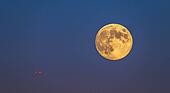
So, tonight I drove home with the strawberry moon looking through my passenger window.  It was really, really pretty.  But one thing I noticed was that the strawberry moon was not strawberry colored in the least.  In fact, the full moon in June is nearly always a golden color because when it is low on the horizon the heat from the Earth colors the view of the moon, transforming its usually white glow to a honey shade.  Those who drink ale or amber beer call it the old word for beer - mead. So, tonight my passenger on the way home from work was the honey moon, the mead moon.

This moon was a little more special tonight than most full moons, though.  Tonight is Friday the 13th.  What are the odds that a full moon would land on a Friday the 13th? Pretty high, right.  The last time that occurred was October 13th, 2000.  The next occurrence of a full moon on a Friday the 13th will be in the year 2049.  Now, that's special.  So, I'm feeling pretty loved for my good fortune of having the honey moon accompany me on my way home tonight.  But, this is really a much more special moon than what I would have ever imagined.  The last time a honey moon appeared in June on Friday the 13th was in 1919, almost 100 years ago.  The next time that will happen will be almost 100 years in the future, 2098.

I am now feeling that the celestial order has treated me royally.  The majestic splendor of the strawberry moon rode with me my entire 50 minute commute from work to home.  Wow. I haven't been treated so special in I don't know how long, and couldn't help but compare it, figuratively, to times in my life when I was treated that regally.  The strawberry moons in our lives, like the real ones, happen rarely, and the figurative honey moons of Friday the 13th even more rarely, so when they happen, we see their majestic splendor.  The most recent strawberry full moon for Friday the 13th in my life was so special that I still feel its warmth, its heat coloring my life in the amber of mead.  It was my honey moon because it was pure gold, my strawberry moon because of its taste - J ust L ike trawberries.

Oh... so delicious... so majestic.


Tuesday, June 10, 2014

The taste of fruit

I only live on a small block of a very big nation, but the idea of "being smart" is still the talk of young mothers and young teachers.


The idea of intelligence and ranking that intelligence is still alive and well. The arguments that surface most often in favor of its existence are that some kids score high on tests consistently, understand a concept the first time, need very little reinforcement to retain the concept, and retain the concept over a six-month span of time or longer.

They make some good observations that have to be addressed.  Those who believe in intelligence take the three observations above and construct measurements that correlate initial depth of understanding, speed of understanding, and length of understanding.

At the outset, a definition of terms needs to be addressed. Understanding and learning are terms that appear to be synonymous among those doing the measuring. In popular vernacular, the two terms certainly have the same meaning.  But, when working with statistical measurement, it is important to make all terms clear.  Understanding contains the idea that information has been taken in and that a person can manipulate it, use it, have experience with its applications, and have enhanced familiarity with it without forgetting the concept or the mechanics involved in massaging it.  Learning is related to taking in information and in a very short period of time after the information has been presented,  mimicking or applying the principles to a problem containing them on a test (an artificial written instrument, not experience nor manipulation in real-world use).

So, when people begin to make observations about intelligence, they tend to measure learning rather than understanding, they exclude real world application and experience with a concept in favor of presenting information in books and testing retention.  And, they restrict the learning to academic subjects.  Of course, many kinds of information can be learned besides what is contained in books in a so-called core curriculum... many, many kinds. 

Just on the basis of how restricted the sources for learning are (academic sources only) that are measured, the results should never be generalized from such a narrow database to the larger world of learning.  The learning is different outside the books and core curriculum, so the results cannot be generalized.  A non sequitur exists.  

When it comes to the observations of depth, speed, and length of time applied to learning, then one sees right away that other factors enter in.  What is depth? Is it how much that can be reflected in a test once or should it be how much can be applied in 10 different situations?  Is it a percentage of correct answers on a test or is it knowing how to act, what to say when one is in the presence of someone whose career or life's work uses the information, someone with the knowledge of something through experimentation and presentation of a variety of problems? 

What is speed? Reflecting a right answer on a test immediately following a concept? Showing knowledge after working with carefully constructed experimentation? Spending a year in the same grade level and remembering a particular fact for that length of time? Is it learning something, forgetting it, being reminded, forgetting again, finally seeing the fact appear in one's environment, forgetting, seeing the fact again being presented in the environment, not forgetting finally (like learning the tax code, jumping a car from another car's battery, knowing to check air pressure in tires in spring and fall because of the fluctuation in temperature during those seasons, applying rate of metabolism to exercise and intake of calories, etc.)?

What is length? Understanding implies experience.  How long does that take?  Learning  doesn't necessarily require experience or manipulation.  Learning can be a demonstration of facts.  Retention of facts depend on how synapses in the brain have been organized by individuals.  That organization is dependent on children's backgrounds.  So, is length related to a type of background that  produces a particular synaptic organizational pattern?  Of course, that thought is absurd since synaptic organization is as individual as fingerprints.  So, should there be different measurements for length? One for learning facts and one for learning applications?


Even if one could measure what is learned, then is it proper to tie those individual measurements to a general number, an index number?  What does a 70 IQ mean? Does it mean that someone has difficulty with understanding or learning?  Is the problem with speed, length, and depth, or is one area more affected than another?  Is the problem transferring learning to understanding?  Oh, right, transfer was not part of the measurement process... ha. And other factors enter in that are considered more minor to the intelligence measurers like background and personality traits, neither of which is considered in their IQ index.

I wish people would not be fooled.  Unless there is a defect in the development of the mind in the womb or shortly after birth, every child is smart because the chemicals of the brain are distributed to the same areas and in amounts common to all humans.  Biologically, infants learn to navigate their new environments in predictable ways.  After two years of age, personality enters into the equation of navigating the environment as does a child's health.  As time goes by, the influence of the parents begins to enter into the navigation.  And as a little more time goes by, peer influence becomes a factor.
  

Intelligence is a false notion.  It is a game concocted by those who want to structure society according to a system of role recognition so that they can belong to the role in some prestigious way, a way that touts the taste of apples above the taste of oranges or grapes.

Thursday, June 05, 2014

Once you start looking

On April 17, 2014, an Earth II was discovered in the habitable zone of the Kepler 186 star system, constellation Cygnus. It is about 10% larger than Earth and could contain life. You can read all about it in the journal Science.

On June 2, 2014, an Earth II was discovered in the habitable zone of the Kepler 10 star system, Constellation Draco.  It is a little over 2 times the size of earth and has dense composition for rocks and other solids, so life could exist. You can view the press conference made at a meeting of the American Astronomical Society to hear all about it.


There will be many more announcements in the future simply because there are a myriad more planets to be found all around our galaxy.  And when we can break free of our own spiral arm of the Milky Way, we'll find thousands more.  They're out there. Once you start looking, you tend to find what you're looking for.

Discoveries like this sure make me wonder about life out there.  I'm quite sure we'll meet ET sooner or later. It would excite me beyond words to be a part of the first contact.  I would love to hear the story he or she tells of the existence each one has in the universe. I won't make it to that point in time, nor my daughter or my granddaughter.  But in a couple or three hundred years, I'm hoping that some posterity of mine will eventually migrate to the place I'll be staying at that time and tell me what it is like to know about all those other worlds and the ETs that exist on them. I can't wait to have that conversation.

Wednesday, June 04, 2014

Holy Mackerel, Brontosaurus!


We all know that scientists have been working on artificial intelligence for 30 years now.  It's old news.  But news clips have been reporting that progress in the field has made great strides and have shown robots that greet you and carry on a simple question and answer exchange.  The military has demonstrated its own success with drones (primitive, but first-step AI) in both a battle and surveillance mode.  They run remotely and are controlled to a certain degree, but they also can think for themselves when taking camera shots or adjusting missile ranges and margins of error, or make recommendations to fine-tune any commands they think aren't entirely accurate.

Everyone knows that the day is coming when machines will think for themselves.  And we know we will get there step by step.  So when Apple held its news conference two days ago, step one for the commercial use of very early AI was seen.  My goodness, now the apps on a phone can communicate with each other. Apple called it a "kit."  They had two that they announced.  The home kit takes a voice command, "I am going to sleep for the night," and turns off the lights in the house or turns off the ones you want off and leaves on the ones you want on.  It also adjusts the thermostat, sets the coffee pot to turn on at a particular time in the morning, sets alarms, turns on night lights in halls and/or bathrooms, and activates the alarm system, shuts off or changes the setting of ceiling fans, and about anything else that is electronic in nature.  That is all coordinated by a voice command.


Oh, it will get increasingly more sophisticated from here, but this is an impressive first step. I wonder what a person would have had to know to make this kit come together.  You would have to know how devices communicate with each other.  You would have to know how to bundle them.  In old computer terms you would say you have to know how to make the information into a macro.  You would have to tie the macro to oral language.  You would have to know how to parse speech into the particular syllables that spark the catalyst for the macro to cause all the settings, adjustments, and activations to take place. In other words, you would have to know how technology works, how code works, how algorithms work, how spoken language is keyed to electronic signals, etc.

Would a student in an average school today even understand the first thing about the concept of a kit? They would be reading stories and adding, doing a little averaging, working with fractions, writing an essay or two. Ha! They would know how to work in a job for the 1980s well enough.  Can anyone see that the syntax of coding has replaced stories and essays, that sets and algorithm use have displaced averaging and fractions, that the dreaded science fair project is really the kind of logic one needs to have as a rule, not as a project so uninteresting that kids won't do it  and their parents try to help them save face?  Tell me how important the facts of Westward Expansion are or the Treaty of Versailles in a world where the boundaries of space are pushed outside of our solar system and instant communication happens between people 24/7?  The cell phone is a major tool so the apps and now the kits that control a person's environment seem a little more important than learning how a speech course, for example, painfully and slowly reviews the rudiments of face-to-face interaction for occasions that might not even exist in about another quarter-century.

If Apple's announcement didn't get the attention of those in charge of children's learning, then truly they are dinosaurs seeing the meteor streaking across the atmosphere within seconds of wiping them out never to return as one of Earth's life forms again.  I trust there are those out there who understand adaptation and make some bold moves.  The world is not in books.  It's in real time.  We'll get more of the past if we continue to prepare people by studying it and filling the ranks with those who know it.  3D copiers, 3D imaging, holographic transmission and viewing are already in use. Tablets (the electronic kind) for two-year-olds contain cameras for pictures and software to photoshop them.  That's the new child's play.

Holy Mackerel!!! The Earth has gone around the sun 900 times already since the Medieval Ages, 238 times since the Yankees and Red Coats fought, 70 times since World War II, and even 34 times since the advent of the personal computer in commercial markets.

Again Brontosaurus.  Just saying...

Monday, June 02, 2014

20 year difference


When my children were in grade school and younger, we used to buy party invitations for their birthday parties, write out the details of the party, and invite the friends they wanted to come. There would always be that R.S.V.P. number on the card for people to reply if they were coming or not. So phone conversations would ensue, at least 10 of them.

That was then. This is now.

I click on the Facebook icon on my computer's favorites bar to bring up my newsfeed.  I scroll down and see that there is a picture of a birthday invitation saying that I and only 24 other people have been invited to click on the card. So I do. I am taken to a screen that gives a few details of the party for this person's twin 6-year-olds and a way to reply to the invitation, meaning I acknowledge that I am coming.

If social life has changed this radically in just 20 years, I'm thinking that other things have too. For sure it applies to how information is learned.  Dinosaurs on the cusp of the KT boundary of reading and writing from books need to take note - just saying yet one more time.

Saturday, May 31, 2014

Following the lead

I am really taken with Elon Musk, owner of many companies, but Space X among them.  He has a space vehicle that can  enter and return from space with soft landings. His spaceships are light weight and mostly electric as are his all-electric cars, called the Tesla series.  In fact, he uses much of the same technology from his Tesla cars with Space X. He is cutting edge because he is a visionary that puts his predictions for the future into actions for today.

Musk leads people into a new age.  He stands side by side with others who have done the same like Galileo, Isaac Newton, Albert Einstein, Bill Gates, Tim Berners-Lee, Mark Zuckerberg, and Steve Jobs.  I don't have illusionary dreams that any work I do rates anywhere close to the great minds that lead others to a new age, but I want the small amount of work that I accomplish to be on the same track as these great thinkers.  I want people to know that they have been somewhere they would not have otherwise gone when they engage me or hire me.  I want to take people off the beaten path, not just for the  adventure, but for the improvement of their lives and their thoughts.

My hat is off to the greats who have gone before, who inspire the rest of us to provide those in our spheres an enlightened experience.

Wednesday, May 28, 2014

Leaving the arbitrary


Some things are so arbitrary. Days of the week are an example. Division of time into hours, minutes and seconds is another.  I guess those who lived in ancient times just needed something to do after dark since they had no electricity. The names of everything are also arbitrary. Try learning a couple or three languages to prove that point. The work day is arbitrary.  I would like to know who in the world began the 8-5 work day.  I do so much better starting work at 10 or working a few hours in the evening.  My mind is clearest between 11 at night and 1 in the morning.  Eating 3 squares a day is sometimes too much and sometimes not enough. But, most events work around the noon meal and the evening meal.  Dressing with a tie or not, putting on heels or not, follow rules that are so arbitrary.

Unfortunately, society is built around making normally arbitrary matters a matter of rule.  So, people's jobs revolve around the noon meal and their evening events around the evening meal.  People dress up or dress down according to the rules of etiquette governing what is appropriate at work and play.  Most events have a starting and ending point; they are not come and go affairs.  Figuring time by days, years, decades, and centuries helps categorize without a doubt. But, what if something is not in a person's memory (or cell phone these days)? Does that person need to categorize anything?

Working with those who have ventured into the virtual world already, I have found that there is really no need to keep the arbitrary reckoning for things.  Who cares when the work is done as long as it is ready when it is needed?  Who cares when a person learns particular target information as long as it is learned in a manner timely enough to be used for a person's needs?  Who cares when the next meal is as long as a person eats when hunger urges one to eat?  Who cares when sleep happens as long as a person is rested at the times (s)he needs to have energy?

The mind is truly more creative when allowed to follow what is needed when it is needed rather than assigning or being assigned busy work to fill time and to meet deadlines.  That freedom, not to live according to the arbitrary-turned-mandatory, allows me to do what is necessary, and I feel so much more fulfilled, more energetic, more optimistic. I fully support the movement of the world to what is less arbitrary-turned-mandatory.  It actually leads people to the more deliberate things in life.

Sunday, May 25, 2014

Replenish me

It's so beautiful, peaceful, and lovely. It splashes lightly into puddles and it drives down hard on the ground, windowshields and anything else that is covering the ground when it falls. It comes in torrents or merely mists ever so wispy-like hanging in the air, brushing your face and skin.  Sometimes it lasts for a whole day or two.  At other times it rushes  through a territory in a matter of minutes.  But it always brings refreshment and hope of new life.

In the very beginning it brought original life to the Earth.  It contains the ingredients needed to build life anywhere in any galaxy on any planet.  It's magical that way.  The variety of forms produced radiate with color of all kinds in every imaginable pattern and design. It's pleasant and enjoyable like that.

That's why I love rain.  It's a miracle-worker for my way of thinking.  It gives me hope and allows me to have momentary freedom from the rules that bind me to the world I live in.  Tomorrow and the next day are supposed to have rain of all kinds, torrents, mist, soft, and hard-driving.  I can't wait.  It will adjust my attitude and allow me to break free from my normal way of viewing things.  It will produce a world of new colors and refreshing life in my mind.  Bring on the rain!  Two days of heaven.  I'll be a better person when the sun reappears.

Friday, May 23, 2014

Ruminating on a dream


Dreams, to me, represent fragments of information that are jumbled in the mind, information containing unresolved issues from different sources. The mind jumbles them into scenarios for me to mull. Dreaming is a way for the mind to nudge a person to resolve what has gone untended.

So, I contemplate my dreams when I remember them. Thinking through the dream helps me resolve the issue in my conscious life.  A couple of days ago, I had a dream that happened in a house which I had seen in previous dreams. The house was in a different place this time, a different street and town, but it was the same house.  The layout of the rooms was familiar, the way I explored the house's three stories was the same, but the 4 people in the dream were different from times past.

The dream ended with me being drugged so that I was sluggish and couldn't find the person and things I needed to find. Truly I have wanted to act on a desire I have had for a while now, but have found myself "drugged" from acting on it. Of the 4 people that were in the dream, only one was a person I knew, and he was someone I don't really care for. He is a very judgmental person, distant, and always rude in one form or another. Near the end of the dream two people spirited me away from the house. I think it shows that life as I desire it isn't happening.

I suppose the house represents my current world. Every time it appears in a dream I am exploring it, running all over it.  This time, though, the back yard began filling up with water. When I went to the neighbor's house for help, I saw that his yard was underwater too. That was when I was spirited away in a car. I very soon afterward showed up again drugged. As I was leaving the car, I woke up.  (I felt very groggy when I got up, I might add.)

I plan to make "exploring this house in a different place" a much more pleasant experience. Nothing will be underwater when I am through. I will have my wits fully functional. And my greatest desire will be closer to being accomplished rather than lost and distant.


Saturday, May 17, 2014

Don't tout the notional

The Language of Love was a very popular book in some circles when it was published in 1988.  It was a book about how to use word pictures to express one's affection. I heard a number of people talking about it at the time, but I didn't read it. Yesterday, a conversation I heard on how to talk to a spouse triggered a memory in me of this book's title and the gist of the book according to people who had read it.

I looked up the book on Amazon.com and was able to read excerpts from the book.  I found that a revision of the book had been published in 1991 and that in their revised edition, the authors apologized for quoting research and misapplying it in their book about the functions of the right and left hemispheres of the brain. The authors said that they were shown more current research indicating that their applications of the functions of the right and left hemispheres to expressions of love between men and women were without substance.

I admire the intellectual honesty of people who change when others show them when misapplication has occurred.  I wish they had known about some other research that had been conducted so they could have corrected another notion they had as well.  In their authors' note, they claimed that their observations from hundreds of talk therapy sessions (not their research or review of the literature on the subject, only their observations) showed "God-given differences" in the way men and women communicate. Men use a "language of the head," while women lean on a "language of the heart." They went on to say that men speak of facts and when they run out of facts to speak, then they are out of words - they stop talking.

It's time for a GM recall here.  Literature on men and women's language (even in 1991) doesn't show a picture like the one the authors presented here at all, not at all.  I would like to see the notes they made on their observations in order to conclude that men run out of words when the facts they know have been exhausted.  And the language of the head and heart categories are a gross oversimplification of both the styles of their speech and the substance of it.  What? Do women not have a language of the head?  And do men not have a language of the heart?  Absurd.  Of course, they do.  And finally, what the authors attribute to God-given differences seem to be more related to the socialization process dictated by culture.

In 1998 the authors put out study books for their main book so that couples in small groups could learn how to communicate well.  That was 16 years ago, but the thinking they presented in their book continues to make the rounds misinforming people of men's and women's communication process.  I hope that people will have either heard about more recent research or have the good sense to know that observations and empirical study are two very different animals.  For whatever reason I didn't read the book in 1988 or 1991, I am thankful that it steered me clear of some erroneous reasoning and saved me from more "unlearning," which I had to do during the whole decade of life from 1995-2005.  

I am much more careful in my learning these days. These days empirical evidence is the beginning of learning.  I don't have time for notions and observations.

Wednesday, May 14, 2014

Pretty sure

Last week on the local weather forecast, the weather man reminded everyone that we are more than 8 inches behind the average for the year. It seems that we are in the middle of a bad drought that is getting worse with time. Three summers ago it was really bad too, the second worst in the 120 year record of tracking rainfall.  This year is the third worst in that historical record so far.  The difference is that it is not particularly hot this spring, and three years ago nearly all records were broken with the scorching heat.


Some years are just like this one in our lives.  We mentally track our lives making comparisons from one year to the next, one decade to the next, one quarter century to the next.  Pictures help us remember too.  Some years are good ones like others have been, some bad like others have been.  Events happen to us that spiral us downward for a while, others propel us to great heights to enjoy the scenery for a while.  Like the weather, there are seasons to life.  I could tell you about the most scorching year in my life and the one that had the most rain when lakes and pools of water were full.  I have tracked them.

This year is the third worst drought in 120 years.  That's about right for what I remember of my life as well.  But, I do know this: rain will fall even if it is not soon.


Next year, the record will reflect a different set of events.  And sometime in the future, the third worst flood on record will happen.  So, I contentedly wait.  I would like that flood sooner rather than later, but it will come.  I am sure of it.

Sunday, May 04, 2014

Clear air


I am always humbled when I spend time with my linguist friend from the Graduate Institute of Linguistics in Duncanville. His presence always lets me know how good life is for me. He recently came back from a stint in Nigeria. His stories make me glad I'm alive and not being threatened and my worst days are good by comparison to life in a third world country. He is home permanently now because of medical conditions he developed while in Nigeria.  That's the second linguist friend that has been docked stateside because of illness from a third world country. The other happened about 13 years ago, and he had been in Ethiopia.

Most of all, visiting with them reminds me how they have used their talents in the field and not wasted their training. Both are now still employing their talents, but in teaching others who are headed to the field. That is admirable on both counts. A conversation with either of them shows me how sharp their minds are, how developed their talents are, and what standard I must maintain in order to keep having conversations with them.  And how I love holding conversations with them.

My most recent conversation, last Wednesday, brought a great discussion about an ancient language.  I was reminded of how that language functioned so differently from English. We bantered about translation of that ancient tongue on a few points, and I applauded his most recent conference presentation presenting his discourse analysis of a reading from this language.  I came away from the meeting feeling good about contributing something, and feeling better from having been contributed to.

I felt that way a couple of weeks ago as well when another friend came to visit. We spent the day together just talking. We ended on a great note by attending a professional baseball game.  Our discussions were not linguistic in nature, instead they were conversations that fed my soul because we fully understand what the other is about.  He also inspires me to be better because we talk about matters of the mind and soul.  Our thinking is often the same even though we arrive at  the same conclusions in very different ways and apply them differently in our outward lives. But we get each other.

I love being around compatibility.  It's the same as breathing fresh air.  Very often the air around me gets stale. Being around compatible friends help clear the air.


Friday, May 02, 2014

Gatekeeping

During the last 50 years, those who prepared educational reports drew the conclusion that skill in reading divided those who did well in society and those who didn't. This was no surprise; society expected that it had been true all along.  However, in the last 10 years, those who prepare educational reports have changed their minds.  Algebra is the gatekeeper course for those who do well in college (who are the ones who do well in society according to them).  That seems to be a little counterintuitive to the public.  Most people don't do well in math and plenty of successful people say they don't have math skills, at least not algebra skills. Surely there is some mistake.

Sometimes those writing reports say the discipline of learning algebra is the indicator for doing well later rather than the algebra itself.  But, I would like to point out that many contributing factors create discipline in our lives, not just algebra.  And when reading was king of the gatekeeping courses preparing us to do well in college, it was said that the discipline of reading was the indicator, not the reading itself.

The world today and the world of yesteryear are very different.  So, for that reason I am glad to hear the change in rhetoric from reading to algebra.  Today it is much more incumbent on someone to know math than reading.  But, the underlying assumption that doing well in school and doing well in society has really eroded in reality.  The perception of those making educational reports still say there is a link between school success and business success.

If I look at the larger circle of my family and friends, I see the inverse is rather true. Less education equals more money.  Reading is not part of the equation because all friends and family can read what is necessary to perform well on their jobs whether or not they have read a novel since high school. Algebra appears to have little to do with business success too. The discipline in people's lives who have the most money seems to be driven by desires other than the one to learn the mechanics of solving for x. Success has come in a variety of ways, not the ability to perform well in school as a teenager in a gatekeeper course.  One middle school dropout I know has more money saved from doing consulting than almost all of the people with college degrees I know.  The driving force behind his discipline to do well was that he was always trying to show that his word was his bond and he would guarantee any work he did.  Now he only consults on the big money jobs of his choice.

Developing skills of any sort takes discipline.  Becoming the best poker player in the world could be a gatekeeper skill because of the discipline involved in manipulating card decks in one's mind.  Learning three or more languages contains enough discipline to be a gatekeeper skill because of the different grammatical and lexical manipulations required.  Neither is a school-oriented learned ability.  I wish those who write educational reports would understand their circular reasoning.  Desire for heightening any skill leads to discipline and expertise.  If Steve Jobs taught the world anything, it was this principle.

Creativity is an attribute of humans just because they are members of the human race.  It is not an attribute learned at school necessarily.  Creativity is derived from a whole spectrum of human activities, not merely from a regimen of core subjects studied.


Tuesday, April 29, 2014

Perpetuation has changed forms


Of course language is for communication.  In the first days of language, it was for face-to-face communication.  Then, people saw that simply making marks for money transacted was a good way of keeping people from changing what they agreed to.  Later, marks for representing geographical landmark words and words for boundaries and measurements were devised.  Before long, a system emerged that represented what people wanted to perpetuate.  Kings, for example, wanted to tout their spoils in war, and those who knew how to write wanted to keep a list of kings and sometimes their accomplishments for posterity.

Not too far down the line from property records and annals of kings came the keepers of stories.  People wanted to record their myths (used in a literary sense), so they wrote them down.  But, more and more tasks were put into writing as cultures flourished for long periods of time.  However, at the root of every written system was the face-to-face communication.

Now, however, face-to-face communication is beginning to disappear.  Virtual communication has begun replacing face-to-face.  With virtual communication, the need for writing stories or observable information for posterity or for back-up of a real conversation is dying.  People can record their virtual communication in several different forms.  Thus, the need for making marks on a page is dying.  The other forms are more efficient, faster, and are more exact.

Making the marks and making sense of those marks (writing and reading) have lasted a very long time - about 5000 years, but since their need has become unnecessary, their perpetuation has also become unnecessary.  It's really that simple.  Adios, farewell, goodbye to an old friend who has served us well.  It was a good run.  But, it's time to move on.

Sunday, April 27, 2014

I feel summer comin' on


Good and slow,
Pure and sweet,
Something past
From days gone by.

Definitely American Honey!

Wednesday, April 23, 2014

The next future

I've been hearing about electric cars for years.  I have read of the experiments.  I have seen the tests of fully electric and hybrids.  I have been waiting... until now.  Now let the hoopla begin.  The fully electric car is practical, safe, and synced with your cell phone for convenient functionality.  Charge stations exist nearly everywhere.

Tesla S

I knew the time would arrive if I would just have the patience.  And do I like it because it is a new toy, a new gadget to play with?  Hardly!  It is the next stage in transportation because it is a gateway vehicle to another way to travel.  The kinks will be worked out on existing roadways.  But the fully electric idea makes the car run digitally - from a computer, from a cell phone, from the car itself.  A self-sufficient car controllable from remote means.

Nissan Leaf

This is the stuff of science fiction.  Well, not this car exactly.  But about the fourth generation from now, it will prompt advances in roadway construction, such as the totally drivable road without having people steer the car.  The road will have electronic signals built into blocks the road is built with and will communicate with the car's electronic signals.  It's really not science fiction because this type of road has already begun its experimental stage. And, it opens the way for engines in vehicles without wheels.  Usually people are thinking about backpack travel when they think of wheeless vehicle travel. But Tesla has already experimented with above ground movement using electro-magnetic propulsion.

Nissan Leaf

A car driven and controlled electronically and digitally is only one way the world is entering a very visual stage in its history.  And, of course, everything digital can have an associated file for transmission to a cloud storage source.  Call it Big Brother if you like, but it is a significant advancement in transportation for what it allows to happen next.  I'm almost due for my next car purchase.  It will almost certainly be an electric car.

Monday, April 21, 2014

Unbelievable but typical


Someone showed me a reading list for their daughter's sophomore year from a home school association. The person said the teacher was a "classical education" teacher and wanted her students to be able to pick up any piece of literature and be able to read it  in her students' futures.  The teacher said it was the best approach for college preparation.
,
I had to show my disbelief that such a teacher still existed, but after recovering from that, I had to comment on about the 18 novels on the list.  Oh, yes - 18... in a year.  Complete with a major written composition (literary criticism) after each novel.  Well, here's the deal.  A classical education prepares a student for a classical world, which the year 2014 doesn't belong to nor did any year after the invention of the computer and its connection to the internet.

College preparedness these days doesn't necessarily include knowing how to critique a fictional story, ancient or contemporary or anywhere in between.  The University of Phoenix' online college, which probably represents most of the online world of private universities, explicitly states that their curriculum is built around asking businesses what they want out of a graduate.  Being able to pick up any piece of literature and read it was not a priority on that list.  In fact, writing a literary criticism expertly wasn't either.  Presenting graphs and charts and meaningful talking points in a meeting, however, was.

I exaggerated a little to say that I was in disbelief that such a teacher still existed.  I hear about them too often.  I rather think that teacher is a typical English teacher.  I also think the University of Phoenix is on the right track for preparing students for the future.  The reality is about to be that reading and writing are going to bite the dust. If a graduate picks any field in science, the field will be about the iconic use of the alphabet, not reading.  If technology is chosen, it will be all about working on monitors or in 3D as the medical field exemplifies with MRI and laparoscopic (robotic) surgeries. Choosing engineering will be all about numbers, charts and graphs, of course.  And, math? Well, there are letters, but not for reading - for showing variation.  And the letters are not always from the English alphabet.

Wow. 18 novels... 18 compositions. Not even the discipline of doing that will prepare you for anything I know of in the year 2016 (the year of graduation for the student I saw the list for).

Friday, April 18, 2014

It's time


Earth 2.0

It was only a matter of time.  But, the time has come.  Knowledge is always first.  Pursuit will be soon to follow.  These are exciting times.  The link below contains the explanation.

http://www.space.com/25531-new-earth-size-planet-could-have-water-video.html

Now it is much more believable that reading and writing are relics from a world not dependent on telescopes, infrared detection, computer simulations, 3D graphic representations, and other ways to present information.  But our world is dependent on all these things and will increasingly store, transmit, and present in only visual modes with the aid of identifying symbols and tags.

Time is quickly disappearing for reading and writing to serve a useful function... only a short 2 1/2 more years now until the two will decisively be relegated to the rear view mirror.