Search This Blog

Tuesday, April 23, 2013

Fingerprinting learning

Above all, the brain is efficient.  So, for learning to take place  it has to have a reason for taking up space and time.  Otherwise, why would learning take place?  So, early on in life, a person learns that experience is the best teacher.  All of us continue with this idea throughout our lives because "life" in this case refers the dichotomy of learning - what gives us pain is to be avoided, what gives us pleasure is to be rewarded.  The brain will create elaborate schemes if necessary to avoid or reward.

Learning is related to these two ideas in one form or another.  Something has to have + or - value for memory to form, so the first line of memory is to find something utilitarian that helps us in advancing ourselves or taking caring of our needs.  Language is learned for this reason.  It is utilitarian.  After a while language is manipulated, so it becomes ever increasingly more sophisticated in use, but at the outset and for most purposes it remains utilitarian.  Can schools really capture this idea?  Most learning at a school is hypothetical.  Some children can find a use or pretend a use for the hypothetical, thus making the learning utilitarian, but most cannot in the early years.

Humans also are unique in many ways.  One of those ways is in personality.  Some likenesses in personality span the human experience, but not many.  So, if learning is also to help design our uniqueness, it is laughable that education would even attempt to standardize learning.  Humans are the guardians of what they develop, and they develop it according to what motivates them, both from experiences that are utilitarian to them (because what is utilitarian is not usually universal across people) and that are motivating to them.  Commonly, this is referred to as extrinsic and intrinsic motivation.  And because humans continue their journey in seeking to be unique, they develop interests that vary in degree.  The stronger the interest the more + value it has.  The weaker the interest, the more - value it has.

So, a place of learning should enhance what comes naturally to a person.  The real problem is that people have different things come naturally to them.  What has + value to someone, has - value to someone else.  What has a great degree of + value to someone, has a + value to someone else in a greater or lesser degree. And, even if there could be a set of shared and common facts to be learned in grade 1, it would erode and disappear the older students became.  The idea of having electives after grade 5 tries rather poorly to deal with this truth.

Individualized instruction becomes impossible, then, when students are grouped in 20s or 30s or when given some broad choices.  When students ask why they should learn something, they are manifesting a primary function of their brains.  When the answer is because you will need this later in life, it is likely that the learning that sparked the question will be sorted into the discard pile.  Its utilitarian function for any value is not apparent.

I suppose one could say, "If all of this is true, then how is it that the US has such distinguished astronomers who can see planets beyond our own solar system or such wonderful surgeons who can restore health to ailing people, or such (name the group) who can (name the specialty)?"  How many astronomers can find these planets?  Oh, 30 (maybe).  Out of 315 million people.  That sounds rather individualized to me.  Even if the answer is 500, what is that percentage out of 315 million?  Even if one speaks of engineers or architects as a large group, how many can really design an 80-story building, or a building in a bay, or a bridge to carry the weight of all types of traffic for 100 years, or a vehicle designed to be electric and respond to an app from a smart phone, or...

But OK.  Test away on a common curriculum.  I'm pretty sure I know where that path leads.

Sunday, April 21, 2013

The default is forgetting


If I visited a classroom today, no matter what level in the educational bulge (1-12) I visited, I would hear and see that reinforcement is a well-liked idea.   It would appear that good pedagogy includes introducing an idea and repeating it until all of the 20-30  students have at least heard it a minimum of 10 times, whether or not the concept is grasped.  Teachers wait for the golden mean to happen, that is, they wait until the middle number of students, 10-15, have demonstrated that by the 10th repetition of the concept they can perform the task.  A really good teacher will have all or nearly all students demonstrating understanding by the 10th time.

I cannot quit laughing at this notion.  Principle number 2 is all about the way that a synapse is formed.  Gary Lynch in California worked for nearly his whole 30 year career in the last two decades of the 20th century and the first decade of the 21st century trying to actually see a memory being formed.  He finally did.  And, then, he saw it replicated but not as many times as he expected.  After all his trials of getting the cells to  remember something he realized that the brain is programmed to take in what is necessary for reaction and survival, but to remember only what is worth remembering.  It doesn't really remember electrical impulses carrying information until the information is notable.

So, when I visit a classroom and see students with a vacant stare after a concept has been introduced, I know that the information being transmitted is not really notable; it doesn't have worth.  Even after the 10th time, if an idea has no worth to someone, it will not form a synapse with other related information.  What is more, Lynch found that impulses lit up (showing the remembrance) for different lengths of time, mostly measured in milliseconds.  The shortest impulses didn't last long enough to form connections to other dendrites.  So, even if a student showed understanding for one sitting, it is common only to show it temporarily, not for long term understanding.  Those memories are for information that has worth.

The real job of a teacher seems like it should be to show worth for the information dispensed.  Otherwise, it would appear that ease of forming ideas is rather a lost cause.  Reinforcement (repetition) doesn't have a place in memory formation.  Perhaps it does in memory storage, but the last word is not in on that yet.

I do see a problem for the schools knowing how memory is formed.  What is notable is many times linked to what is in a person's background, what is of value or interest, or what contains motivation for a particular individual.  I'm not sure a teacher has that varied a bag of tricks.  Even if a teacher does, I am certain a teacher doesn't have the time for making information notable to such a varied number of students (making one piece of information notable for someone, times 20 or times 30, times the number of concepts to teach in a day's time).

There's a reason one size does not fit all.

Tuesday, April 16, 2013

I'm seeing iridium

Here's the great irony.  Teachers in the classroom today think they are teaching things that are relevant.

Hmmm.  Let's review.  My 15-month-old granddaughter knows how to look at pictures on the phone by swiping from left to right and vice-versa to change from one picture to the next.  She knows how to enlarge and shrink the screen.  My daughter and her friend even tonight were joking about having to learn cursive handwriting when no one ever writes that way anymore.  Online banking has removed the need to keep a check register.  Receiving change from cashiers is always preceded by the "register" telling you how much change is needed.  Every smart phone made in the last two years has the capability for people to search by voice command and texting can be done by speaking rather than typing.  Text messages and Facebook messages are typically about 20 words long.  Twitter only has room for 140 characters per tweet.  No matter how long an article is on the internet, most people read only the first two paragraphs.  Information garnered from articles with headings is most of the time limited to the heading and two sentences.  Fewer and fewer people handle money.  People swipe their cards instead.  Skype and Facetime are as easy to use as regular voice mode when carrying on conversations.  Taking pictures of things to remind ourselves of what information it might have carried is the most common way for reminding ourselves of something.

It's a great irony that teachers think their classroom teaching approximates anything relevant to survival in today's world.  I'm seeing the iridium already building up in the boundary between the Cretaceous and Paleogene (formerly the Tertiary) layers of the Earth.  Just by way of reminder - no dinosaur remains have been found above the K-Pg (KT) boundary.  The brain really does develop through what it takes to survive in the present and in the future.

I'm thinking that some changes are in order.

Monday, April 15, 2013

Much ado


The brain will assess its environment.  If it is hostile, it will determine whether to stay and ward off the danger, thereby learning something, or retreat to fight another day.  In education, the environment is called socialization.  But, that is a cover term for allowing a lot of sorting to happen in order to find a pecking order.  That kind of sorting teaches a student that a day of reckoning will happen sometime during the school year when her or his order will be decided.  Much of the time a person will not like the sorting process or the order that is decided for them.  The environment then begins to grow shields and spears and limits learning severely.

Also, the brain will assess the learning environment for its value in determining future success.  It will override the impulses for flight or fight if it thinks the long-term result is worth the fight or the retreat.  But too many times, there is no information worthy of subject matter matching future needs for survival, thus no relevance.  Then, the environment is deemed hostile since it is of no use.

Bill Daggett has been harping on the importance of relevance in the curriculum for years.  People have ignored him.  But, the evidence is written on every senior's transcript because the ability to communicate in numbers is very, very low and the ability to communicate substance meaningfully with words using any format has diminished.  Following Daggett's ideas for relevance would certainly help.   A student will certainly learn more if two things exist.  1) ensuring that the learning is clearly linked to future success, and 2) ensuring that the environment does not make one feel that fighting or fleeing is necessary.  Otherwise, 12 years of education is much ado about nothing.

Saturday, April 13, 2013

Refinement time

So what would education be like if teachers paid attention to the principles found in the brain studies and cognitive research?

First, the brain has developed as a tool for survival.  That comes with a flight or fight feature.  When a child finds that she or he no longer can survive in a school environment, flight takes place, if not in body, then in mind.  People who describe "mentally checking out of school" say they wish they had been able to overcome their fears, but they couldn't and it has limited them, following them into adulthood.  But, beyond the safety of the environment, a person retains information that pertains to his or her perceived survival for the future.  If the information isn't pertinent, then why bother with it?  The principles that follow decide the data's fate.

Second, the brain follows a particular method for forming synapses, connections linking things that are remembered.  And, things that are remembered must have something memorable to spark a particular kind of impulse to flow to a cluster of dendrite terminations for the possibility of joining a synapse in the first place.  That memorable spark has to be remarkable because the brain's default is set to forget what is seen, heard, touched, smelled, tasted, and felt unless it is memorable.

Third, the brain is very efficient, so it only allows for knowledge that advances the individual's cause.  Information that is utilitarian is the primary reason for learning anything.  After that, information tagged with motivation (both intrinsic and extrinsic) gets captured for a synapse to form.  After that, information that is compatible with one's personality, what some call information of interest, is used to personalize, and tailor one's experience.  And, finally, information that comes from someone else of value, that originates from an established rapport with someone significant, will present itself as important enough to connect with other information garnered.  So, general information is packaged by the brain and made unique or it won't be remembered for a synapse to be formed.

Fourth, the brain follows a certain logical pattern - one that follows a protocol for growth in two areas.   The areas, one for communication in words, one for communication in numbers are designed to develop simultaneously and equally.  Lack of stimulus for either logic stunts its growth.  And, lack of stimulus translates to lack of efficiency, which throws its development back into the arena of principle three above.

Fifth, the brain functions best in a dynamic environment, not a static environment.  Although routines are established for involuntary systems of the body, routines for learning have not been observed as necessary for forming synapses.  In fact, connections made from various sources of information are stronger connections and more numerous than connections made within a single environment, such as attendance in one room with the same people for years at a time.

Other principles exist, but these five are enough for a person to see that what is touted as education today doesn't follow how the brain forms multiple and strengthened synapses in an efficient, logical, and personalized manner.  It's high time for schools to reconsider what forms the basis of information retention.  Someone will do it.  Probably someone in the business community.  He will make money, and the method will be efficient... like the brain.  We will ultimately see how much time is wasted today on things that don't have much to do with efficiently transmitting information for future survival.

Sunday, April 07, 2013

Hard to watch

Stephen J. Gould's book, The Mismeasure of Man, accurately reviewed the outrageous testing and false hope that the U.S. put in psychological testing.  Aldous Huxley's Brave New World portrayed the natural societal results of such outrageous notions as people being born with a certain amount of IQ and the jobs that that IQ was suited for.

To some degree American society listened to Gould, but for the most part, the populace and educational community, including those trained to teach America's children, have continued to perpetuate those early 1900s outrageous, unsubstantiated notions of the psychological community regarding IQ.  Copious studies of the brain exist from both medical and cognitive scientists that discount entirely the early notions of IQ.  It is clear that humans' brains are equal and that learning takes place across the world's populations regardless of the formality of the training.

I am so very sorry that the educational community continues to accept the notions of psychology from the early 1900s and ignore research from more specialized and better suited fields bearing on how people learn. It is hard to believe that 150-year-old ideas and techniques still inform modern teachers, curriculum directors, and educational businesses.  The 12-year, lockstep, uniform, curriculum with its accompanying tests to "ensure that everyone learns only the same set of ideas" leads to mediocrity at best.  It serves no one's best interest.

The world has changed and in the next 10 years will undergo such radical changes in information delivery that  to continue the current system of education will be certain doom for all those who perpetuate it.  Fortunately, people like Ian Dukes have spoken loudly enough for anyone with ears to hear.  Others like him are paying attention to the current, specialized research in brain studies and are laying out paths for people to follow so that learning in the US doesn't become antiquated and contribute to the country's demise.

I leave it to the business community to lead the way out of the mire that the public schools seem to be unable to find their way out of.  My hat is off to business leaders like those at Exxon and those who are associated with Bill Gates who can see some handwriting on the wall and react accordingly and timely.  I am counting on them.

Saturday, April 06, 2013

Transparent printing


Traces is the word I usually use when speaking of things that linger from the past and show themselves in the present.  I think that is because traces is a word used in the linguistic literature to show underlying grammatical structures that have disappeared but that still have prints on the surface structure of a modern usage.  But the word traces lacks the idea that the prints left from past use are still extant because they are so very important to the people still speaking the language.  The prints have merely survived for one reason or another through accidental fortune.

When it comes to experiences that have indelibly imprinted my current way of thinking and acting, I believe that a different word is better.  Latin had two words that have come to us.  The way the roots came into English were the same,  via French, and were only separated by a couple of hundred years for their entrance into the language.  The second word meant the same as the first, but had an aspect the first one didn't have.  The first word shows up in a number of  examples like tract, retract, detract, contract, subtract, and a few others.  The past participle form of trahere is tractus  which meant to drag.  That implies that someone can see evidence of the item being dragged.  Tractus morphed into a verb in French during the Middle Ages when French customs and language were fashionable in London.  That French word  became the word trace.  But, another Latin word was making its way into English, also via the French influence on English, at almost the same time, vestigium,  footprint.  That word showed up a little later in English as vestige.

So, now two words exist to choose from that are very close in meaning.  As I consider my current way of acting and believing, I want to choose the more recent word.  It is not merely a fortunate accident that I have become what I am, it is because someone's live and active footprint stepped into my life.  Someone walked with me and became a part of the fabric of my soul, my psyche.  The memory foam of my mind recorded the exact print and it lives in a place within even today.  The vestige of that print is extant... deliberate... and very important still... for anyone to see.

Friday, April 05, 2013

Enjoying a few moments of water

A fish out of water tonight.

I was sitting at a table in the banquet hall at a charity attended by many who had deep pockets in the suits they wore, came in their Benzes, and gave generously to the cause.  The program was nice, the food was excellent.

During the speaker's allotment of time my mind wandered, however, to a place I would have rather been... far, far away, where there was relaxation, ease, laughter, and love.  For a few moments, I enjoyed the water. I stayed there as long as I could, but the speaker finished, the charity ended, and reality reset itself.

Sunday, March 31, 2013

Smorgasbord

I'm thinking tonight of restaurants that have dotted my memory.  When I was a boy, from ages 5-10, I lived in a small town in the center of Wyoming.  I remember going every Sunday to the Teton Lodge, a restaurant inside the hotel in the center of town.  Normally, I would order the open-faced roast beef sandwich with mashed potatoes.  I can taste it even now.  The roast was so tender.

The restaurant I remember most from my junior high years is a cafeteria in Arlington, Texas, the Colonial Cafeteria.  Every Friday, because my parents were too tired to cook, we went out to eat.  Most of the time there I would eat the ground sirloin steak patty.  I would get it with its natural broth poured over it.  For dessert I would always get the Eagle Brand lemon pie.  So delicious.

By far, the restaurant I went to most in high school was Kip's Big Boy Restaurant.  It was a hamburger place that had the equivalent of a Big Mac before Bid Macs were a part of MacDonald's menu.  The guys from the basketball team frequented the place.  We would go there after the games on Friday nights and sometimes on Tuesdays.  It was the Thousand Island dressing they used in the place of mayonnaise that lingered on my taste buds.

In my 20s I would visit a place called Daniels on a regular basis.  It was only a few blocks from where I lived.  Their chicken fried steaks were to die for.   Lots of crust, lots of gravy, mashed potatoes with cream gravy also, a roll and corn.  It was always finger-smackin' good.

From then on, money flowed a little more freely, so I was fortunate enough to eat at many places.  There are some standouts, however.  There's really not a better flavor for steaks than the steaks served at Outback.  The seafood at Red Lobster is hard to beat even if you visit a coastal city and eat at a local restaurant. I have tried to eat at some really fancy restaurants like Aquarium and some celebrity owned ones like Planet Hollywood.  I have eaten at some chain restaurants on foreign soil like Hard Rock Cafe, Cancun, and a whole host of local color restaurants in states strung out from Washington to Maine.

Besides the fact that I love a well cooked meal, I think they represent something for me.  They help me place my important memories in space and time.  Those memories, too, are flavorful.  The people in them added meaning to my life and made me who I am today.  Along those lines, then, the "flavor" of three restaurants best all others - The Rainforest, La Hacienda, and Little Italy.  Sacred ground, those restaurants, till the day I die.

Saturday, March 30, 2013

Enjoying my milkshakes

Once in a while I swing by Baskin Robbins to get a milkshake.  I go to Baskin's because of a particular ice cream that I want used in the shake - Jamoca.  I don't drink coffee anymore, but I do like that flavor still in my shakes.

As I look back on my life and realize that some things have not made it forward to the present, I also see that some things served as a foundation for some of the little pleasures and left a trace that they had been there once. So many past likes in my life have disappeared with no trace.

Today I stopped by a Baskin Robbins and bought a Jamoca milkshake.  The flavor of coffee made my day as did the traces in my memory of some past, sweet days that have indelibly stamped my present stage in life.

Tuesday, March 26, 2013

Sweet translation


There's always more than one way to say something. Translation work shows this principle best and interjections or expletives highlight the difference. Spanish speakers use ojala when they are excited that something is about to happen. They anticipate the event, counting on the event to happen and meet all their expectations.

Usually, ojala is translated as "hopefully." But that doesn't really capture the excitement and anticipation of the Spanish phrase. Hopefully is much too casual. It has too much que sera sera in it to be a decent translation. "I hope so" is the sister translation if one wants to expand beyond the single word to a word phrase. But even that leaves out the expectant factor of ojala. Perhaps "I can't wait" is an equivalent phrase for ojala, but it's a phrase rather than a one word equivalent. I think when people are anticipating something good for themselves, they smile and say "Sweet!" with great emphasis. Sometimes people will become really animated when they think something great is coming their way. They'll exclaim, "Yes!"

So, "sweet," "yes," and "can't wait" are sometimes the best translation choices for ojala. I've never heard it translated those ways, but that's because the Spanish phrase is a stock phrase, so it is set in stone. Translators want to make the matching English translation a stock phrase as well. So, if they can make it a one-word translation, they feel like they have achieved their objective. Of course, they have fallen short for the reasons stated.

I look at life's experiences in much the same way. It seems that people want to duplicate good experiences. So, they find some experiences that relate somehow and they're satisfied. But when I have an experience that I want duplicated, I will not use a stock phrase that doesn't capture all the same aspects.

And when I speak of that one experience in life that I have faith will recur, then I use the word that captures all the aspects I need. Ojala. But for friends who won't use Google translator, allow me to translate for  you... "Sweet!!!"

Wednesday, March 20, 2013

Distant twinkles

It's been a while.

I can still see the twinkling lights across the lake from my place on Lake Travis.  I would sit on the back deck overlooking the lake around midnight and gaze at the lights shimmering from their reflection in the water and twinkling from the actual houses where they were.  Double contentment.

I also have some definite associated memories with those glistening lights of  a time in Camelot when life was noble and there was life and light along my shore... a light that glowed... a light that was splendorously distinct from the darkness... a light that relaxed the fabric of my soul... one that centered me... one that I could see reflected in every experience... so, double contentment.

It's been a while.

Monday, March 18, 2013

Alike


On a particular day of the week when I go to work, I look across to the far end of the parking lot from where I park.  The car is usually in a different parking space, but it's always there.  It's not there on any other day of the week.  I look over at it because it reminds me of my own station in life.

I see the car, but don't go very near it.  Only once have I passed by it.  It was the first time I saw it on the parking lot.  I was on my way to Dairy Queen close by my workplace and didn't see it because I was looking the opposite direction.  So, I almost bumped into it.  It was hard to see inside the car because kerchiefs and dirty, worn towels covered the windows.

Inside the car was all the man owned - a couple of bundles of clothes, close-to-disintegrated sandals, coats with holes, bottles, food wrapped in paper, a can of beans or two.  The man himself was gray-headed, dressed in a t-shirt and jeans, heavily bearded, and asleep (at midday).  The paint on the car was splotched, showing the paint of a couple of different layers, and looked to be a model from the early 90s.

Of course, I wonder what his life's story is.  But, no matter what it is, I am sure it is the human story.  Something brings us to the place we are in life.  Good things and bad come to us regardless of our position in life or of our location along the journey that takes us to our final destination.  I have a feeling the man is doing his best.  He may even be happy, living life with no regrets.

He and I are alike in that.  Whatever people see on the outside, my goal is to be content, doing the best I know how.

Friday, March 15, 2013

Time for landscaping

In one phase of my life, I lived in a house for 13 years.  I didn't really do anything to it as far as landscaping went - for the whole 13 years.  I did put a pool in the back yard after the first two years, but didn't really landscape the yard around it.  I did maintain the two trees that grew in the back yard.  They grew strong, tall, and thick over the years.  The bushes and trees in the front of the house maintained their luster.  And, the grass was cut and green during the summers.  Cooking barbequed meats was a pleasure under the roof of the patio, but I never really changed the patio's looks either.

I look back on that and see that it represented what I was doing in life.  I maintained the seeds of what had been engendered within me since childhood.  I added something pleasurable to my life that would add sparkle to it.  And, one season of the year the house looked really nice.

I don't live in that house anymore.  But, I have seen how much could have been done.  Of course, there's always a reason why nothing did get done.  Mainly my kids were growing up and any large amounts of time spent were dedicated to taking them places or spending time with them, their friends, and their events.

But, now... there is another agenda for me.  I can spend large portions of time however I want to spend them.  My landscape will better reflect the more aesthetic things in life and the more meaningful things.  I need to plant something in the right places that will grow.  I need to nourish what is in place or change the look altogether to a view more to my liking.  I need to invest in plants that return year after year.  And I need to make the overall look something attractive so that return on investment (resale) is always enhanced.  The housing market will someday be very conducive to turning a large profit.

Saturday, March 09, 2013

No dinosaurs allowed


I drove up in the driveway to the house.  Immediately lights on the exterior of the garage and the porch light came on.  As I walked up the entry way to stand at the door, I could hear a voice inside announcing my presence by name.  I heard a click on the door and the voice from the speaker on the outside of the door softly spoke "Welcome."  The door was open, so I walked in.  The light in the entry way came on.  My phone vibrated as the projected 2- inch picture of my host appeared in 3-D, saying, "I'm almost through in the bathroom.  Be there in 5.  Have a seat and tell the TV what you want to watch."  I sat down and said, "Scandal."  The TV flashed on and asked, "Which episode?"

On the way out after supper, I noticed the pictures in the art niches in the wall.  In one niche, the artwork changed every 10 minutes.  They were beautiful pictures - paintings and photographs that had been digitized.  If I wanted one of the pictures to stay for more than 10 minutes, all I had to do was to say the name of the picture and give the amount of time I wanted it to stay present.  In a second niche, 3-D holographic images appeared every 10 minutes of famous sculptures and monuments like The Thinker and The Leaning Tower of Pisa.  The same voice command worked for them too.

There was more, of course.  I loved it.  Can't wait to see the 22nd century.   Ri-i-i-ght, I should live so long.

Friday, March 08, 2013

What's taught and what's true

Things plague me that probably shouldn't. When things are supposed to be one way, then suddenly they aren't that way, then it bothers me. I guess that has to do with trying to live life in the best possible way based on the information we have available to us. And it bothers me even more when people continue thinking in the vein of what changed when clearly the change has made something very different.

A number of examples can be cited. In history, I was taught how great a president Lincoln was. But, through the years, I have come to see that he barely won his presidency, and his administration was every bit as divisive as any that have existed in modern times. In English, I was taught that "proper" language was the basis of a good education. The truth is that educated people speak pretty much like everyone else their age, and the notion of "proper" is associated with a dying breed of grammarians who had delusions of a golden age of education in the country. In education, I was taught that having a solid foundation with a liberal arts education would propel me into the future with a solid base of financially appearing better than those without a complete education. But, the job market is much more complex than reduction to a platitude. Many with lesser amounts of education than I have are doing quite well and sport a higher level of quality of life than I will ever achieve. In geology, Tectonic Plate Theory is still new enough that many discount its ramifications that the Earth's crust has evolved over a really long period of time. In theology, I was taught that the Bible pretty much came from heaven. But it has a traceable history, signs of borrowing from sectarian culture, and a hint that politics determined some of the outcome of the books in it.

I watch many documentaries about what archaeologists have found from the ancient world. The more we dig, the more we find that it is a silly notion to think that the world of prehistory was crude. Toilets and hot/cold water capability was found in the Minoan civilization in the third millennium BCE. Cities have been found underground in beautifully carved caves, underwater with precision cut stones for highways and fortifications, and under existing towns with gold and weaponry in their burial sites. Relics have been found from humans at the time of the disappearance of the last ice age. Paintings have been found in cavern systems that illustrate the life and environment of people around 30,000 BCE. Three different species of humans inhabited the Earth at the same time, albeit a short time.

I guess my main beef is that all the changes make truth "a hard deer to hunt," to use Stephen Vincent Binet's term from his short story By the Waters of Babylon. I walk on a shifting foundation. What I thought I could count on turns out to be relative. That does something to my thinking. It makes me tentative.

Then again, who gave me the idea that I live in a black and white world anyway? I was one of the people that was taught that the world was stable and certain and dependable. I just need to forget that and move on with my life.

Wednesday, March 06, 2013

Miles

There was before me,
Mile up on mile
Of snow, ice, burning sand.
And yet I could look beyond all this,
To a place of infinite beauty;
And I could see the loveliness of her.
When I gazed,
And in my gazing, desired,
Then came again
Mile upon mile,
Of snow, ice, burning sand.

Stephen Crane

___________________________________

It is so true that the desires of one's heart, the desires of a lifetime, are miles and miles away, and that only through burning sand and ice can one reach them - if he survives.  There is no doubt but that my vision is clear.  I just can't seem to overcome the miles even if I have walked a million of them already.

But my heart says to have faith.  So I will.

Pristine


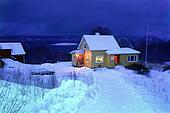
Since nothing is 100%, I suppose not everyone does, but it seems to me that most people want the peaceful, serene, and pristine life - like a very private house on a winter day secluded among mountain peaks. One can wake up on a snow-set morning and gaze upon ice crystals covering the peaks, trees, and everything else surrounding the house. Who wouldn't?

Life is not always cruel, but it has a way of giving us desires even if only seeing them as dreams, or it allows a stroll down a path to see a spectacular setting, then quickly turning away from the splendor, leading to something much more mundane.

I prefer to live the unquestioned life, wholly compatible with someone who gets what I'm about, in a private house on a winter day, surrounded by snow-covered trees and peaks. Who wouldn't?

At present, though, the splendor-filled scene of my preference has twisted to the more mundane realities of living. Somewhere down the path, life will turn back eventually. I will venture upon a scene of splendor around some corner up ahead. I just need to keep the picture in front of my eyes until I make that corner turn. Then, talk about pristine...

Sunday, March 03, 2013

Reading tea leaves


On the weather segment of the news tonight, the forecaster showed a disturbance in the upper atmosphere halfway between Siberia and Alaska. The computer that tracks storms from this area spit out 3 scenarios for the movement of the disturbance. According to one of the models, my area should get a soaking rain next Sunday. According to a second model, rain will come next Sunday, but the front bringing it will blow right through without leaving much rain. The third scenario shows the front coming through too far north to bring any rain at all. Weather forecasting is inexact still after many years of refining the technique of reading radar and clouds.

 And such are the days of our lives. Our minds can easily run some possible scenarios of what the future holds given the variables that face us each routinely. Some years are so out of kilter with the rest of the years, that it is impossible to predict what will happen very far down the road. Other years are much more stable and allow us to predict with accuracy what the next few months will be like.

 I've looked off the coast of Alaska on my horizon. But, I know that where I am now is temporary. Predicting the movement of disturbances and their timing for my area is still enigmatic, but I do know that spring is coming. It comes every year, and most of the time it is wet. Last year, not so much. The rain came early this year. Spring is early too. Rains should come in June. I'm running the models in my mind. But I'm living for the precipitation of June. Till then... chin up.

Wednesday, February 27, 2013

Lab rat


It reminded me of the back room of casinos where people are taken when casino bosses cut off their debtors' fingers and beat them.  Ducting showed below the ceiling.  Lights dangled from the ceiling on poles. The plastic on the machines used were of the old beige variety of the 1960s and 70s.  Wires snaked along the floor everywhere like the ones from the 1990s connecting electrical guitars to speakers strung across a concert stage.  I was on the table.

First they had to map the nerves down the side of my knee by using electrical shocks.  Supposedly, I was not to have felt the shock.  But, a number of the buzzes sent my leg to shivering vigorously.  Then, they went in with very thin needles to areas that had been mapped in order to find a nerve root in the subcutaceous region.  Now, that was electrifying.  I was supposed to call out when I felt a sensation with one of three terms - local (meaning the pain was felt where the needle was stinging), sharp pain (yep, the shock felt the entire length of my leg), and twitch.  That was the term they wanted to hear so that they could stop and hear the brain's signals to the nerve.  Strong signals would mean there was too much pressure in the vein along which the nerve root was located.  Normal signals would indicate normal pressure.

This went on for one hour.  Mostly I used the word local, but a good number of times I felt the sharp pain from the shock down the length of my leg.  Only once in a blue moon did I say twitch.  The net result was that the doctor couldn't find enough nerves that told her that there was pressure being affected.  Other "noise" interfered with the signals because the muscle wan't relaxed enough.  Imagine that.  Pain locally and sharp pain down the length of my leg for the better part of an hour, and the doctor thought I wasn't relaxed enough for her to hear the signals clearly from the nerve root.  I kept telling myself that this was experimental after all, but this was really on the inexact science side of things.  The doctor told me she wouldn't continue after an hour - good news.  Oh, but that was followed by, "Schedule another appointment and we'll try in the other leg."  Now that was comforting.

Wednesday, February 20, 2013

Faith, rain will come

In the hilly areas of the country, streams bring much needed water to plants, animals and humans living in lower lying areas. But these streams only run after a rain. Most of the year, they are merely dry, cracked stream beds. I have been through several spells of drought in my life, one of them for the last couple of years.


But I know that at some point the streams will swell again to bring life. I can't always see or smell the refreshment promised by gathering dark clouds, but I know they will come. The beds are carved into the ground because rain has filled the streams many times before. So, I watch the skies and wait... with anticipation.

Tuesday, February 19, 2013

A miss in guidance

It's always interesting to hear what people say about the languages of the Earth.  Having a cozy conversation with language teachers the other day proved to be enlightening. The conversation began by three teachers talking about how some people were able to learn several languages while others sputter to master their native tongue. Finally, one said that languages have the same patterns, so finding the universal pattern used in languages enables them to quickly learn many.

Wel-l-l-l, not exactly. I let it go at the time it was said because the two other teachers agreed with the notion. A little reading about that subject would have helped them have a more fine-tuned view of the subject, but they had not read, nor did they plan to read more, so this was not the time or place to comment on what was common knowledge for those aware of the field's literature. Right, universal grammar is the holy grail of linguistics, but to date, the grail has been illusive. Maybe a philosophical comment will be appropriate someday, just not this day.

But therein lies a point. A person only learns (or in this case, dispels a common notion) when the context for learning has produced a desire or need. Those contexts are not continuous nor related to routines. But these 3 teachers were products of the system that touted continuous learning, continuous improvement, and repetition. I'll check their students for fluency in about a month, but I already know what I will find because the system they think gives progress, has a long track record of failure to achieve its goals.
What a different story for their students if they would read about the brain's workings and the purposes for needing and developing systems for communication.

Monday, February 18, 2013

Being true

I have heard the advice frequently given, "Be true to yourself." Socrates is many times credited with saying this although his literal words in translation were, "Know yourself." Shakespeare put the words in the form of advice from his Hamlet character Polonius when bidding bis son farewell. His exact advice was, "To thine own self be true, and it will follow as the night the day, thou canst then be false to no man."

Call it wisdom of the ages, I guess. But the same advice is still being given. However, competing advice is also heard these days in the form of, "Consider the audience and act accordingly," and "Don't cut off your nose to spite your face."
While it is important in daily interaction to listen and not to be offensive, it is still good to stand for your own beliefs, make every effort to achieve your own goals, and stand alone sometimes , not acquiescing,  when you have more knowledge of something than others or when you know your own desires better than others who only think they know you well. An exception is when you have expressed your desires to someone else so that they know you as well as you know yourself. But that kind of transparency is rare, as rare as the true beauty of the person with whom the transparency is a shared commodity.

Friday, February 15, 2013

Guineas and changes


The diagnosis was hyperplasia from one doctor, hyperaldosteronism from another.  It's one of the newer conditions treated by specialists because no one knows what all exactly it affects or what all affects it.  It's somewhat rare now, but specialists don't really know how many people might be affected because the condition goes undiagnosed for the most part.

So, it was no surprise when I received a call to ask if I would be a guinea pig.  Not literally, of course.  Specialists wanted to sample my blood using a special procedure so that they could see what areas of the body were contributing to the condition.  Well, it's ok by me.  Why not.  It's all for the cause of progress and medical advancement.  And, who knows, it might promote a more normative condition once they pinpoint the cause, remove it, and take a sampling of the blood after removal.

Before and after is definitely a part of the scientific process.  And, it's a part of my own life story.  I have seen my life's trajectory before certain events and seen the line after.  Definitely a trajectory change.  What's even better is that I know the cause for the change, so I don't have to go searching for it or isolating probable causes and retesting.  I am thankful tonight for the one who brought such a trajectory change, who reversed a declining curve, whose essence is restorative.

Monday, February 11, 2013

A number of deep meaning

Numbers take on symbolic status in a great number of cultures both ancient and modern.  The Epic of Gilgamesh is the earliest story on record.  It is a story by the Sumerians that shows how culture was born through an involved series of symbols, some through worded analogies, others through numbers chosen to represent special actions.  One such number was 10, especially for distances in the story.  Another number was 7, used for meaningful forces.  Both heighten the experience of the characters in the story.

Other stories from the old world have survived as well.  The number 3 was important to Egyptians and Akkadians alike because it represented the fullness of the mystic forces early people had no understanding for.  Classical Greek records the numbers 2 for happiness, sometimes discord, and 3 for strength as did the Hebrew records.  Romans lived in a dichotomous world, one world of practical, utilitarian living, the other world for the great secrets of life and mysticism.  Their symbol of strength was the number two, represented by their consuls during the days of the republic and by their founding mythical fathers, twins, Romulus and Remus.  But they also loved the number 10 and its powers of 2 and 3 (100 and 1000) for overwhelming, unbreakable, impenetrable force.

Religion through the ages has also developed its own number values for symbols.  3, 4, 7, and 10 have been their old reliables.  From the Christian age onward, 3 has represented the deity.  Four has represented the four elements of the Earth or the four corners of the Earth, depending on the era.  7 often represented completeness, and 10 represented something with force or something in an absolute form.

For me, the symbolic number is 5.  It doesn't match anything from literature, modern or ancient, but it does symbolize complete happiness and satisfaction from every fiber of my being.   It provides strength during difficult times, vitality during peaceful times.  5 is every bit as significant to me that 3 is to Christendom, 10 is to the Romans, and 7 to the Sumerians.  My life thrives on five.  It is my special number and heightens my experience.

Saturday, February 09, 2013

A priori

Rank ordering is a simple exercise, but I find that many cannot rank their days or their emotional meanderings.  Sometimes people find that they can set a goal or two, but watching their actions to obtain the goal they have set shows that rank ordering is not something they are accustomed to doing.  Too many other desires pull them away from what they say is important.

Higher education helps to a degree so that people know that they really can't achieve something unless they rank order.  And certainly, advanced studies or successful entrepreneurship prove the necessity of rank ordering in order to achieve what one sets out to achieve.  Watching the most recent superbowl showed the importance of rank ordering for sure because the quarterback with no superbowl, or playoff experience for that matter, didn't know to rank order clock management as an a priori task in his preparation.  The other quarterback did, and the game came down to managing the clock well.

Since my 30s I have rank ordered my life, and when the circumstances allowed for unilateral control of a situation, I have done exactly what I have wanted to do.  That's not the whole story, though.  Circumstances seldom allow for unilateral control.  I didn't order the death of a beloved professor that, had he lived, probably would have changed the path I took.  But he died, and I went about my business bettered by his influence, but not bettered by his direction.  I didn't order my son's death at a young age, and that altered my path over time absolutely from the trajectory it was on. 

As I consider the rank order of my top five desires, I know what it takes for each item to be realized.  Not any of them are wholly within my own ability to realize.  So, I am setting out toward the realization of the top ranked item first, knowing that, with faith in the part not dependent on me, its realization will bring me the greatest of earthly happiness.

Wednesday, February 06, 2013

Mid-winter dandelions


The groundhog predicted an early spring for this year.  As I look out my window, I can confirm that the spring will come early.  Dandelions dot my yard.  Dandelions only show up in mild temperatures indicative of spring.  It has been a mild week for temperatures in the dead center of winter - 80s last week, 70s this week.  So, seeing dandelions makes me know that the trees will be ready to bloom in about a month.  I know this because the round head of soft fuzz replacing the dandelion after its flower is gone, is ready for a strong wind to spread the dandelions across my yard to neighbors' yards.  This means that February will have one or two cold spells of slightly under freezing, but after that, the winds of March will be ushering in the spring weather.

Because of an early spring, then the usual "April showers bringing May flowers" will not occur.  Rain events will be split between March and June.  It's all about watching signs and having gone through the cycle before.

Life offers its set of patterns also.  A book from the 1980s called Passages helped me see these patterns.  That is not to say that life is predictable.  It is to say that large patterns tend to guide people through the decades of their lives.  For the people going through the decade, everything happens fresh and new as if they are the first to ever experience life in their own unique ways.  While that is true on a day-to-day basis, a larger pattern follows certain guideposts.

So, I am going to sit back, enjoy the spring when it strikes early, and enjoy my life knowing what the big picture is about to bring.

Thursday, January 31, 2013

Supreme status


In ancient, classical Hebrew there is an expression that indicates something has the highest value.  That expression was used in naming a book of poetry found in the Jewish collection of sacred writings.  The book contains the story of two young people who fall deeply in love and live to show this love in a number of different ways.  All kinds of metaphors are sprinkled in the lines of this beautiful love poem.  Thus, it is called the song (because it was at one time thought to have been sung to music) above all other love songs...  The expression is: Song of songs.

In Koine Greek, an  expression exists that shows the supreme place something has in one's view of status for things in life.  That expression was used in a very simple, but beautifully symbolic, book of a deity who came to live among a people before rising to his position of importance in presiding over them.  The Roman rulers of the time used the title translated lord.  The Greek rulers from times past used the title translated king.  So, when this new group of people wanted to say that their deity presided over them in a way superior to the current Roman rulers or superior to the glorious rulers of their native past, they called him confidently: Lord of lords, their king of kings.

 In modern English, someone can use a particular expression to signal that a thought is so meaningful, so special and superior that other thoughts pale by comparison.  That expression is said to originate in the heart.  So, to let another person know of the special importance (s)he holds in someone's heart, one uses the expression: heart of hearts.

If I choose to express myself to the one in my life of highest value, of supreme importance, of greatest meaning, I use this ancient but very modern expression...  that my affections come from the depths of my being... with all my heart... from my heart of hearts!

Saturday, January 26, 2013

Pondering

Interpreting what people say is a mechanism of the brain that automatically works in all human beings regardless of language.  People understand the nuances of others' words without any problem.  Especially during the socialization process, when children turn into teenagers and continue through adolescence, do people learn to "read" what people are saying with their words and their intentions.

Adolescents learn that words can take on all kinds of meanings.  So, they experiment with fad language with all kinds of words.  Cool is no longer about the weather, but is uttered when something beneficial happens or when something trendy surfaces.  Bad becomes the opposite in meaning, but good doesn't change at all.  Sarcasm is a staple of the teenager's language currency because it allows them to say what they mean and then change to the literal meaning from the opposite meaning if someone questions their intentions.  During socialization, people learn to be ambiguous so the use of the auxiliary verbs may and might, should and would increases.

One of the last things to be learned about nuances usually comes in the mid to late twenties.  People learn to respond to one part of a statement but not to another portion of the same statement.  Doing so makes the listeners think that the person is giving assent or acknowledgment to the rest of the statement because no comment was made about it.

However, a person has to be a really astute observer of language to know how to interpret what is not said.  Learning that aspect of language prepares one for the final step in learning nuances.  What do silences mean?  Like the rest of language, silence is heavily context-dependent for full meaning.  Some silences are  easy to interpret.  If someone doesn't want to do something, he will be silent, hoping you will move on to something else and not probe the silence.  Or, if someone doesn't want to be negative, "it is better to say nothing at all than to say something negative," a very common saying across the U.S.

Dislike and disagreement cover about 50% of the territory for silence, but that leaves a lot of uncovered ground for the other meanings for silence.  So, it's not exactly a necessary life skill to learn to interpret the range of meanings for silence, but excellent observers learn to make appropriate responses to silences and navigate more easily in human relationships.

Other reasons for silence are ineptness, indifference, highlighting a point of conversation, proving a point, inattention, uncertainty, formulating thought, comparison, groping for a frame of reference, disbelief, or deception.  Other reasons abound, so context becomes supremely important.

Many people don't probe the array of meanings for silence because they don't like silence for themselves.  They create distractions like having the radio or television constantly playing in the background to take their minds from observing the meanings of silence.  But, silence works for me.  I like it because it causes me to ponder situations.  One of the semantic domains of ponder is silence (or at the very least, focus and concentration).  Pondering is a revelatory experience for me.  During the process of pondering I review conversations for both what is not said about about something in general and in particular.

I'm not 100% in navigating smoothly from interpreting silences accurately, but I try hard to understand both what people don't say and why they are silent.  It helps.  And, I depend on forgiveness for those inept moments when I misinterpret silence.

Friday, January 25, 2013

Outstanding

It's been 10 years!  Happy Birthday to a young man who is a star in the making.  This young man has such tenacity and determination, he puts most adults to shame.  He is a sportsman royale who practices and plays with precision.  In other areas he is a standout too.  He is modest on top of all of his talent in both the sports and academic arenas.

He has worked extremely hard to get where he is, but I also know that he has the support and love of an amazing mom who has blazed the way before him, excelling in all she does.  What a great model to follow.

Thursday, January 24, 2013

No, not biting

Sometimes I just can't believe my ears.  I guess people think they can get out of what they say as easy as changing clothes and then lying about what they had just worn.

I was being told about a woman who had gone into great detail about an incident that had occurred in her life 44 years ago.  She was in a setting where there were 3 other people in the conversation, all of them her immediate family.  Each one was relating a story about an event that was his or her greatest regret.  This was not a Truth or Dare game, it was not even an agreed upon activity.  It was just one person relating an incident, then the next person deciding to do the same, then the next, until all 4 had expressed some regret.

The kicker was that the woman was soon after alone with her sister, who was a participant in the conversation, and the two were rehashing parts of what had been said.  She told her sister that she was sorry for telling her story, that she had made peace with the whole incident, and that she had not intended to speak of the incident.

I had to forcibly keep my eyebrows from being raised when the person relating the story to me said this last part.  She had not INTENDED to speak of the incident? Who was the woman kidding?  She had spent a lengthy amount of time (for a casual conversation) giving details and commentary of the incident.  This was way beyond the Freudian slip.  Freud knew that people speak intentionally.  Later attempts to cover their tracks wouldn't erase the tracks.  The whole premise of communication is still that humans want to speak what is on their minds even in the post-Freud world.  People mean what they say.

Two of the three people listening to the woman tell her story actually could have averted the disaster that had happened to the woman all those years ago.  But, they hadn't and she had allowed the circumstance to emotionally scar her for the last 44 years.  It was her way of signaling to them that they had hurt her and no amount of  time or number of apologies would rectify what happened.  She was still harboring bitterness even if she tried afterward to say that she had made peace with herself.  She had spoken to punish the two who could have helped her, using the third as a witness.

She had not intended to bring up the incident?  HA.  Conversation operates according to certain principles.  She can backtrack and be polite about what was spoken.  She can gloss her words and paint a picture of having moved on to higher ground.  She can SAY anything she wants.  But, her original words were clearly spoken.  And words reflect thoughts as surely as mirrors reflect the images they are facing.

Subsequent words of explanation are also a reflection of thoughts.  Posturing to save face or create false impressions was the intention of this woman's later statements rather than proving how unaffected or unflappable she had been since the incident.  She can change clothes and lie about what she wore before the change, but her word choices tell a whole different story.

Monday, January 21, 2013

Enjoyment mainly

As cognitive science makes its strides as a discipline, researchers will come closer and closer to the workings of the mind.  One area of particular interest to me is the relationship between thinking and speaking.  A number of articles and several books have been dedicated to the topic.  The question started in the 1920s with Vygotsky asking "Do we think in words or in thoughts that become words?"  His conclusion was rather indefinite although he preferred the idea that thoughts become words.

Now the field is much more sophisticated because we know so much more about the workings of the brain itself and how, when, and where thought is transmitted.  Scans of the brain's waves and impulses have accelerated us far down the road to a more exact relationship between words and thoughts.  Now we can track a thought's representation via electronic impulse down a dendrite to a synapse, and if the impulse continues traveling, we can see it split down three or more dendrites to other and related synapses.  (Some have hypothesized that deceptive thoughts spring from certain areas of the brain, truthful thoughts from another.  That house of cards is feeble at best and will probably fall with the next experiment done in this area.)

The particular impulse that spawns words hasn't been tracked yet, so it is still an enigma as to whether the electronic impulse coming through the synapses forms the words we want to use for the thought or contains the words a speaker's language already uses for the thought.  What exactly causes a person to say, "Oui, si, yes, ya" or one of many sets of sounds for acknowledgment if a speaker wants to simply say yes?  How does a person receive the information that will use words in a particular grammatical order to carry the semantic meaning intended?  (When that information is forthcoming, then the deception deer will be an easy animal to kill.)  The researcher Pinker hypothesizes that the electronic impulse interacts with  chemicals that change information to words in a speaker's language.

In the meantime, speech will (enigmatically) continue to function according to its many splendored purposes... for encouragement, for inspiration, for command, for guidance, for sarcasm, for deception, for truth, for emphasis, for negative connotation, for nurture, and for signaling feelings.  But, I want to use my speech for expressing enjoyment mainly... for the impulses carrying the idea of a particular laugh, a distinctive touch, a specific scent, and a special, sacred scene to yield words of beauty, a smile, and the most pleasant of sentient thoughts.

Saturday, January 19, 2013

Driving adjustments


The NFL channel runs a series called A Football Life.  An outstanding coach or player's career is highlighted showing some of the off-the-field parts of a the great one's life that were a driving force behind the great career.  Vince Lombardi was one of the first lives selected for the show.

Another of the episodes depicted Bill Bellicek, the New England Patriots coach, who is next to Lombardi in the amount of success he has had.  The episode was in two parts, so it was the lengthiest episode of the series.  But, out of the two hours presented, it came down to the last 5-minute segment.  The television camera was in the car with Bill as he drove in the pre-dawn hours to his office at Gillette Stadium.  He was commenting on the nature of the job.  He mentioned the satisfaction he derived from his satisfying career, but ended with musing, "You give up a lot of things to be coach - family, kids, missing ball games and part of their lives.  Life passes you by."

I have mixed feelings about that ending.  I am glad that Bill told the truth and that the program was true to Bill in not editing the comment out.  But, I am sad that Bill has gained the phenomenal success that every coach starts out to gain but doesn't, and finds that the pot at the end of the rainbow contains tarnished gold.

I want very much to achieve success, but I have not been willing to let life pass me by.  I have wanted to participate with my children and extended family in visiting places of interest, relaxation, and beauty.  I have wanted to find a person I could trust, respect, and enjoy.  I have wanted to travel in my job.  I have wanted to experience an exotic place or two.  I have wanted to rise as high as possible on the professional food chain without compromising any of the above. 

In the last 5-minute episode of my life, I don't want to say, "It's been a great ride, but the important things in life passed me by."  Nearly everything I have wished for has happened.  For the main desire of my life that has not materialized to this point, I have faith.  Life happens pretty fast, so it is easy to understand how a person can let life become a blur in the day-to-day routines.  But we all have rear view mirrors in order to make adjustments on the road for seeing when life is about to pass us.

Of course, some of life inevitably does and will pass me by.  Still, though, I have faith that the important part will not.

Friday, January 18, 2013

Paradise... nightly

In discourse analysis, focus is another word for topic.  The way a sentence is worded shows which part of the sentence is being emphasized for importance.  In English class one learns that the subject of a sentence is the topic of the sentence.  That is sometimes true for simple, declarative sentences. 

But thoughts are usually complex, not simple, and the subject is not always the emphasized idea.  Primary importance is given to what is emphasized first in a sentence.  In the case of complex sentences, the subordinate clause can come first.  What is first is the focus.  Interruptive relative clauses are primary in importance because they separate the main clause's subject from its verb.  And, contrary to what is taught in some English classes, compound sentences still have a primary idea rather than two equal ideas.  The topic of the first independent clause is primary because the two clauses would have been switched if the second clause's topic was more important. 

It sounds like common sense.  Except that the ideas lower in a paragraph or mentioned after several other thoughts in an utterance are usually ignored since they come closer to the end of one's thinking process for lengthy ideas.  But they, too have a focus which might or might not be the same as the focus in sentences or utterances closer to the top.

Topics in one's journey through the mind act in much the same way.  Intensity and significance replace primacy of order and emphasis.  A person thinks and mulls the important events in life.  The events that recur in the mind are selected for memory.  What is remembered often forms synapses with many ideas, and these many synapses continue to form with even more thoughts.  The more synapses a single thought combines with, the more significance it has.  The more intensity a thought has when formed, the the more synapses are formed as well, and thus, the more significance it has.  So, when remembering, what thought or picture comes up often?  What routes in the mind's thinking end up with the same idea, place, time, or visual?

For me, I end up every night thinking about the same time, place, and visual before drifting off.  It is my main focus in life.  Nearly every thought is routed to the synapses containing these particularly important times, places, and visuals, so I know they are the focus. And when I write or speak about this collection of memories, the focus surfaces every time first in importance.

I am fortunate.  I am in paradise every night.

Monday, January 14, 2013

Not many

I am... I said
To no one there.
And no one heard
At all
Not even the chair.


Some days are certainly like this.  Some periods of time are like this.  It haunts a person's mind when in this state because one has to ask, "Is this really true?"

--------------------------------------------------------------------

Did you ever hear
Of a frog who dreamed
Of being a king
And then became one.

Some days are like this... not many... but some.  The allusion in this verse is probably to the fairytale of the frog prince.  But it took a princess to kiss him for him to become the king.


There are days like this... not many... but some!

Saturday, January 12, 2013

Appreciating the unusual


This morning I set out to change the battery in my Sebring since it was dead.  I found that out because I was needing to take the car to get it inspected yesterday.  I turned the key and heard not a sound.  So, I wanted to change the battery this morning and inspect the car. 

Three things, of course, took priority for the morning hours, so at 1:30 in the afternoon, I went to take the battery out and go to the parts store, exchange it, and buy a new one.  I happened to forget (because it has been two years since I last changed the battery) that the battery is not visible by raising the hood and looking into the engine.  It is somewhere hidden under the engine. 

So, I looked up on You Tube a video to show how to replace this particular battery.  It took 8 minutes to explain and show where the battery was and how to dismantle everything to get to the battery (take the front wheel off, remove the tire well cover, unscrew the tightening bar, etc. ad infinitum).  I could see that this was about a 3-day project for me because the car expert was going to take about an hour to do it.  At this point, I knew I would take it somewhere to have it changed and inspected. 

So, when I went to hook up jumper cables to the car I had parked next to the Sebring, I discovered that the battery on it was hidden beneath the engine as well.  So, I had to get my third car, pull it next to the Sebring and jump it off.  Finally, mission accomplished. 

The place I took the car to was efficient and within 30 minutes, they had the old battery out and the new one in.  Four hours had elapsed since I began the task of wanting to get my battery changed to get my car inspected. 

I asked if they were going to inspect it next.  "No," was the answer... of course... It seems that there is a new rule that if the computer running the systems of the car is disconnected before inspection, then a person has to drive roughly 80 miles for the computer to fully reset all the car's systems.  "See you Monday," the service manager waved. 

And that is how life goes usually.

I have come to appreciate the unusual days whenever they randomly happen.

Wednesday, January 09, 2013

Mellow moments

Outside, a true rain event is going on.  It rained off and on from about noon to six, but since then, it has rained softly for about 5 straight hours.  The clouds have decided to stay and according to radar and weather conditions, it should be raining softly for the next 8 hours.

Around noon tomorrow the skies should start to clear.  But I love to sit and listen to the tapping and thudding on the windows of the house.  I love to smell the fresh air blowing gently, hear the distant thunder echoing, and watch the lightning flash brilliantly.  The sound and flashing allows me to think, reflect, and consider in the mellow atmosphere.  I am so totally relaxed.

These are some of my favorite moments, so naturally, I can slip in and out of visions of my favorite moments in time with the idea that those moments will recur even if that happens in momentary, dreamlike, imaginative bubbles of thought.

I should be so fortunate as to be stuck in moments of contentment.

Monday, January 07, 2013

Beneath the complexity

Personality is a very hard entity to define or to recognize in its entirety.  As psychologists have studied it over the years (at least 150), they have tried to give its characteristics.  At first they explored it as a philosophy behind a person's actions. Then, some of them took the reductionist approach.  These psychologists classified major traits and saw that these traits formed basic groups.  A particular psychometric company even administered a test that allowed people to see their patterns of thinking and behavior based on 4 main traits that they seemed to act on.  Disastrous.  There really is no such thing as a Type A personality.

Some psychologists have decided to find patterns in what people are interested in.  These interests help define a person because they manifest themselves in jobs, hobbies, and philosophical persuasions.  Tests were developed to let people see how their interests could drive them in major areas of life.  People answer a series of questions that cater to the manifestations of their interests.  Again disastrous.  People's interests and values are derivatives of personality, but they don't tell what underlies them.  The real nemesis for this view is that people change, or at least become more experienced, and thus, interests can follow a different path than their philosophy at the time they took the test.  Does personality change?  Of course not.

Personality is a hard deer to hunt.  It is more than interest, behavior, talents, and aptitude.  It is also more than the sum of those.  It depends on interactions between people and events.  It is dependent in part on priorities assigned to various values delicately balanced between what is experienced and what is inherited.  A part of the formula has to include patterns that emerge and the search for what underlies those patterns.  But another part of the formula must include reasons for acting and finding what contributes to forming those reasons.

It's complicated.  But here's the final result.  People relate to each other because of personality.  Hatred and disdain are driving forces for personality.  So are attraction and admiration on the other end of the spectrum.  Personality alignment is the game people play when hiring, forming friendships, developing routines such as timeliness, turn-taking in conversation, showing interest, avoidance, and hundreds of automatic and deliberate actions and reactions.

But, even though personality is a complex issue to discuss, define, and classify, people find it beautiful when personalities harmonize.  It gives life  more quality.  When personalities don't match so well, quality is sacrificed.  And the decision to act on being with people of complementary personalities is also a function of personality because it governs priority assigned to values such as change, tradition, perception of (or by) others, approval of third parties.

I do know one thing is very true about personality.  When two personalities harmonize, enjoyment rises to its highest level making life worth living, and the absence of harmony makes life less navigable, certainly much less enjoyable. 

Sunday, January 06, 2013

Twists and turns


The word wonder  has been in our language for a long time - in fact, since its inception.  The Angles and Saxons brought it with them when they settled England.  Every culture has to have a word for "surprise."  That's because life is rather uneven and ragged.  So people can predict all they want to, but life has a way of sending twists our way.

It's the twist that wreaks havoc on our psyches because we have expectations, some of which are based on how predictable we think people are or events are.  In the early days, the Vikings would raid the shores of the countries around them.  They would attack without warning, so wonder was used on such occasions.

Life weaves its sometimes beautiful, sometimes sordid events into our lives, and as we look back we can see that it has anomalies and events that don't seem attached to other events in our lives.  They're there nonetheless.  And it would be foolish to think that what is in store would be something to expect or predict based on what has happened.  But, I do often sit and wonder.  Some surprises are wonder-ful!

Thursday, January 03, 2013

Considering the new shape


Tonight I consider the stretch of time in front of me known as the new year.  There are a number of things that I want to happen, some of them possible, some of them unlikely.  Nonetheless, I know that next year at this time, I will look backward for a moment to assess how the year went and how the new year must go, as I am doing tonight.

Each year has its own character, so I don't know at this point what shape the year will have.  I have an agenda for the year to help it keep on track, but the #1 item on the agenda is not a happening that I have control over.  I'm not sure I can even contribute to its happening or not happening, but maybe.  It's not an occurrence that is on the same plane as a professional athlete practicing hard and long and making some desire of his or hers happen from sheer will.

So, I will watch the year take shape - participating where I can, planning where it is prudent, enjoying moments where they present themselves - believing that something good, something more than I deserve, something with happiness, something that I don't control necessarily but that comes to me will fill the stretch of time in front of me called a year with raw, undiluted, unmistakable, soul-rattling contentment - believing that life will say, as Captain Picard said so often on Star Trek as he gave a command: Make it so. 


Sunday, December 30, 2012

Come again


Most people would tell you that time is linear.  I know that is how it appears in the smaller increments like minutes, hours, and days.  The progression from sun up to sun down makes us experience the linear nature of time.

But then, there's the measure of a year that masks linear time and makes us see that time is cyclical.  The seasons make us know that somehow we have been in this period of time before.  Each spring we feel hopeful for what is to come and look forward to seeing life all around us come to life all over again.  Each summer brings its special delights of travel or other enjoyment.  Every fall we settle in for the beauty of leaves falling and weather changes.  Every winter we hibernate to the comfort of our warm houses.

And, to some extent, decades and centuries act cyclically as well.  We feel that others have passed through this time before us and had many of the same kinds of experiences we have had.

Inside my mind tonight, I look back down the line of time.  I pause at the places I want time not to march past, but to stop.  Several of those spots bring laughter or joy or pleasure to my heart.  And then there's this one spot... ahhhhh this one place... where, when I look closely, the line becomes the circle of the yearly cycle, and where the laughter, joy, and pleasure last as if time is in slow motion.  More than anything, I wish the loop here would not simply slow down but change again into the circles of infinity.


Eventually, however, even in slowed time, the cycle runs its course and straightens again into linear time.

But tonight, I am inside that slow-moving loop... cherishing each of its seconds... loving the joy of those seconds... and having faith that another loop with the same moments will fill a spot soon on the timeline.


Saturday, December 29, 2012

Light and heat

Cold and dark are not two terms a person really wants to hear.  They suggest that something is amiss or miserable.  They conjure up something unrelenting or hard to bear.  They might even suggest an eclipse of the human spirit.  Tonight as the sun set and night crept in, it was cold and dark.

Fortunately, I could go inside where light and heat shut out the dark, cold night.  I could relax and eat and enjoy my evening despite the conditions outside.

I think everyone, in the chambers of his or her heart, has a person and some places that serve as houses where light and heat exist.  And how necessary they are against those who make us miserable and try to eclipse our human spirit.

Wednesday, December 26, 2012

Christmas closing

Narratives in a novel can be the author's best friend if written well.  They can convey setting and feeling all at the same time. On this evening of the first white Christmas in a long time, the following narrative capsulizes my closing thoughts for the day:


Outside, the howling wind that brought the blowing snow had subsided.  Inside, the breeze of air that brought warmth to the living room from the central unit had just clicked off.  That left the man in absolute silence.


His outward appearance would make a bystander think that he was frozen like the beautifully white landscaped scene outside the doors and windows.  But, inside this man's mind was a flurry of activity, not of this particular day, but of a time that brought happiness to his heart.  And, he wanted to heighten the perceptions of those scenes going through his head of that time not so long ago, so he allowed his senses to add to each scene.

He heard echoes of an unmistakably familiar voice followed by laughter, so light and full of cheer.  The sound relaxed his whole body.  He remembered the fragrance pervading the space around him.  The aroma had arrested his attention as he awaited the next movement that would waft a pocket of scent again by his nose.  His mind switched to tactile sensations and his fingers felt smoothness, softness.  He recognized every movement in the scene, every color, and he tasted the air of the memory.

His mind lingered on the captured memory.  But the lateness of the hour overtook him eventually.  The man would sleep deeply and happily this bitterly cold yet robustly warm night.