Time is important, but it has its place. We have to be places on time and start our various daily activities on time. Otherwise, our world would operate in chaos. On the other hand, when we don't have these timed activities in life, why do we bother with measuring the time?
The most regular untimed activity in life is our sleep cycle. (Even if we set an alarm, the time during the sleep cycle is not consciously noticed as being timed.) After we sleep, we wake to feel more rested than before regardless of the amount of time that has passed. Sometimes our bodies are fine with shorter amounts, sometimes with longer or more frequent periods. Whether short or long though, we feel better than if we had missed this untimed activity.
During our waking hours, however, we choose to measure time. Generally,we fill it with hours that have monetary value assessed to the hours. But there is also time, measured or not, in which we are not charging for our labor? Do we simply pass it doing things we enjoy, or do we pass it by filling it with more timed activities? And what is the effect on our bodies and minds if we measure the time for activities? Are our bodies and minds more relaxed and rested, as during sleep, or more worn?
The Earth in reality just spins on its axis and rotates around the sun. I suppose we have gained a lot by counting the number of rotations of the Earth around the sun because it gives us some idea of the length of our lives, the amount of time an era contains, and helps us with segments of our days so that we can act in harmony with each other and accomplish some things as a society.
But, really, other than the amount of time we charge out for our labor, I think more harm is done than good when we micromanage those segments of the Earth's rotation so that we can "pack in" a whole lot of activities to attend. Maybe we're better people for it. We learn how to manage our lives from some of those activities as the number of rotations around the sun accumulate. But, I really think quality of life disappears when we micromanage our leisure segments of time.
The key is to "enjoy" our time in the sun rather than merely to be busy during our time in the sun. And, that means that some of our little slices of life neatly packaged on some kind of regular basis should be curtailed so we can enjoy the moments that occur in unmeasured amounts.
I was speaking to a Chinese young man yesterday. I have visited with him regularly for the last 3 months. He has a good sense of humor, a more-than-average knowledge of the world, and a decent skill in video games. He comes from a home of privilege in China. He's currently studying in the U.S.
I asked how he was doing in school, and he told me about his classes. But, he said he was failing in English. We continued talking because I wanted to know what kinds of activities he was having trouble with in English. It was the usual regimen: novels, short stories, vocabulary, Shakespearean plays, essays, etc.
Before he had come to the U.S. he had taken English in China. But, he had been poorly prepared. His listening skills were almost non-existent, but they taught him grammar well enough for basic understanding of simple sentences. He did well in his studies in China, but has struggled mightily in the U.S. because of the language barrier. Biology, American History, and English are virtually impossible to understand because of the academic jargon used by the books and teachers.
So, when I thought of trying to read the Elizabethan English of Shakespeare, of trying to slug through 150 or more pages of a novel in a short period of time, of trying to write essays in competition with native English speakers when verb tense, pronoun case, and SVO order pose huge problems, I had to just shake my head in disbelief. Of course, the school he attends put him in ESL classes. I think he understands the stigma. American students in this elite school vie for spots at Ivy League schools and prestigious state schools. They don't really give him much attention because he's the foreigner in ESL class who won't bump them from their spot in getting ahead in life.
This sad snapshot depicts a really broken approach to education. It defies understanding that a screening system for international students' understanding of English is not in place for both receiving and sending countries in an exchange program. And I am appalled that a grading system of averaging would be applied to anyone who has little understanding of the nuances of spoken language and the academic wording of written language.
I am certain that this year's experience will not hold this young Chinese student back in the long run because his spirit and background will allow him to rise higher. But the picture could have been and should be much, much different. The stigmas that our schools' grading systems put on people often aid young people in having a less than healthy view of themselves and their capabilities. At times like this I wish I had a magic wand.
Jimmy Kimmel had the president on his nightly talk show several days ago. While visiting with the president, Kimmel asked the president an area 51 question.
All former presidents have outright denied that alien life exists. Obama's reaction was different. He didn't deny aliens existed. The problem is that Kimmel's show is supposed to be entertainment where people relax and laugh at people's funny experiences or at jokes told. So, when Obama made statements about ETs, this context made it difficult to discern the meaning of the president's remarks.
Obama's three statements were:
1) The aliens won't let that happen - to reveal all their secrets.
2) They exercise strict control over us.
3) I can't reveal anything.
One of the best ways to tell the truth without lying, is to tell something straightforwardly in a context where it sounds absurd. Of course, it is really not. So, three times the president told the truth, but it sounded absurd. One can hear the audience laughing in the background. They didn't believe it.
The most telling piece of evidence is the answer to the question Kimmel asked. He said if he were to ever be elected president that he would go through all the files on Area 51 and UFOs to find out what happened. Then he asked the president, "Did you do that?" Jokingly, Obama said that that was the reason Kimmel would never be president. Eveyone laughed. Then shockingly, Obama said that aliens would not let that happen.
Kimmel was talking about Area 51 and UFOs. Obama used the words aliens. People who write essays, novels, and research worry about variation of terms, but in spoken language, that is not the primary concern. Redundancy of terms is the usual rule in spoken language, that is, the second conversant repeats the term(s) of the lead conversant when it is his turn to elaborate in the conversation. Some people don't, but most do. Obama didn't.
The reason? Maybe he wanted to cut through the chase and not play the game of continuing the very light-hearted chatter about Area 51 and UFOs. He uses the word alien so that they could move quickly through the segment, bring it to an early end, and move on. Maybe, Obama wanted to say the word alien so that in the joking context of the show, he could tell the truth, make it sound absurd, and move on without further prompting more questions from Kimmel.
Or maybe, he assumed Kimmel was talking of aliens. Many other kinds of activities happen at area 51. Hovercraft is merely one of them. In addition, it is only rumored that aliens have been kept at Area 51. Obama could have left the whole discussion in the realm of rumors and responded very nebulously. He also could have hedged and deferred to sensitive information the government keeps. But he didn't. He was straightforward from start to finish, ending with "I can't reveal that." The obvious meaning of that statement is that there is something to reveal.
If I were advising someone on truth value, I would say the truth was told. But, since the forum was Jimmy Kimmel Live, a not-so-serious talk show, the hunt for alien life will continue.
I was sitting in front of a restaurant in a small town today waiting for my daughter to pick me up. She had to park a distance from the restaurant and was picking me up due to a disease that strikes my leg periodically and makes it hard to walk. While I was waiting on her, I stood leaning against a pole listening to people around me speak.
Several of the local townspeople were carrying on a conversation. I wasn't paying much attention to the topics they covered, but I was noticing their distinct country drawl. The pace of the speech and the lengthening of the vowels, like the long o sound and the short a sound, marked their dialect. A lot of people view that speech as stigmatized and further relate style of dress and type of job to their stigmatized speech in a way that is very condescending and disrespectful.
I admit that my first reaction to that variety of talking is not one of prestige, but then, if I think about it any length of time at all, I find it is merely another way of speaking and should not have a + or - prestige value attributed to it. Who am I who could render a judgment in the first place on people I don't know and whose lives I know nothing about?
I know people play games with language all the time, categorizing people as prestigious or intelligent or educated or poor or oppressed (and all the other value judgments that can fall neatly into categories) based on accent alone. They shouldn't. Period. I'm glad to have heard that variety of English today. It keeps me in touch with my beginnings and reminds me who I am at my core.
I have read two contemporary short stories recently. I don't know that they are representative of the literature that will shake out as the sign of these times, but if they are, a couple of traits stand out.
The first story is about a high school girl sitting in class, bored out of her skull. She is called from class by the police who inform her that her mother has died. She is taken to the morgue to identify her mother's body. The story at this point goes into a narrative of the girl's thoughts about her life with dear mom. Mainly it was about all the dysfunction that happened between the two of them. At the end the police deliver the young woman back to her school. She goes to her next class, and the story ends.
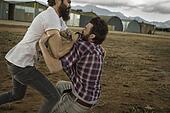
The second story is about men at a barber shop watching a man being beat by a couple of other men. The men make comments about whether people deserve the treatment they receive in life because of their own actions. Finally, one of the men leaves the shop, stops the beating to ask directions of one of the beaters, then continues on his way.
The main feature of the stories is that life is mundane. Even though important events happen, life is too strong, or even if events presented themselves where they could help to make the world better, they don't engage because life merely continues on its march through time. People's actions to change anything are overwhelmed and buried over time, so nothing to change its course happens. The other feature is about the main characters. They have no cause in life, or they don't have an interest in engaging anyone or any event in order to brighten, change, or provide enrichment to their otherwise mundane, isolated lives.
While I do see those tendencies in a lot of people around me and in certain types of group behavior, I would hope that it doesn't form the core of a majority of society. If it does, the world of 1984 will happen without question. If it doesn't, the world of Star Trek and Star Wars, where good is still a cause worth fighting for, will have a chance of appearing on our horizon.
Meanwhile, Curiosity, the Martian rover, is just getting underway again with its extended mission assignments. It is finally at the base of Mt. Sharp.
We have just entered (that is not "about to enter") the cusp of the phase that transforms reading and writing to the next evolutionary phase in communication and the transmission of information. This has been possible for a little while in movies and cinematography, but now it has real world applications. This will only grow in capability, completely nudging out the need to read and write except at the most basic and semiotic levels.
Holographic technology of scientists examining Mars from different angles, but 360 degree angles, allows scientists from around the world to "meet" on Mars through their holographic figure, study the terrain, and talk to each other in real time. In January, NASA and Microsoft teamed together to make this study of Mars possible.
Such a meeting truly will change the style of dialog in the scientific community. Pictures are not sent back for scientists to debate in written journals. Streaming live feeds and points of reference for the holographic figures allows debate and conversation with spoken language in both real time and in recording. That recording will be logged, transmitted, and open for view for other scientists who want to join the debate. The only thing written might be the title and date of the file in an electronic database.
People have thought I was kidding. 2017 is just two years away. That's the end of the 10-year war that traditionalists have waged for keeping reading and writing at the forefront of education at every level. I am very proud to see that the breakthrough moment has come from the top level. It will trickle down from there. Exciting stuff! This is important for space exploration without a doubt. But its implications for wider application is absolutely a game changer!!!
Things orbit the Earth all the time. We're used to it. Thousands of satellites give information to governments and companies every second of every day. We wouldn't really have some of our beloved cell phone features like Skype and weather radars without those orbiting machines above our heads in an atmosphere we can't see through.
So, what was the big deal last Friday when the news reported another orbiter dropping into orbit? OH, it was not our planet. Ever heard of Ceres? Yeah, that planet.
We've orbited Mars a number of times, so again, what's the big deal? The orbiter dropped into its orbit of Ceres on Friday to map a planet that most people have never heard of. Ceres, you say? Yeah, a little over 300,000,000 miles away... out there in the Asteroid Belt between Mars and Jupiter... circling the sun with hundreds of other fragments of the solar system exactly in the position predicted for a major planet. It's never been explored.
People are ecstatic about Dawn's, the orbiter's name, mission there. On approach to the planet, Dawn snapped hundreds of pictures. They show two bright spots in the craters of one side of the planet. Also, vapor has been detected coming from the planet. Now wouldn't that be just be the irony of the century! We find life on a little dark planet that wasn't even discovered till 1851 and ignored completely because it's only one of those "fragments" out there floating around between the two larger and more interesting planets Mars and Jupiter.
Stay tuned. In April, Dawn will be a mere 8500 miles above the planet photographing it to its heart's content.
I love undiscovered territory. I love the surprises it yields, the knowledge it adds, the secrets it reveals, the richness it brings with its freshness. I have my own Dawn going on, dropping in to observe a recent, latent, ground-floor opportunity.
I am hoping to find out what those bright spots are.
I grew up in a totally religious atmosphere. Doctrine mattered. In fact, it mattered so much that I was taught that the particular doctrine given to me was exclusively true.
30 years later, I was raising children. Doctrine mattered less. In fact, when my high school son asked one time if what the preacher said was only his interpretation, I answered, "yes" because I had learned that truth doesn't come in a box.
Now a third generation has appeared. What matters? Not doctrine. But what is good, right, and true matters. Even if those are relative terms, one needs to know what is good, right, and true for their time and their place.
People remember you for the good things you do, the right things you stand for, and the authentic life you live. That's what matters.
As I passed the downtown area on the freeway, the fog was very heavy. Every skyscraper had only the first 12 or so stories visible. The higher 40 stories had disappeared into the clouds of the fog that had set in over the area. The usual beautiful architecture and color of the buildings were shrouded and gray.
Occasionally events turn foggy. The usual color of life is grayed out, and the normal layers of my life can't be seen past a certain point. At these times I have to exercise extreme caution because my journey on life's highway requires people to rush on by without noticing how many stories there are or the careful craftsmanship and color that are missing.
But fog and occasional events are short-lived. Beauty and color return. Skies are blue. Nothing is hidden. The cold mist of the fog turns to the warm rays of the sun. Life resumes in its normal way. The fog is a good reminder of what life can be like when all is scaled down and one-dimensional. It's not fun, but it turns to warmer weather sooner than later.
I like reminders, though. Life is more basic for a short while.
I had a talk with my nephew the other day, a rather long one. Subjects came and went as we talked, but mostly the topics ran along the vein of the idea of why and why not people do things and why and why not truth might change from time to time. It's always amazing to younger people how the world has changed just in their lifetimes, much less over long periods of time. I remember well the awakening that occurred to me as I went through adulthood.
Realization is a great happening in the brain and it happens over time, never all at once simply because a frame of reference takes a little time to establish and comparisons to that frame take time encounter. I have noticed, however, that some people encounter comparisons to their frames of reference and resist any change in themselves. They become less malleable over time. They usually stand as beacons of a day gone by, and they seem to have less and less to do with the world. Others learn about frames of reference and learn how to compare and glean what is best for them as life changes over and over.
At one time, the word "paradigm" was popular and took over the idea of frames of reference. But, it has diminished because it, too, is rather rigid in its meaning. Frames of reference has more of a flow to it as if one has the need to change the frame from time to time. Frames are not good or bad - they're just frames yielding the characteristics of points in time.
Picture albums are probably good symbols for frames of reference... people's changes are noted and tracked. In the same way frames of reference are good symbols of our essences, and it's good to review the frames from time to time.
I was sitting in Starbucks not long ago when 3 teenagers came over and asked if I would answer a couple of questions for an assignment they were working on. They were teenagers from a local Christian school putting a survey together. "Sure," I said.
Question 1: Do you believe there is an absolute right and wrong?
My answer: No.
Question 2: Do you believe there is such a thing as right and wrong at all?
The second one is a trick question. Right and wrong seem to be related to what a society wants to have as their values. Thus, the answer to the first question. Given that reasoning, then the second question is only a reiteration of the first. Of course, societies everywhere want to dictate what people can and cannot do as they live together in communities. The oldest law code discovered, the Code of Hammarapi from Sumeria, governed people living about four millennia ago. Their sense of right and wrong matched what they expected about their culture. I don't have to worry about most of that today. For example, a law specifying damages for my bull goring my neighbor's child is not a concern I have - at all. Rules about slavery and flooding my neighbor's fields fall in the same category. Right for them, not a concern for me.
So, is there a right and wrong? Only if I'm living around other people and we have to get along. I understand that others see matters differently from me. So, I allow for that and follow their rules in the interest of cooperation, but not in the interest of right or wrong. Sometimes people live with things they don't fully agree with because the laws that exist may be the result of compromise. It's not pure right and wrong, it's a compromise measure, so we live with it.
Explaining all that probably wouldn't make too much sense to teenagers at a religious school for an assignment that would lead them to tally percentages of people who believe or don't believe in right and wrong. Life is not dualistic like that. It has contingencies. Right and wrong change over time and exist only when people want to live together cooperatively. Otherwise, nature dictates necessity and that is not a matter of right and wrong, but of survival. That's why I answered the second question with "probably not." I just didn't want to explain to teenagers with preconceived notions derived from religion.
Edward DeVere via his pseudonym William Shakespeare penned poignant words when it came time for his main character Hamlet to act. He had to approach his mother because he had to confront her with the theory of the affair he thought she was having.
'Tis now the very witching time of night,
When churchyards yawn and hell itself breathes out
Contagion to this world. Now could I drink hot blood
And do such bitter business as the bitter day
Would quake to look on..
I love that phrase, "'Tis the very witching time of night." It has several meanings and was probably meant to be a pun like so many other of his lines. The witching hour was the hour of midnight. In times gone by that would have been about 4 to 5 hours after dark. People were asleep at that time of night. No one would see him stealing away to confront his mother. Also, a witching time was in modern vernacular a bewitching time. So, he was referring to his mother being bewitched into having an affair, but he had to find out. Hamlet was so mad that he could drink hot blood, like vampires who want their subjects to suffer but live with them forever. Hamlet didn't really want to kill his mother, only to return the hurt that her actions had made him feel.
The witching hour does strange things to people. I get there more often than I need to get there. It drives me to want to do bitter business. But, it's contagion from a terrible place, so I refrain. Life goes on. Hamlet paid for his rashness with his life. I won't make that mistake. But every night has a witching time of night.
My little granddaughter came from her bedroom tonight calling my name. "Poppey," she said in that little squeaky voice that immediately tells your heart that you will do whatever she is asking. "I'm scared." She climbed into my easy chair with me, leaning her head against my chest. About 3 minutes later she was sound asleep.
It's that kind of night tonight. Sleet coming down on top of rain that has lasted all afternoon. Blankets in chairs where we have been sitting in the warmth of the living room, watching TV, scrolling through Facebook, watching nursery rhymes on the Ipad Air 2, working online. Schools have made their cancellations as have workplaces. Everyone's socked in.
It's pleasant tonight. Serene tonight. Thought full tonight. Tomorrow will come in due time. More sleet will arrive in about two to three hours ensuring that tomorrow will be a very dangerous place for those who venture onto the freeways. But in the pocket of time named tonight, I am enjoying every second as it passes by me on the highway of time. I'm loving the serenity full of thought, the pleasantry of the seconds passing with notice. Oh how I needed this pocket full of such seconds.
The iceberg teaches a good lesson. It appears above the water as something beautiful as it sits there floating on top of the water. It invites you to come and touch it, climb it, skate or ski on it, just enjoy its slick,cold surface.
Even as teenagers, though, people learn about icebergs. They are taught there is more to them than appears above the surface. And the Titantic is a story people know as a notice of what happens when they get too close to the part of ice under the water.
There are ways, of course, to know what lies beneath the water, to map the entire iceberg so that there are no surprises. It's true with people as well. We're all like icebergs floating in water, taking up our space, some below water level, some above. People can know how to map the unseen. It's called experience, sometimes science, or just long friendship. But we can know.
The experience factor comes from the tracks we all leave in the water. The science includes the various methods developed in detecting truth and deception. And, the friendship factor allows people to see where the average is for someone as we go through the ups and downs of our friends' lives.
Life teaches us about icebergs, for sure... sometimes Titanic style, sometimes with life-long friends, and sometimes with the ability to connect dots. We all change through time, in part due to our redirection to miss unseen icebergs.
Mount Olivet Baptist Church Federal Credit Union - that was the sign across the top of the building. Diagonally across the street was the Mount Olivet Baptist Church building, built, I'd say, in the 1950s or 1960s. The auditorium looked like it would hold about 500-600 members at one service.
I like the concept. That's a great application of the 2000-year-old Good Samaritan parable, a really old tale. I don't even know what the business includes or entails at this credit union, but what it represents is helping people where the rubber meets the road. Interest alone is probably a good generator of revenue for the church. I like too another comparison. Leprosy was a dreaded disease of that ancient world. Some of Jesus' recorded healings are about ridding people of this disease. I'm sure the credit union is also a form of healing for its members since money problems could easily be viewed as a modern plague.
Somebody at this church was thinking.It's a great spin on an old tale. Religion would do well to give new spins to old tales if they want to remain the least bit relevant in this age.
This time of night sounds stand out. I hear the slight but uneven strike of rain against the window and deck of the back yard. I don't know why rain is so refreshing and cleansing to me. I think it is partly due to the illusion that time has stopped or slowed and I have time to think about things more clearly. Perhaps it is partly due to the aroma that fills the air as it is raining and the pure air smell immediately following the rain, as if the world is ready to accept me now or as if I can start again with no strikes against me.
Tomorrow I will face the same problems that have presented themselves today, but for now those are suspended. It's raining. Softly. I'm thinking pleasant thoughts, seeing sacred memory screenshots in my mind's eye. I have been washed. Clean again. I'll get dirty again tomorrow. It's time for rest now.
With the advent of the daycare in the 1970s, the boom period when women began working to provide second incomes for families, (I know that WWII is the usual marking point for this, but the 1970s solidified the trend because after that point the workforce shared with women never fell below the 60% point of women who opted to stay home instead of working), an argument arose over television's affect on children. Some said a lasting detrimental effect would happen, that children would be dependent on others to do their thinking for them. Parents were no longer providing trips and play for their children. TV was raising children rather than parents.
We're at the half-century mark since that time, but one can easily see that the reaction then was an over reaction. Children didn't have lasting damage from watching TV. Children learned to control TV when they became adults. They didn't sit mindlessly waiting around for someone to tell them what to do. They invented TIVO and DVRs to record only the shows that they really wanted to see. They invented HULU and other sites to stream to them only what their interests were. They invented games to play on TV monitors and skip the programming altogether. They invented cable in order to make available the specialty types of programs they wanted to watch.
Today, I hear a lot of talk about the use of the cell phone and how children will not learn to communicate with each other like people should do, face-to-face. The last time that happened was with the advent of the telephone and people said that the younger generation would stop going to visit their families and friends, opting instead to talk on the telephone. Ha, ha. Those children developed faster cars and more airplanes to handle their travel needs. They actually increased the number of friends and family that they can see.
There's a lesson from the last 50 years. Both examples above tell us what to expect. Today's children are very capable and will learn to control the smart phone environment. Already there are some really good apps to control the environment. The most recent is Apple's "Pay" app. Use your phone to pay for goods at any store. Paypal has the same ability with their app. Apps already exist to control cars and houses. That will both increase, become cheaper, and get better and easier. Drone delivery of items ordered from Amazon will soon have an app. Order in the morning and come home to what you ordered sitting on your front porch. Personal apps accessing camera shots of intersections, residential blocks, stores and other public places is in the offing. This is the tip of the iceberg.
Children are not going to become more and more stupid, texting and leaving voicemails all of their lives. They already know how to share, very specifically, what they want with all of their friends on various social media venues, in addition to their normal fraternizing as they always have. They're just better at it because they know how to control their environments. What will they do in the next 20 years? I can safely say they will not to sit idly by and let their lives waste away. People are industrious. Survival of the fittest dictates it so.
I don't pity modern teenagers. They will take the world to a new and much better place than at anytime in the world's written history. I would love to join them. And may - if they concentrate their energies on longevity of life as some predict they will. I hope they do. I'm with them.
China has enchanted those outside its domain for a long time. Marco Polo journeyed to China in around 1275 and was enamored beyond telling, writing about it in very glorious terms. 350 years later, Samuel Purchas of England wrote an account of some of the Kahns in China using Marco Polo's account. He, too, wrote enchantingly about China and about a city in particular. Its name has a number of spellings since Chinese script is not alphabetic, and travelers there approximated the sounds they heard in different ways, Ciandu and Shangdu being the most popular. One of the Chinese Kahns of the region wrote an account of his city about a hundred years after its establishment, however, and it is from this account Samuel Purchas immortalized the current spelling of this beautiful capital city. Purchas wrote of the inner court of the city, "In this enclosure or parke are goodly meadows, springs, rivers, red and fallow deere, fawnes carrying thither for the hawkes...," and a great number of other descriptions about the splendor of this city.
122 years after Purchas wrote his book about this city in China, a fellow Englishman, Coleridge, read Purchas' account of this beautiful capital city of China built in the time of Kubla Kahn, son of the great Genghis Kahn and was taken by its description. Coleridge was actually reading the description and smoking opium for his illness (so he says) when he fell asleep and a dream came to him about this great capital city. Upon waking from sleep, he sat down and began to write the images he saw in his dream. He began his poem with the same words that Purchas started his account, "In Xanadu did Kubla Kahn." From there Coleridge constructed a poem of vivid imagery, clear in its every detail. It begins,
In Xanadu did Kubla Kahn
A stately pleasure-dome decree:
Where Alph, the sacred river, ran
Through caverns measureless to man
Down to a sunless sea.
I particularly like the end of the poem, or fragment as Coleridge calls it. A woman playing a dulcimer binds a spell on everyone with her music wooing people to see that she had inspired Kubla to build this city for all to admire him, the builder.
And all should cry, Beware! Beware!
His flashing eyes, his golden hair!...
For he on honey-dew hath fed,
And drunk the milk of Paradise.
I retreat in my mind often to the sacred scenes of Xanadu, to the pleasure dome, to the sacred river, to the caverns, and to the woman playing the dulcimer providing inspiration to do something people are in awe of.
I was listening to Danielle Bradbery's new album and a particular line in her song, I'll Never Forget You, caught my attention. In the song's first verse she has the line "take it one tear at a time." I often hear people say "take it one step at a time." During the NFL season, players and coaches alike speak to the press and use the phrase, "one game at a time." Alcoholics Anonymous has made the phrase famous, "take one day at a time." I have even heard psychologists tell clients, "take one year at a time."
The whole first verse says, "Sooner or later, they say, it all gets easier. Take it one tear at a tme."
I remember vividly a conversation with a colleague who asked about how things work out in life. I answered that precious few things work out. I suppose that some people have a different experience of life, but I have never really had success with any plan of mine working out how I had imagined it in the first place. Some of that is due to my limited vision of what I wanted to have happen, but even when I could see the whole plan, life didn't really happen in that fashion.
I have had some great moments in life without a doubt. And there have been some steps, games, days, and years that have provided great memories. But, when talking about life as a whole with all of its stages and phases, I think the line in this song captures the essence of my experience. It's true that life gets easier, but that is only because you learn how to respond and react better to tearful situations.
It's good advice for life... take it one tear at a time.
I used to look to the skies in awesome wonder of what was there. I didn't know a lot about what was there or how it operated. It was quite the mystery. I am certain it was quite the mystery for our ancestors as well who knew less about it even than I did when I was young.
Today I heard a song about the mystery people see when they look to the skies. The whole song was about the wonder and mystery of God and was based on thoughts written by ancient person recorded an ancient book. I think modern people take comfort in a song like that because they don't want to know about the details. It seems that they want to depend on laziness than apply the basic astronomy they learned in school to their understanding of a tremendous frontier lying just above their heads.
Learning about the skies diminishes one's mystery all right. But, it increases understanding. And that understanding pierces the mystery - only to lead one to see more wonder, more marvel, more splendor, more majesty than (s)he could think possible. So, I don't have much appreciation for songs that perpetuate the wonder of the mystery of the sky. It's so worth the effort to pierce the mystery and gain a fuller understanding of the grand design we're a part of.
No one knows for sure. Is it alien or is it human? What does it say or mean in either case?
I haven't really heard people venture a guess as to the symbol's meaning should it be alien. What would it mean?
I have a suggestion.. We've seen the sign before in a little different form. The idea is from a myth. The Earth was chaos. From the chaos came order and harmony. Its an old, old story, and it's not Hebrew in origin, but Chinese.
Everything evolves, even alien semiology. Their message is the same as it was from the beginning of their exploration. If the Chinese explanation of their Yin and Yang is right, we know the meaning of the recent symbol. If not? Well, then all bets are off and we're back to square one.
I saw a picture on Facebook today of a book with the title How to Read a Book: a Classic Guide to Reading More Intelligently. The person who posted the picture was a young father of about 28 years with three children. His caption read: Better late than never.
Maybe for him. But it's really too late even for him. A person cannot ignore the blitz of media available in today's society. Learning to manage the media is what he should be reading. His three children are dead in their tracks if they follow the advice in this book. They need to know how to present with all of media's available tools including streaming video. YouTube is merely an intermediate step to what will be available when his children are adults.
There is nothing about reading that will prepare the children of today for what they will need tomorrow! Nothing!! Absolutely nothing!!! Zero to the nth power!!!!
I listen to a radio station that gives little ditties for blurbs throughout the day. They are supposed to be humorous, sometimes sarcastic. A person pretends to be a caller speaking to an answering machine. Every blurb starts off with "Hey Jack." Today's blurb was supposed to be funny, but it had that ring of truth in it where humor eases the pain of hearing something profound.
"Hey Jack, today I found the truth, but it didn't make any sense."
This has certainly been my experience over the last 20 years. People's truths seem to be contradictory sometimes, or incomplete, disconnected from reality, shallow, unproven, or notional. Even the hardest core truths from my teenage years and early 20s now seem oversimplified and untrue. Certainly they were untested. The landscape is different now.
I'm not saying I have found the truth because sometimes truth comes in multiples. Truth now seems so relative, a lot less absolute. And, I've found that my truth doesn't make sense always with what other people find to be true. Imagine that.
It was an interesting project. I had read about this before, but had never really pursued it. I had often wondered if it would be easy or hard. Now I know.
Is there such a thing as deceptive advertising? Of course, the answer depends on perspective, as do most things in life. I heard the commercial (but not the one above from YouTube. This one is just an example of representing the possibilities) and tried to decide from that if I thought anything was deceptive. A lot of things came to mind. But I had to evaluate the possibilities so I had to analyze with more than the ear.
The bottom line was to defend a position on whether the commercial was deceptive or not. I had often wondered if it would be easy or hard to defend a position about deception in a commercial. Yep, it was a piece of cake. And, like everything dealing with perspective and interpretation, it leaves others thinking how can you sleep at night? Easy. I just wash my hands after its over. On to the next thing.
I needed to do 100 things today. But instead, I did only one thing. Here it is in the middle of winter in one of those mid-winter breaks from the cold weather. So far, the month of January has been 10 degrees on average lower than normal. Then we hit this 4-day pocket of warm air. It was a lovely 72.
My granddaughter wanted only one thing - to go walking. That's usually what we do in warm weather. She loves it. We go to the creek, find some rocks to throw in the stream, wander aimlessly down the creek watching birds, airplanes, and stray cars that come by. It's a good hour before we return to home base.
I needed to do 100 things, but only one was accomplished before work today. It was worth it to walk with such an angel who sees no evil around her, who soaks in everything she discovers on her walks, who says hi to all the walkers on the trail regardless of age, who still has the exuberance of living each day to its fullest that so many of us have forgotten how to do.
It relaxed me to be with her. I didn't once worry about what was not getting done. The rest of my day went well, but mainly because I did one thing not 100... the one right thing, the linchpin of my day.
I get lost in art, usually. It liberates my mind. It helps me see something from many different angles. It allows me to see that possibilities exist that I haven't bothered to see before. It allows me to think, If that is true, then why is my present thinking true?
Some pieces are more thought-provoking than its sister pictures, and then there are those that make me click the pause button. I have to take in the symbolism and the message before going to the next.
In the video above, the picture changes every 5 seconds. There are about 68 pieces of modern art. Enjoy the next 4:00 of your life. You're going to have your mind liberated.
A church in Florida is named Relevant Church (one in Atlanta too for that matter). I guess that's good. But, to me it's a sad thing that a church has to use the word relevant as a separate word in its name. That tells me some things about the culture I live in.
It tells me first of all that people in Florida don't understand that the word church implies relevancy. Quite the opposite, I think. It is checked out from people's lives, has an aging population, and is otherwise engaged in serving itself. Doctrines are no good because they don't connect to one's daily life. Wouldn't that be something if the other churches in Florida all put irrelevant in front of their names? I guess they already do since it seems to be implied in the name.
I think a ton of people know what the Floridans know about the word church. In the semantics of that word is the word irrelevant. While that is not the same as dying, it has the same effect. Modern people want something that is needful and efficient. Until that happens, I believe groups of people socializing in a needless, inefficient way will go the way of the obsolescent buildings that contain them.
I mean, if you have to put the word relevant in the name on the sign...
The cultural aspects of sacred books don't seem to figure much into the practice of the people using those books. People seem to want to do the things specified in the books even if the culture of today doesn't use or even think about practices specified from ages and ages ago. I had a discussion with a young man not long ago, who was not particularly knowledgeable of the Bible, comparing the laws of the Old Testament with another ancient law code (Hammurapi's) and with modern American laws. He had no trouble at all commenting about how things had changed and how modern laws were so much better, more humane than the old laws of both the codes.
He thought, for example it was much more humane to have prisons than to kill or mutilate (like taking a hand off). Expediency in dealing immediately with the crime wasn't a consideration for him over having another chance. He thought it was much better to wait time than to have swiftness of punishment. I noticed also that he didn't have any trouble with some of the laws being outdated or not in step with modern lifestyle. For example, one law said that if a groom was disappointed with not getting a virgin for a wife, he should produce the sheets from the wedding night. He mentioned that that law was of particular notice for being very out of touch with today's reality.
Finally, he spoke of the two law codes from the ancient world using the phrase tagged to the end the laws that they were in effect "for all time." American law has a better system he thought because of the built-in mechanism to change laws with an amendment process.
If I have a main beef with modern religion, it is that it doesn't account for what has happened in the world since the sacred book was written. God is unchanging they say. Well, even if that is true of God, it isn't the case for humans. When we moderns look up at the skies, for example, in our world, we know that the sky looks like it revolves around the Earth but it is because of the Earth's movement mainly, but also its movement in conjunction with other bodies. We know distances between planets and stars. We know exactly what the surface of at least two other celestial bodies look like because we've been there. We know that our system is heliocentric, not geocentric. We know what other galaxies' shapes are and our galaxy's place among other star systems is (one of trillions). We entertain life existing on other planets rather than dieties coming to our own.
There's a disconnect in the world today with that of a view from a previous time. And, not a small one as exemplified in the paragraph above. Orientation is unequivocally different. The change in laws systems is a great analog to point out the disparate viewpoints between two cultures separated in time. That's really bothersome to me and the reason why religion seems to be, like the bodies in the universe, moving away from position it has held as the center of modern life.
For every story there is a back story. It's always interesting to hear what happened for events to come together, to know what went on behind the scenes before the show started.
So what happened to make the Phillip Phillips the American Idol choice of 2012 and one of the most popular idols in the aftermath of his win? The back story is that he grew up in a "no-nothing" swamp town of less than 3,000 people after age 12. The median income of the town was roughly $29,000. Only 10% of the population was 10 or younger. It didn't appear that this boy would make anything of himself. He didn't even pick up a guitar until age 14.
His brother-in-law taught him how to play the guitar. That, too, usually doesn't usually mean the person being taught will end up in the category of "really talented." He grew up in the 90s and early 2000s listening to the 60s and 70s music of Jimi Hendrix and Led Zepplin. Really! However, he graduated to the Dave Matthews band after learning to play the guitar, which is reflected in his own style.
How he became great is simply a matter of family values. His family was all about being close and enduring to the end once something is started. America was ready for this no-nonsense, determined personality, appreciating his risk in using his own style, and his down-home, home-spun kind of singing. If that's what America was looking for, then Phillip was the perfect candidate. America not only liked his style but his determination because he had a very painful bout with kidney stones during the competition that would have caused most people to drop out of the contest. But viewers wanted to show their love for that family value of finishing something and finishing strong against adversity. That's the back story for a young man who was in the right place at the right time.
Back story is important. Phillip Phillips had the right background at a time that America wanted exactly what he had to offer. Right time, right place was the catalyst for his ingredients. And Phillip Phillips is now a rising star.
It's not often I dedicate space to write about two losers.
I need to go back to 1975. Loser number 1 (L1) graduated with an economics degree from a little college in Connecticut that no one ever hears of. He took all that knowledge of economics and hired on as a $25 a game assistant to a head coach in the NFL. Yeah, a loser would do that. In 1976, L1 switched teams, but still coached in one of those assistants to the assistant loser positions. He repeated his losing act in 1977.
I mention 1977 because that is when loser number 2 was born (L2) in an average-sized town in California. He went to a private high school, but he didn't really graduate with an economic advantage over anyone else. After graduation his hopes ran high because he was drafted by the Major League Baseball team Montreal Expos. That faded rather quickly as happens to all losers.
L1 ended up with the New York Giants working as an assistant to the defensive coach with special teams and linebackers. He had this loser, unnotable job for 8 years. L2 in the meantime went to Michigan after washing out in the baseball pros, tried out for football, and was 7th on the depth rating chart for the University of Michigan. What a loser. He even went to a psychologist to cope with his failure as an athlete.
The great coach Bill Parcells had mercy on L1, giving him a chance at being a defensive coordinator. He showed a little promise, but Parcells moved on. Cleveland, in 1991 decided to take a chance on L1, but true to his losing nature, he won less than 50% of his games as head coach, so he was dismissed. Loser coach, loser team. He hooked up with Parcells again to be his assistant coach, just trying to hang on.
L2 didn't quit football at Michigan, but his first two years were bench-riding years. He worked hard and moved up the depth chart, but not to a starting position. Finally, he was given a chance to starts his last year to play and he won some, but he had the knack of being behind at the end, he pulled out most of them, but he was not seen as having a lot of talent. Accordingly, given his choice to turn pro, he was taken in the sixth round of the 2000 draft, #199 to be exact, the equivalent of being 7th on the depth chart. Loser.
That was the same year that L1 got caught up in a squabble between the New York Jets, New England Patriots, and Bill Parcells. As a result of some last minute swaps and trades and squabbling, L1 ended up being the head coach again at New England. New England who? Yeah, a loser team. Drew Bledsoe, a very decent quarterback, couldn't even pull the Patriots from their faltering status. Bledsoe started for the team with three backups. Yeah, backup #4 was L2
The year 2000 was no magical year. L1's record that season was 5 wins, 11 losses, like his losing Cleveland head coaching days. L2 never entered a game but did work his way up to #2 quarterback. Nevertheless #2 is a bench position. Right, benchrider - Loser!
SOMETHING HAPPENED.
In the second game of the 2001 season, in the fourth quarter, Bledsoe was injured. L1 sent L2 into the game. Oh, good call. Loser number 1 sends loser number 2 into a game.
Tonight Tom Brady and Bill Belichick go to the Superbowl for the 6th time in 13 years. Unprecedented. They have all kinds of NFL history records between the two of them. The New England Patriots have superseded all other franchises in many ways. If L1 and L2 win, both will go into the history books as the best ever, the most elite of all NFL history.
Yep, losers - posing as the most successful winners in the most popular sport in America. Hopefully, that is a story to give everyone hope. It should give hope on several levels. One level is to enjoy the satisfaction of working with people that complement us. Another is to work with someone who can showcase talent. Another is to see enjoyable fruits from your labor. When we are L1 or L2, we can at some time know that something will happen to give us satisfaction, to showcase our talent, and to see enjoyable fruits from our labor.
Three counties in north Texas, Dallas, Tarrant, and Denton, have about 10 million people within their county lines. Considering the population of the United States, that's but a drop in the bucket, about 3%. If I compare the number 10 million to the world's population, it is not even a drop in the bucket, but a microscopic fragment of dust, 1.5 of 1%, or .00015.
That's about the same number of Catalan speakers in the world. They're from a region of Spain known as Catalonia, in which the main city is Barcelona. People know Spanish there, certainly, but they nearly all know Catalan. The number of speakers of Catalan is approximately 10 million. So my chances of meeting someone who speaks Catalan, a language spoken by 1 1/2 of 1 percent of the world's population, living in a country across the Atlantic Ocean in a small area of a small country in Europe. would be minuscule, almost non-existent.
A few days ago, I was in my little pocket of the world working. I was introduced to a young lady. I asked her where she was from. "Barcelona," she said. "Do you speak Spanish?" I asked. "Yes, and Catalan, too," she replied.
Imagine my surprise and my first thought. It's my lucky day. 1 in about a 50 million chance. I should play the lottery. Her accent in English was an interesting mix of three languages. She was in the U.S. with her husband who was here on a work visa. Wow, Catalan - I should be so lucky. The language will probably disappear over the next couple of centuries and be subsumed by the surrounding Spanish language. But, lucky me. I got to hear a language spoken by some of the fewest speakers in the world.
Now if I were to judge my luck for the coming year on this experience... no, I probably shouldn't go that far.
Humans on Mars? Of course, and it will happen in my lifetime if it happens somewhere between now and 2040. If Elon Musk has his way, it will happen in the next decade. We'll see.
But when we do land on Mars, it will be, as it always is, a tribute to all that has gone before, to the foundation that has been established. And, what has gone before? Oh, at this point it has only been all the rover landings and probe landings that have been sent. We have found out much from the 23 missions. For example, 6 of those missions were not successful. They were mostly in the early going of trips to Mars. But, each failure was important because of what we learned. The successful trips were important for the same reason. We learn either way.
But we know more about Mars than merely our own missions provide. At the moment, along with the six operational orbiters and landers around and on the planet, India has an operational orbiter and the European Union has an operational lander collecting information, a lot of which we don't have or know. China will try again; they lost a mother ship and orbiter in 2011 as did Russia. Both countries will send again as soon as their economies become robust again.
For all countries, 51 missions to Mars have been attempted and less than half of them have been successful. I'm impressed with the tenacity of the human spirit. I think it has always been this way. Which is a message to me if I think about it. I have tried a number of endeavors in my lifetime. Some of them didn't work out, probably at least half of them, just like the Mars missions. The ones that haven't worked out have taught me much about people and life. The U.S. has been successful on its last 7 trips. I hope that kind of success rate after early failures will be true of my experience too. Once a person learns, success follows. I'm counting on that.
In 8 minutes you can experience what the world is about to be like - not in 100 years from now, nor even in 25 years from now. But now, next year, and about 5 years from now.
This should radically, I say RADICALLY, I mean RADICALLY change the way education approaches preparation for the next generation. Underestimating these certain directions in experiencing the world won't merely set a person back in being a productive member of society, it will relegate him to an unrecoverable disadvantage in quality of life and ability to generate income for normal, regular day-to-day living. Underestimation of this direction will sink one's boat to the bottom of the ocean.
I didn't think I would live so long as to see a self-driving car, but it's here. It's not commercially productive yet, but we're on the five-year countdown now. That's the average time it takes to go from convention show floor to dealership show floor. All those buttons and knobs have changed to icons in a display. Everything is regulated by touching and setting parameters, never by turning or twisting or pushing anything - wipers included. All of this since 2007, the advent of the iPhone.
And now cars can see. At least, that's the way to say it using human analogy. Sensors are everywhere on a car so that it can drive itself. It calculates speed, road position, and objects ahead, behind, and to the side microsecond by microsecond.
Amazing. And it will impact the world. And it will impact how a person lives and works in the world. And it will completely leave behind those in the world who don't want to join the new direction the world has taken. And I pity them because they will be fossils in less than a New York minute!!!
Chris Young's lyrics in his song I Hear Voices represents a great principle of psychology. The original term used in the discipline was inner talk or self talk. There are various other terms now used, but the idea is the same. "Voices" is as good a term as any. It represents what guides our actions and decision making.
I know what guides me in these ways. There are fewer and fewer decisions made and actions taken that I have to think about for any length of time. It's easier too project outcomes or plausible scenarios. There is a logic this line of thinking follows. Computer programmers have dealt with loops and nested loops for years - the "if => then" loop.
I think the voices have changed for me over the years. Experience does that for a person. But I still have voices I listen to. The self talk is more assured. Every day I act and make decisions.
Sometimes new years are merely extensions of the year gone by. And at other times new year's bring with them things that are really new. This year I have a couple of new ventures that I have never done before, never tried before, and never saw coming before now.
Experiences are supposed to build so that one leads to another and that leads to another, building block style. But some experiences just happen as anomalies. They don't seem to be connected or so loosely connected that the true connection is lost at first glance. My normal experience is the former. This year, however, the latter is going to happen.
In some ways, I can see great promise. In other ways, I can see setback. If the ventures work, it will alter my path. If they don't work out, it will force me back onto the old trusted path of the past. All of my formal training will get put to the test in ways that I hope have prepared me well. It's a little like pilots trusting their instruments when landing in fog when they can't see the runway. I'll just have to trust my training.
I have always heard the saying that people need a little something of the new and a little something of the old in their lives. The last two and a half years I have had a little something of the old. So, here goes in 2015 - a little of the something new. Bring it!