Search This Blog

Wednesday, April 16, 2014

+ x t

Intersections are everywhere around us.  Everyday I pass through at least 20 of them.  Usually they are the same ones, the ones around the area I live.  Sometimes, I go to a place where I pass 20 intersections in just one trip.  And, if I leave town, I get to to experience new and different intersections than the ones in my daily routine.

With people it is the same.  There are those whose lives I intersect everyday, those whose lives I intersect weekly, and those whose acquaintances I make only occasionally or only once.  Some people say the intersections are by divine appointment, others say intersections are completely random, still others have some existential combination of the two possibilities.

It seems that to some extent we choose the intersections we have on a routine basis.  At times, though, it is clear that outside forces make our paths cross with other people.  Opportunities are presented to us daily that are unplanned and planned.  The planned intersections comprise our daily routines for the most part although we plan trips and vacations (the occasional or singular intersections).  The unplanned ones comprise the occasional and singular intersections for the most part

As we construct our lives as adults, we know our personalities well.  So, we plan the intersections that are compatible, or compatible enough, for us to enjoy, risk, have adventure, achieve, and experience many other activities within the limits of our personalities.  Rarely, we are subjected to intersections beyond any control, but we keep these to a minimum if at all possible.

So, I'm not much of a believer in the divine appointment idea for daily activities, maybe for the rare ones, but not for most.  We are all control freaks when it comes to establishing routines that match our personalities so that we can have maximal enjoyment of our lives.  And, for those intersections that have happened that we didn't control and that have dropped from our routines, there are three choices for us.  We can discard them, treat them as part of our normal experience, or consider them sacred.  Sacred ones are few, but I am thankful to have had them.

Sunday, April 13, 2014

Recall


I watched a TV program to its conclusion and left the TV on unintentionally.  I got up to make a sandwich, and when I returned to the living room, the next program had already begun.  A local prominent speaker was in the middle of one of his advice-giving speeches.  I don't normally watch this program, but I thought I would just listen for a minute to see if I should listen further this time.

He spoke of the importance of communication. I couldn't agree with him more about that.  The next thing he said was one of those ideas that got a lot of air play about 30 years ago when it was being investigated more scientifically for the first time, but he must have quit listening after that point because the investigation has continued and the newer information is quite different from the advice he was giving.  He continued to say that communication was important and that men in particular needed to learn that.  He said that men didn't communicate well how they feel or what they are thinking.

If the speaker had paid attention to more recent investigation, he would have known that his advice didn't represent an accurate picture.  Men talk.  They talk frequently, on subjects of interest to them and of interest to others, and reciprocate when asked about personal matters.  They talk to women, they talk to men, and they listen as well.  There's really not a communication problem that men have to work through.  I hated that a lot of people heard inaccurate information from an advice-giver that people seemingly like and follow.

Generalization of a concept is not the best thing to do most of the time.  And, pop culture psychology is not something that should be disseminated or adhered to as if it is the gospel truth.  Research is finer-grained about men's communication patterns than the generalizations made of them 30 years ago, and people, like this speaker, merely want to share their unrefined gist of the research to sound as if they are well versed on a topic geared to half his audience.  But the actual research is usually too detailed for people who want only the bottom line to spew out for impressing people of their grand amount of knowledge.

A little lesson from the car manufacturers is in order for this person.  R-E-C-A-L-L.

Saturday, April 12, 2014

Successful

I don't often go to see a movie on opening day, but today I made an exception for Draft Day.  It was good for several reasons.  I had wanted to see draft day strategy.  I wasn't disappointed on that account.  The plot was simple, but had several points of suspense built in.  I wasn't disappointed on that account either.  But, the movie had a subplot that I hadn't heard about and that I really enjoyed.  Kevin Costner's character didn't want to lose the woman he loved.  It was a great parallel subplot to the main plot.  He didn't want to lose in his job, in the competition of football, or in expressing his love for the woman he loved. He succeeded with relish on all three arenas.

I am jealous of Costner's character.  He succeeded in making himself a premier general manager.  He succeeded in having a team that could win the Superbowl.  He succeeded in restoring the relationship he most coveted in life.  Yep, I'm more than jealous.  Succeeding in life is a very sweet feeling, but more than a feeling when speaking of love.   Life is hardly worth it if love is absent.  Costner's character was a lucky man to have someone who believed in him.  She made him successful, and he worked hard to keep her at his side.  His world turned more pleasantly with her.


Thursday, April 10, 2014

Tired of simplest terms

Three times in the last two weeks, I have asked for an explanation to something.  Each of these three times I received an attempt at an answer, but the person giving it was so limited in both knowledge and words to use for description that the person became frustrated.  I marveled at the inability of these people to explain something.

The question was asked to employees who were supposed to have been trained by a company to give explanations of how cell phones work.  But, the company either didn't give the workings of data transmission or didn't give the trainees the vocabulary to work with.  Eventually, in the questioning of the employee, the person couldn't make the right connections of one idea to another.  The person's knowledge was compartmentalized.  The meanings of particular terms, like gigabyte, data transmission, and resident on device were fuzzy for the person as well.

The whole reason people talk is to communicate ideas.  If that end is missing then the means (the vocabulary) is lacking.  I have to ask myself what in the world is going on in the mind of people who can't explain something.  In an unrelated matter, a person called me for directions but couldn't tell me her own location in order for me to help her easily.  It's tempting to relate all this to whether or not I get the right food in my sack at a fast-food restaurant after placing the order at the speaker. About 50% of the time something has been changed or omitted.  But the problem may be in lack of life experience, unfamiliarity with input to an ordering system, or inability to transfer the meaning of an order to a screen for someone at a different area of the restaurant to read rather than a direct communication problem.

Part of the problem lies in the socialization process of young people.  It is a well known phenomenon that teenagers learn their initial introduction to adult vocabulary from their peers.  If that becomes the extent of the person's experience with communication (often the case), the communication process is truncated and the person will struggle when posed with questions that lead to ideas outside of their experience and consciousness (theory of mind).

I relish the times when communication happens on a level above the one described.  But it is certainly not as common an experience as I would like it to be.  I am relegated to speaking on life's simplest terms.

Wednesday, April 09, 2014

Beyond the tree tops


Everyday I pass a house that fronts the service road of the highway I drive on. The construction is out of the 1970s, and it's in need of a lot of repair. Behind the house is the rest of the property, what looks like about 10 acres covered with a forest.  The forest is thick and appears overgrown with low-lying shrubbery, making it look shabby, uneven, unkempt.

That's about all a person can see from the highway. But, if one is on the service road, or if one has to drive slowly on the highway, then (s)he can see beyond the house sitting in front of the forest. Slightly above the tree line, the tops of some very nice houses, the million dollar variety, can be seen.  Turrets appear on these houses, double chimneys, peaked roofs covering two stories, and gables.  A whole housing addition full of brand new million dollar houses lies hidden behind the shabby, overgrown forest enticing people to come and see more.

Forensic sciences in general, and forensic linguistics in particular, act in much the same way.  Speech at regular speed doesn't allow a view of what's behind it, what it might be hiding.  Many times speech is verbose, repetitive, containing fillers, and passive constructions to hide meaning - what one might call overgrown.  It contains informalities, expletives, and idiomatic expressions that appear inexact; they're decoys  But, if a person looks beyond the words, a truer image of the meaning of the words appears - elaborate constructions to dress up the truth, to hide accuracy, to report what didn't happen.

Facades of beauty house rotten things so much of the time.  Forensics bring out what is hidden.  It's a dirty job, but somebody has to do it.


Sunday, April 06, 2014

Making it worthwhile

My favorite song tonight at ACM awards was sung by Dierks and Sheryl Crow...  Absolutely.


I certainly do.

Saturday, April 05, 2014

Time for a joker

It's quiet right now.  In less than 8 hours it will be raining, and in about 24 hours the wind will be howling through the chimney flue and at the back door.  The weather forecast is pretty accurate these days.  Details are missing, like amounts of rainfall or intensity of barometric pressure, but I know to count on something if rain is forecast at 100% coverage.

I can't really see around the corners on the journey ahead of me, but there is some accuracy in what happens if I chart the future based on  the patterns we know about. In 8 hours when it's raining, I will be working, and in 24 hours the pace of work will pick up, blowing through faster than in the past.

What I enjoy more than knowing the patterns, though, are the wild card factors that don't appear in the patterns.  It's not in the usual cards, it's the wild card.  I love those when they happen.  They're not often; that's why they're not a part of the pattern.  Generally, the changes they bring are pleasant.  It's about time for one of those jokers.

Thursday, April 03, 2014

Beyond that


Civilization has come a long way.  Ancient humans knew quite a bit about their immediate environment.  But, when they looked to the heavens, it was an amazement to them.  They really didn't know what was out there or how to put in perspective what they saw.  The Mayans, and the Babylonians before them, were very well versed in the movement of planets and the various constellations, but beyond tracking movement, they didn't know much.  The makers of Stone Henge and some of the other stone monuments around the world knew about length of days and associated that to the time of year, especially the two solstices.  But, they didn't really know how to view the heavens.

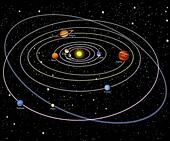
Compare that to modern knowledge and perspective.  There are 8 planets, an asteroid belt, moons revolving around most planets, a Kuiper Belt containing icy planetisimals, such as Pluto, and an Oort Cloud, which has two parts, an inner disc around the Kuiper Belt and an outer circle that defines the cosmograph of the solar system.  From the sun to the outer limits of the Oort Cloud is about 1 light year.


If I travel beyond the Oort cloud another 5 light years, I come to Alpha Centauri the nearest star to Earth's sun.  Astronomers have found another 4 stars in the Alpha Centauri field since originally finding and identifying Alpha Centauri.  Those other four stars have planets revolving around them.  Of course, there are many more solar (stellar) systems in the Milky Way Galaxy, between 100 and 200 billion of them, all of them in the 100,000 light year diameter of the galaxy.

Beyond that are billions and billions of more galaxies, with diameters up to 25 times that of the Milky Way.  All of them contain billions and billions of stars, many of them with planets, which have moons.


So, when I read documents from the ancient past, I know to read them with the perspective they had of the heavens, which was very, very, very, very limited.  We still have much to learn about our skies, but we know infinitely more than the documents coming from generations before the 1600s C.E.  Ancient documents were intended for people with the same understanding as they themselves, not for people of the future who know infinitely more.  If I understand that, then ancient documents don't impede future progress or hold me back from doing what is right for me in a modern period of civilization.

Tuesday, April 01, 2014

Against the grain


The last 5 years I have worked against the grain. That means I have worked at a time when others are off.  I have worked in a field that tries to improve what is typically available.  I have worked with a company that would end the way things have been done for the last 500 years.  And I am working now to innovate a realm that has not listened to the experts in its field for over 60 years.  Yes, against the grain I would say.

My personality is well-suited for working this way.  When I was only 8, my third grade teacher told my mother that I always seemed to take the opposite viewpoint.  In college I took some of the least taken courses like the history of China, the history of Rome, history of the English language, and the introduction to linguistics. When I was in my 20s my mother told me I was a contrarian because of the type of reading I would spend time with, such as Qabala.  In my 30s I sided with the evidence that Shakespeare hadn't written the world class plays attributed to him.  I now believe in the properties of logic that show that language and math are manifestations of one and the same system of order our brains depend on.  The list goes on...

While I enjoy a good debate, I relish the time I spend with like-minded people and those who are compatible with my personality.  And if someone is compatible, it means they too are working against the grain in some fashion or another, like not settling for what 75% of people settle on for their own education, or what even another 18% of people settle for in receiving formal training, or even what another 5% try in advancing their educations one more level from the 18%.  They settle for what only 3% push on to receive.  They do things like disagree with the way things are and see the things that are coming. They can work within a system already in place in order to drive that system to a new place.

I have come to accept my role in society, the stripes on my zebra coat that won't be changed.  It's a comfortable place to be,  I like being there and with those who "get" what this role is about.  Everyone recognizes it's not the same grain.

Monday, March 31, 2014

Marking

One of the ways to describe what happens in a language is to notice markers in language.  In English, the nouns are marked.  Nouns don't occur in English without marking it as singular or plural, general, specific, unmeasured, or abstract.  So, if I want to use the name of something, I have choices to make.  The first choice is to mark the word as plural or singular, which is done in a millionth of a second.  The next choice is to mark the name with specificity or not (a/an or the) followed by the choice of abstract or concrete, measured or unmeasured, both in about a hundred thousandth of a second.

We decided to move tables today.                             
We decided to move a table today.                           
We decided to move the table today. 

 I want coffee this morning.
 I want a coffee this morning.
I want the coffee I had yesterday.

Sometimes marking happens as a word in front of a noun.  Sometimes marking happens as a last letter in the word, a suffix.  Sometimes words are marked by word order.  For example, nouns appear both before and after a verb.  The one before causes the action when using active voice.  The one after receives the action. Thus, word order distinguishes between a subject noun and an object noun.

Volcanoes pour lava onto the ground below them.

Other types of words are marked as well so that English can be well understood by millions of listeners, but this part of the naming process of English is used as an example.

I know that my life has markers in its different compartments, too. I was brought up in a very strict and religious home.  That compartment of my life remains to this day because it has always been one of the possible categories for me in life.  However, I have chosen to mark it in different ways as I have traveled through my experiences.  The marking is one of the ways I communicate who I am to others.  Education is another compartment which I have marked.  Treatment of others, work ethic, view of rule-keeping - I have marked each of these categories for myself in different ways.

Love is no different.  I have marked this category in ways for others to understand as well.  One of the ways was by having children for posterity. But the most significant way was to designate one person as the one for whom my heart beats, life's one true love.  One of these was marked early in my life, one late, but marked nonetheless.  And the markings were made so that I could communicate who I am and what I mean so that anyone who sees me knows what the markings mean.  I didn't create the marking system, but I learned how to use it well and deliberately.

Saturday, March 29, 2014

It's not hidden

The question of how a language is learned has been studied for several millennia.  It's an ancient question.  For that reason it ought to be clear what the process is for learning a new language.  But, that is not the case.  Well, if you believe Rosetta Stone, you think it's clear (or Berlitz, Pimsleur, Living Language, or the name of a 100 other companies).

But if it's true that a person can learn a language in a matter of a few months rather easily, then when I look around at all the countries of the world, I should see a great number of bilingual, trilingual people.  I do see a few pockets of proof of this theory.  Swiss denizens, South African, Ukranian, and a few others do learn 2 or more languages just from growing up in a multilingual environment.  But most people in the world don't.  Why not? It's so easy, right?


Upon further study by modern scholars, variables enter into the equation when learning a language.  One's age when learning a language, for example, yields different results.  One's purpose for learning matters.  The method used sometimes facilitates or impedes learning a language.  Other factors also enter into the picture, such as educational background, opportunity for use, and societal status of each language.  All these factors should make the learning process transparent and easy because methods could and have been made to take into account all of the factors affecting language learning.

But, even if there were a hundred factors in learning language, it should be easy by now, given the thousands of years people have been learning and speaking other languages. Modern people have left it to the schools rather than language scientists to teach languages to people. The schools have used various models for teaching languages, but it still takes place in an artificial environment with the accompaniment of textbooks.  In light of all the years of practice and all the years of research, schools have not changed their approach, regardless of model.  In addition, businesses which have specialized in training people in language have adopted the schools' various models as their approaches.

Evidently, these models are flawed.  It's still a daunting task to learn a language. The research has been done, however, and the process is a known process.  It's not hidden.  It's just that foreign language departments, schools, and businesses are not listening or looking to the available language science.  Wouldn't it be nice for people of nations to speak to each other regardless of language.  They could.  Easily. So be it.

Friday, March 28, 2014

Again

I was talking to a friend today who mentioned that he had started again three times in the same business.  He spoke of the first time as merely having a passing interest in a business that wasn't really what he liked doing, but he participated in the financing of the business so as to have partial ownership.  The others involved in the ownership decided to abandon ship nearly a year later, so he had to start again. This time he was with a friend and former coworker of his wife who ran the business.  In a moment of personal desperation from economic straits, the friend bailed.  So, he had to start again.  This time he is very personally involved and giving personal time, money and effort.  He was animated as he spoke of this third time and of all the plans he was excited to implement.

I admire people who can start again... and again and again.  That kind of tenacity is something I don't see often.  People more often are complacent or they retreat into the familiar and the comfortable when adversity arises.  I have had all three responses to life's circumstances.  I've refused to get involved due to complacency before.  The opportunity passed me by, but I learned from the experience.  I've retreated back to the familiar before when something adverse has occurred.  That helped me recover a little, but it didn't do much of anything to advance my desires and ambitions.  And I've gone for broke on a number of occasions.  Not very many of those occasions worked out for the best, but the impact on my personality, emotions, and stamina has made my character richer for the wear.

More coins in the pocket is certainly the reason for nearly all the occasions I gave it my all.  At some point, I hope, I will have a rich character and its corollary, coins in the pocket.  I just have to remember the formula - again... and again, and again.

Tuesday, March 25, 2014

A view like this


There is something sobering about seeing Earth in the distance from the Martian surface.  It takes the platitude of thinking outside the box to a new and higher level.  It is so abnormal to see the Earth at a distance that it makes you feel as if you are an alien looking in on the activities of humans.  "Those Earthlings need to have a view like this," you tell yourself.  "Then they wouldn't really be the way they are."

The rover Curiosity, transmitting from the moon, allows for such views.  That's what scientific inquiry does for any who would follow its principles.  It allows one to see the bigger picture,  to appreciate the wonder of accomplishment and the challenge of the yet unknown.   It causes a hundred different thoughts to pulse through your mind, to view something  from a really, really different vantage point.

I congratulate one who is now looking at Earth, marveling at her accomplishment, saying "Those Earthlings need to have a view like this."  Now the world is at your beck and call.  I know you will change what you see and touch the world to heal it.  I am always proud of you my Godgyfu.

Friday, March 21, 2014

Die with a smile

Some people do well as long as they know what the baseline is.  They need rules to follow so that they are sure they are accomplishing what they can keep up with.  This is not only true for religious people, but it is especially true for them.  They like to be able to put a check by their prayers 5 times a day or by the number of kindnesses they do for people.  That is the way they know they are good people, accomplishing the tenets of their faith.  But even without religion people seem to depend on all the rules of society to keep them locked into doing right things or being productive, acting responsibly.

I know why there are rules.  Don't murder someone seems like basic living to me, but some have a different psyche from mine, so they need the enforcement of murder penalties to deter them from murdering.  I also understand the idea of contracts.  People have a hard time living up to a contract when their living conditions change from the time the contract was signed.  What I don't understand is why people depend on so many rules and regulations for daily living.

Why do people want rules (even if they are self-imposed) to follow about which words they deem offensive and which they want to hear, for example?  I know a person who will not attend any movie because they contain expletives she has conditioned herself to believe are offensive.  It's the tone of voice, not the word that usually determines if a word is offensive or not.  Sometimes it is the subject, not the word that determines offensiveness.  In the 1500s and 1600s people would swear "by the rood."  In Edward DeVere's plays (Shakespearean plays), "'Zounds" was used quite a bit.  The first was swearing by the cross, the second  was an expression of disgust meaning "God's Wounds."  So some religious people at that time thought the subject was inappropriate. Ironically, the religious people of today think it's all right to swear by the Bible or by Heaven. Their prohibited subjects are sexual acts or body parts.  People are so fickle!

Or why do people want rules about role propriety?  In the workplace, people are slighted all the time just because they are not the "right" gender; sometimes they have the wrong color of pigment in their skin, tatoos or piercings on their skin, or their skin is too pale or too tanned (people make moral judgments using paleness or tanned skin, believe it or not).  Sometimes a bilingual person is slighted because one of the languages is not considered prestigious.  My goodness.  Just pick the right person with the right skills and everything else will take care of itself.

There are literally 100s of rules in a society that people want to follow.  I don't get it.  Have the number of rules it takes for people to live peaceably together and then enjoy the diversity and wonder of life.  Rules break us down, making us monotonous people who don't achieve our best.  Rules keep the mind restricted from thinking what is possible. Rules keep the workplace quiet and controlled (like sedation); they don't allow elements that help advance thought in a creative, dynamic, bustling, and vibrant environment.  Rules impede progress, dampen spirits, and restrict the enjoyment of what comes natural.

I'm sure I break 10 rules a day somewhere as I go through daily living.  But after I missed the one opportunity of lifetime 5 years ago, I have decided to skip all but the necessary rules and live more fully.  The road to the end is not as long as it used to be, so the remainder of the road is going to be much less filled with living out rules and much more filled with fulfilling lif'e's natural joys, being around compatible people, attending events that satisfy, and having proximity to those I trust.  I will then die with a smile on my lips, saying to others that life was worth it.

Thursday, March 20, 2014

Disappearing distinctions

A recent conversation I had was flowing nicely when it turned to the difference between wisdom and knowledge.  The Bible was cited about knowledge (of God) being the beginning of wisdom and then was added the adage, "The smart man knows what to say, but the wise man knows whether to say it or not."

I get the distinction.  But, the world has changed 100 times since the first words were coined around 1000 BCE.  The second adage is recent but was coined based on the 3000-year-old observation.  The modern person really doesn't view things in the same light. Perspectives are different.  Knowledge is power.  Knowledge gets you a job you wouldn't otherwise have.  Knowledge allows for promotions and prestige, respect and trust.  There's no difference between the smart man and the wise man because a prudent person will gain more knowledge in one of 10,000 different possible fields of interest in order to make his or her life better.  Companies offer training sessions for everything under the sun and give endorsements, licenses, certifications, and certificates for those sessions.  Universities offer a whole host of formal trainings from A.A. to M.D.

Yeah, it's a different world.  Wise and smart are distinctions from the east, not from the west.  Westerners draw their boundaries differently.  The age of scientific inquiry is for everyone, and everyone participates in order to get ahead.  And in the really, really modern world, formal training is not the end.  The internet makes it possible to find out about any tidbit of knowledge that has been written about anywhere in the world in any language of the world.  Learning never has to end and it is always current.

While it might be interesting to see how the ancient world made its distinctions in society, those distinctions have morphed into a seamless world, no such boundaries still exist.  Having knowledge and being smart are equivalent phrases, but so are having knowledge and being prudent or judicious.  As for me, I would rather live in a seamless world and appreciate the knowledge of an ancient culture for what it meant to them than to try to apply a 3000-year-old axiom to a modern world where the paradigm is so different that people no longer understand the old one without help.

Wednesday, March 19, 2014

That hot, hot year


Today was unusual. Weather records for today go back 125 years, and in that length of time, the day's temperature has never been more than 85 degrees.  But, today was different.  The mercury decided to continue its journey upward.  86-87-88-89-90.  A new record -21 degrees above the average temperature for a 125 year span. The season is still winter believe it or not.

I love anomalies.  They beg many questions.  What was different in the weather pattern today that has not been extant for 125 years?  For a winter that is close to having record low temperatures for the most number of days below 32 degrees, why is there a day that is so out of character from the rest of the season? Why was this spot the hottest spot by 4 degrees from any other spot in a 20 county area?  What kept the temperature from reaching hotter temperatures?  Why was it so hot when a higher than usual wind speed accompanied the heat wave?  Wind usually has a cooling effect on the air.

Sometimes things happen to us that beg questions.  They're great mysteries.  They've never happened to us before.  They seem to be disconnected to what has happened before.  No one would have predicted their occurrence.  I've had such an anomaly, a hottest year ever by more than just a little in the winter of my life.  It was the greatest pleasure to have happened to me, ever.  That year is sacred to me.  Thus far, it's an anomaly... but I long for its return... I would love for it to become my average.

Saturday, March 15, 2014

Deep and intense


In 1995, the BBC wanted to know what poems the people of the British isles loved to read the most. Number 15 on that list was The Highwayman.  I guess I am a hopeless romantic, but I like the poem too, and have liked it since I was in 9th grade where I read it for the first time.  From then until now, I have read the poem probably 50 times or more.

The highwayman loves Bess; she loves him.  The intensity of their love comes later in the poem when The highwayman rides through the night back to see Bess, carrying his spoils from the night.  She warns him of the danger lying in wait for him, but it costs her her life. He doesn't know that, so he rides to be by her side, and it costs him his life.  Deep, intense love.

The last two stanzas of Part One are written below.  These stanzas represent the entire poem to me

“One kiss, my bonny sweetheart, I’m after a prize to-night,
But I shall be back with the yellow gold before the morning light;
Yet, if they press me sharply, and harry me through the day,  
Then look for me by moonlight,
         Watch for me by moonlight,
I’ll come to thee by moonlight, though hell should bar the way.”

He rose upright in the stirrups. He scarce could reach her hand,
But she loosened her hair in the casement. His face burnt like a brand
As the black cascade of perfume came tumbling over his breast;  
And he kissed its waves in the moonlight,
         (O, sweet black waves in the moonlight!)
Then he tugged at his rein in the moonlight, and galloped away to the west.


I guess I'm a hopeless romantic... but it could happen.  Deep.  Intense.


Wednesday, March 12, 2014

The most beautiful word in the universe


"Yes" is a beautiful word.  I like hearing it.  It means that all is well, that progress is being made, that I get to realize something I worked hard for. Sometimes it means that I have been accepted or that I will get to experience the pleasurable side of life.  "No," of course, means everything that "Yes" doesn't.  I loathe hearing the two-letter word.  It has stopped me in my tracks too many times.

I have heard the word "Yes" a number of times in my life, when I met a goal, or when work smiled on me and I got to add to my load or receive the next level of work.  On the other hand, I have heard the word "No" quite a bit of the time.  The work I enjoyed so much came to a screeching halt, when a devious superior influenced a person in charge to tell me "No."  The dream I pursued once never happened because someone who held my future was swayed by another to tell me "No."  What I wanted to have as my life's work received a resounding "No!" The night I cried out for the life of my child, the answer, "No" was even louder.  The one change I wanted to make in my life a few years back depended on hearing "Yes."  Instead, "Yes" was not forthcoming at that time.

"No" is not the stuff of dreams. It thwarts, deters, reroutes, frustrates, and halts goals, hard work, pleas, reasoning, and dreams.

"Yes," however, is a beautiful word.  I love to move forward, to realize dreams and ambitions, to enjoy the fruit of my labor, and especially to make changes.  I listen for the word "Yes" even now.  I'm ready.

Monday, March 10, 2014

Fairy tale ending

Pompeii is that city forever encapsulated in the fires and ash of Mt. Vesuvius.  The story surrounding the city's demise is well documented both from geology and history. People from the day wrote about it. Even an eyewitness account exists. It's easy to know what happened. It's emotionally riveting to know what happened as well.  Bodies litter the floors of some of the buildings and houses, couples that died together, soldiers that stood to protect to the very end, individuals that we would like to know more of their existence.

The movie Pompeii captured the last seconds of the people in the city very well. It matched the eyewitness account well.  In Hollywood fashion, a love story was added to the script.  I'm sure there was one.  The couple that died together seems to tell that tale.  But, the movie did a fantastic job of showing a couple's love through the last second of their existence.

I have often wondered what it would be like to die with the one you love.  This movie captured it the best I have ever seen. It happened as I would imagine it should happen.  And even if I don't get the fairy tale version of dying with the one I love, I at least would like to die in the presence of the one I love.  It would be the best way to end something here and start something new elsewhere.

Thursday, February 27, 2014

Looking at the old

I passed a church building this morning. It seemed like it had been built in the 1960s, judging from its architectural style. It was red brick and looked formal with its white pillars in front of the main entrance.  It looked as old as its 50 years of age  because the white of the pillars was chipped and somewhat faded.  The brick didn't have any luster. Rather, it had stains in places, faded patches in other places, turning the red to brown and rust. The windows were very much the old style, with panes like houses, just like the 50-year-old style it was.  There were no cars around it. But the lawn looked kept and the parking lot had been recently repaved.  Everything looked to be in pristine condition.

That reminds me so much of religion.  It's really old, but it has been kept up well for the 2000 years it has existed (the church was Christian).  The people practice it well if they are anything like the building's condition.  But, religion is old and has to be patched and repaved, interpreted and reapplied for each age.  Stains from past storms are apparent like the crusades and the reformation and the Age of Enlightenment.  Religion is good for its rules, but bad because of them also just like the church building was beautiful in its time, but its beauty doesn't hold for much more than the generation that built it.

Maybe it's ok for religion to be like an old, out-of-place building in a modern neighborhood, but it seems that the message of the Son of God never belonged in a building in the first place for a comparison like mine to be written about.


Sunday, February 23, 2014

To days of pizzazz

Today was one of those mundane working days.  Nothing outstanding happened.  Nothing tragic happened.  Nothing happened to make it a particularly satisfying day or a rather sour, dull day.  The day just happened.  Everyone did exactly what they were supposed to do, and the day went without a hitch.


There was a time when every morning and evening the day didn't just happen. It happened with pizzazz.  I would hear laughter, I would see the day's bright scenes with full enjoyment of them, and drink in smiles and words of encouragement and great contentment.  I hold those days in the highest place in my life.

But, today was mundane as have been the 450 days before them.  It's ok for the moment, I suppose.  Things get done.  Money gets made.  Children and grandchildren continue to grow and mature.  Life happens.  But, my memory serves me that there have been days of glory.

Friday, February 21, 2014

It all depends


When it comes to matters of law, a person has a choice to say I will need a lawyer or I will need an attorney. To most people, the two words are identical synonyms without a shade of difference between them.  When second language learners pick up English, one of the questions they ask is if the two words mean the same thing.  If the teacher answers "yes," then the next questions is, "Which word is more common?"  Well, that's a little hard to say.

Sometimes words used in a language are given preferential status by the people.  For example, "Are you through?" is used much more than, "Are you finished?" or more than, "Did you complete the task?"  It's not that the second two phrases aren't used; it's that people have a preference.  Preferential status may also vary by region.  In the state of Rhode Island, a waiter in a restaurant will ask you, "Are you (all) set?" if (s)he wants to know if you are finished ordering or if you are finished with the meal.  They don't prefer, "Are you through?" at all.

So, when it comes to the lawyer~attorney alternation, which term has attained preferential status?  In the 1800s Hemingway, Emerson, Twain, and others represented the educated elite in America.  They thought of words that sounded French, were a French loanword, or that had a French origin as a sign of sophistication.  That philosophy is not prevalent today, but sometimes attitudes toward words have a way of sticking around.  Attorney derives from the French verb meaning "to turn to," while lawyer derives from Anglo-Saxon meaning "one who is the law."  Is it true, then, that French derived attorney sounds more sophisticated than Anglo-Saxon lawyer?  My limited experience in the northeast of the U.S. gave me the idea that they preferred attorney.  My experience in Texas is that the word lawyer is preferred.  And, my travels around the U.S. give me the sense that whichever word is used depends on the person you are speaking to (his/her background, his/her origin, his/her formal training, his/her profession, etc.).

Does it really matter?  Not unless you're a foreign language teacher.  But I have noticed that this kind of alternation occurs in nearly all matters of life. It appears that most everything depends on the people around you and their origin, background, professions, education, and worldview.  And in intimate situations, when compatibility is so important, preferences cannot be overstated.  Choosing compatibility with someone over all other types of bonds that connect people, especially in the intimate situation, is the one point that makes or breaks the friendship or relationship... more than religion only, more than philosophy of life only, more than profession only, more than spending habits only, more than outlook on raising children, treatment of in-laws, on and on.

Anymore if people should ask what I think they should do or not do, I say, "It depends."  People, I think, want to hear some firm and fast principles, but I just don't see that they are there anymore.  Maybe I should ask, "Do you use the word attorney or lawyer?" and then make the point about "it depends."

Thursday, February 13, 2014

In the tradition of Chaucer

It would be hard to imagine sitting in a church building somewhere on February 14th singing songs or chanting liturgy dedicated to the honor of a martyr of Rome who lived circa 268 ACE.  He was taken prisoner for helping persecuted Christians during the third century.  While he was in prison, he healed his jailor's daughter from blindness.  This came to the attention of the emperor of Rome, Claudius II, who then sent for him to discuss his miracle.  Claudius told him he needed to pay homage to the Roman gods instead of giving credit to a pagan god for this miracle.  The man returned the favor by asking Claudius to switch to the Christian God, the only true God.  For that Claudius ordered his swift execution.

Well, it could be that February 14th would be celebrated as a religious holiday because the martyr's name was St. Valentine.  In different martyrologies a couple of other Valentines surfaced for their religioius service and subsequent martyrdoms, but the above story is the one that is venerated.  Chanting liturgy to honor St. Valentine lasted until the 1380s when Geoffrey Chaucer wrote a poem about lovers, using the metaphor of birds gathering to choose their mates on St. Valentine's day.  Oh, from then on, February 14th was all about lovers rather than martyrs.  In some very famous letters, (The Pastons) from 1477, a young woman called her boyfriend her valentine.  And in 1600, in DeVere's Hamlet, Ophelia mentioned that she was Hamlet's valentine, probably meaning he had made love to her, but at least meaning that he wanted to make love to her.

Let the good times roll.  It's 2014.  Valentine's Day is all about loving our one true loves.  So, in the tradition of Chaucer, I send out this song:


Wednesday, February 12, 2014

I learned to dance

Geoffrey Chaucer is best known for his Canterbury Tales, but without him, we might not have the Valentine's Day as it is celebrated today.  It all began with a poem he wrote sometime in the 1380s, The Parlement of Foules, wherein he speaks of a time of the year (Valentine's Day) when birds would choose their mates.  It became a symbolic time of year for love after this point.  Thank you Geoffrey Chaucer.

So, at this time of the year, I want to say thank you to the one who taught me to dance at the risk of breaking my heart, who woke me from a dream to take a chance, who allowed my soul to escape certain death to live so freely.  I know for sure that love is not only for the lucky and the strong, but that the seed far below the winter's snow, becomes a rose with the sun's warmth.  I thank you a million times over!!!


Sunday, February 09, 2014

Visibility


Driving to work early this morning,, I had to exit on a ramp to change freeways.  I do this everyday, so it is really something routine.  The ramp is elevated and is one of the tallest in the whole area.  But today, driving conditions were not normal.  Fog was very thick.  Visibility was about 50 yards, a little less at some points.  As I exited, I looked up at the curve in the ramp which arcs at 90 degrees to make the switch from the north-south freeway to the east-west freeway.  I should've expected it, but I still was somewhat surprised to see that the ramp disappeared from view up into the fog.  I was reminded of skyscrapers and mountaintops that do the same thing.

I drove up into the cloud and wasn't able to see the ground below where the other freeway was supposed to be.  It gave me that mystic feeling for a few moments, like Merlin the wizard really existed and was about to send me to another place in the world.

It's been a while since I've been in the clouds.  It was fun to have a change in the routine.  It reminded me of places in our journeys that seem routine when, all of a sudden, there is a change and you can't really see the way clearly.  I just trusted that the road really was there in the sky, that the next 20 yards that I could see would lead to the 20 yards ahead of that that I couldn't see, and that the exchange of freeways would not be problematic, but smooth even though the conditions were very different from the norm and there was no chance that I could see that far ahead.  Life really does get that way at times.  You can't see the way much ahead of your next step, but the road beneath is so familiar that you have learned to trust your whereabouts regardless of the conditions.

What's ahead in life?  Who knows... but the road beneath is very familiar.

Wednesday, February 05, 2014

Hanging with the fine arts crowd

This graduation ceremony was really different!

The people making up the fine arts community are a breed apart from the others of us who fall into the safer, less risk-taking sector.  I showed up to watch a friend graduate.  She was one of four.  The whole school of about 60 students had shown up for the graduation.  I have never seen so many bangles and baubles, rings and piercings, tatoos and splotch-colored hair in one place.  But, the hair was the main event.  It was all about the hair - short, shaved, mohawk, faux-hawk, bobbed, tousled, frizzed, wavy - every single style possible was represented.


I was definitely a fish out of water at this graduation.  My style is very staid, conservative, blase, and without risk.  And at a place all about hair, mine stood out since it was naturally colored, had no section of it two-toned, and was not faux-anything.

But, I enjoyed the zaniness of the event.  It made me reflect on what life is really about... people who are comfortable with themselves, who don't particularly care for playing social games, who respect another person's style as much as their own, and who have a talent to offer those who aren't in their own community.

I need to go to a hair stylist graduation more often.  This one was from Toni & Guy's Academy.  It was a well done graduation.  It impressed me to have a little more flair, to live a little, to have broader horizons, and to simply enjoy the environment I have chosen and the people I have allowed in it.

Wednesday, January 29, 2014

Never should've happened

People's life stories are inspiring.  Sometimes it's a little hard to see what is happening during the hardships life brings, but the bigger picture of a person's life is usually beautiful to see... and inspiring.

I'm thinking of a young mother who was a farmer's wife who got pregnant during a very bad time.  Her country was in civil war, so she lived in fear that one day she would have to choose sides.  But life turned worse than her fears.  After her first trimester of pregnancy, her husband died (but not from the war).  She was alone on the farm.  This stressed her, of course, and she delivered early.  Premature babies didn't normally make it at this time, so she was doubly stressed.

Fortunately, 3 years later, the civil war died down and she was able to find a husband, a rather well-to-do one at that.  But, she left her child with her mother to raise.  In any age, grandmothers raising grandchildren is a struggle at best.  Finally, 9 years later, his grandmother couldn't raise him any longer, so his mother came back into the picture.  She had had 3 children by her second husband by this time, so he joined a family of half brothers who weren't thrilled about his return to their mother.  She immediately enrolled him in school to occupy his time and relieve some of the stress caused in the family by his presence.  But, after a year, she withdrew him in order to make him a farmer and give him a trade.

As it turns out, he was not good at farming, so he failed miserably at this endeavor.  His mother was at wit's end.  Her brother suggested that her son might have a better chance in school, so she enrolled her son again in school.  He graduated and enrolled in Trinity College in Cambridge.  He was only able to this through a work-study program where he cleaned wealthy kids' rooms and waited tables in the cafeteria.  He managed to graduate, but with no distinctions whatever.

Then came the good news/bad news time of his life.  Because of some work he had done outside of the curriculum of school, he was awarded four years of future education.  Unfortuantely, disease on a pandemic scale ravaged his country and town, so the university was shut down.  Looking back, the university was only closed two years, but of course, no one knows that at the time it is happening.  So, he took the next 18 months to sequester himself and study harder than he had ever studied on only the subjects he enjoyed.

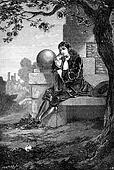
One day, while he was deep in thought, sitting outside under a grove of trees in the refreshing air, the wind blew an apple from a branch.  Usually, this is not an exciting, stimulating event.  But, this time...

The boy who was not supposed to survive, who was born in the midst of a civil war, who was taken from school to be a farmer, who graduated undistinguished from college had an epiphany that day the apple fell.  It started his observations about gravity, which turned into a book about infinitesimal calculus, which led to a theory on light and color, which, in turn prompted a book about planetary motion.

Isaac Newton is considered by many, many scientists to be the father of the Scientific Revolution.  I don't know if it was never meant to be, and Newton just had tremendous stamina, or if it was meant to be, and he was the chosen one.  Either way, his story inspires me.

What is around my next corner?  My history mirrors Newton's early life in many ways.  But, an apple hasn't blown off a branch of the tree I have been sitting next to yet.  I am, however, watching the wind dance in the branches and looking forward to whatever the wind blows in.
Tuesday, January 28, 2014

Ladder to the top

Scientists are getting closer to establishing the many, many facets of DNA and all that is passed on through its rung-like links on a ladder.  So, in another decade, I can write this blog again with much more precision.  But, I know that personality, physical features, sensual capabilities like sight, and latent talent possibilities  get passed on from parent to child.  And, I know one very amazing mom who has a son who will inherit much of what gives her the beauty and skill she possesses.

You're now 11, my handsome young man.  You are climbing a path and finding that it leads to the top of a wonderfully tall mountain.  Your genes have taken you farther than other young men your age.  Many of them will not make it to the top.  But you will; it's a matter of genetic fortune-telling.  Keep up your masterful journey.  You have it in you to conquer each obstacle that arises to impede your progress.

Happy Birthday!  And, congratulations for your great 11 year journey and for the outstanding years ahead containing your accomplishments.

Monday, January 20, 2014

More than a little intrigued

Watching the H2 channel, I came across the series called UFO files.  I watched some of the program before moving on to the NFL channel, but the part of the program I came across was the segment in which a man was interviewed about his experience with aliens.  When he mentioned that he knew how to speak to aliens, the interviewer asked him to speak in the language he communicated with them.  The man obliged, translated the words he spoke, then went on to say he knew 3 alien languages.

Hearing the language was fascinating.  I rewound the program to listen to the speech again.  Well, maybe it was.  I know that many scientists think the universal language is math or binary code.  NASA has sent several probes into space with messages using coded messages in math and computer programming.  NASA has never released a response to their messages if they have received any  The famous show Close Encounters of the Third Kind, depicted communication with aliens in music and color.  And at least one documentary has explored this possibility.

The language the man spoke was similar to Morris Code.  He spoke with short clucking sounds punctuated with voiced d taps.  So I compared the human languages of the Earth to this alien language.  At first blush, I was reminded of the sounds of the South African Bantu languages that have clicks in their speaking.  I also thought of the sounds of Arabic to someone who doesn't speak Arabic. He can  hear the k sound easily in all the words and the dominance of the umlaut u sound.  And although the man in the program didn't use k and u,  he did repeat a luh sound frequently.  In the case of Morris code, it uses long and short sounds or lights to spell letters , but it really doesn't have a grammar all its own.  Many wouldn't call it a language.

The translation of what the man spoke, "Hi, how are you. How have you been doing this afternoon?" has an easy grammar to it.  There is a greeting word, two interrogatives, two forms of BE, a present participle, a determiner and a time of day.  So did the ds and luhs match the forms of words in the translation?  It was certainly possible.  There was a lengthening of the sound at the end for the time of day.  There were extra luhs for the change in the form of BE representing the difference between the present and present perfect ideas. There was a slightly different vocalization before the first luh as if a greeting had a different tonal quality, and a different pattern in the ds and luhs that occurred in the same position as the present participle.

I would love to hear more than the small segment given on the program, and I would love to hear the other languages this man knew for comparison's sake.  Of course, it is always wise to entertain the idea that alien languages won't have developed the same way as human languages.  So, we should compare the language to animal languages and compare it to nothing but its own sounds and syntax.  Chimp and Gorilla language have different tones for the grunts and aspirations, but it has never been determined that there is an order to language, and only in one case has there been an attempt to show tense.  Dolphin and whale language have been scrutinized as well without too much success.  Most accounts of their languages relate to momentary information or emotions.

I don't know what exactly the government has in the way of analysis of alien languages, but I know that they have authorized a protocol for contact with alien species.  It's all very fascinating. It's the stuff of legends and myths, but it's still intriguing to think that others have developed a method to communicate differently, probably, from us.


Saturday, January 18, 2014

Charting patterns


Stock and currency market charts have much to teach about life, not just about money.  There is a big picture, and there are trends and anomalies, all three of which can help us as individuals.

Sometimes, I get caught up in the moment and make decisions that are only good for now.  Sometimes the decisions are bad, sometimes good.  Sometimes though, I don't get to make a decision about matters at all.  The forces in the bigger picture make those decisions, and I have to react to them.  I am not always in the right position to react positively to those forces, and I fail miserably.  However, most of the time I am and benefits result.

The beauty of charting is to see what was true a day ago, a month ago, a year, five years, or a decade ago. I can draw some conclusions about the way I trade.  I can change that pattern or pat myself on the back.  I can learn from those charted periods, or I can ignore them, knowing that each trade is unique to current conditions.  Maybe the period I am trading in is like the period in a previous trading period, but then again, it is mostly not.

Stocks and exchanges teach me that I can miss opportunities, that life moves on regardless of my response to it, that I can benefit if I am a good student of it, and that whether the movement is up or down, there is an opportunity to have good things happen.

I have known this from what wise people along the way have told me. But, charts display it so well that it is hard to forget their lessons.  Their images are in my mind's eye for just the right times.

Thursday, January 16, 2014

Pockets


Pants pockets hold all kinds of objects.  We put everything from coins to socks, gum to gloves, sun glasses to cell phones in our pockets.  They hold the things that mean a lot to us and things that are trash.  We trust them to hold those things until we're ready to use or discard  the items.

As we go through the days of our lives, we accumulate all sorts of experiences.  Our memories hold our response to those experiences in much the same way as our pockets hold the things we stuff in them.  And we can pull out the memories when we need them.  I can pull out some of my crowning experiences and those that I wish I could really forget.  I can pull out the moments I have learned great lessons and the minutes that brought particular joys.  I can revel in the scenes that helped me achieve and relive pictures of paralysis.

But there is one pocket I go to often because it brings to mind the days from a year of complete, unadulterated, pure, pleasurable, utterly enjoyable happiness, full of vibrant life and laughter, replete with smiles, brimming with the essence of life. It is a very worn pocket, even though only five years old, and I am thankful to have it so stuffed.

Monday, January 13, 2014

Fostering distrust

People have fetishes without a doubt and that usually comes up in a conversation when a conversation lasts more than the obligatory 5 minutes.  For some it is like or dislike for a particular food; for others it is bare feet or big noses.  People will certainly tell you what they think of others.

In fact, the urge to say something about others is so common that if you are with someone and he or she doesn't loosen his or her tongue with a fetish, then we begin to distrust the genuineness of that person.  And people will try to probe you for your fetish if you speak for very long to them.

This is hilarious behavior to me.  Some even consider it destructive, but I simply take note and go on with the conversation.  A lot of people distrust me because I don't give up my fetishes.  I have only told one person on Earth what my fetishes are.  They're safe secrets with that person.  I could spend an eternity with that person and be transparent because everything is safe.

But, normally, people have fetishes without a doubt.

Saturday, January 11, 2014

Directionality

When I was young, I remember hearing advice given to me to ground myself in order to have a compass for life built into my head so that I wouldn't lose my direction.  Now, I realize that life doesn't have four main directions.  It has about a million directions (6 billion, really, since the Earth's population is that number).  To make a reference to a compass  in order not to lose my direction in life is such a gross simplification of life that I laugh at the thought today.

And as far as losing direction goes - well, what direction is a person headed at the beginning of his or her life?  There is no way to ever know since there are so many directions to go in the first place.  And even if one could identify the directions, life contains so many changes in it, who's to say that a change of direction is ever considered getting lost, especially since challenging times (even as a result of a bad decision) build character and lead to opportunities that might not otherwise be achieved.

Yeah, a compass for life is the poorest metaphor around as advice for a young person.

Thursday, January 09, 2014

Easy turned hard


Sometimes people focus on word connections between two languages that aren't really there.  It's part of the learning curve when one begins learning a language.  For example, realize in English is used most of the time to mean to become aware of something. But occasionally the word means to complete something.  So, when Spanish speakers begin learning English, they use the word realize in sentences when the best word in English is really do, accomplish, or perform. That is because realizar in Spanish means to accomplish something or as a synonym of hacer, meaning to do.

This is a phenomenon so common it has a linguistic name - cognate/false cognate.  It's quite common in related languages, but not common at all in languages that have no common parent language (Chinese and German, for example).  It's an easy fix when it happens.  One just reinforces the new context of the word through practice and a certain number of repetitions in various contexts.  Voila! Easy fix.

But when it happens in religion, matters are complicated because in religion, one adds to his doctrinal or value basis for one's behavior.  Recently, I was privy to a social media entry by someone who was reading Revelation and came across the two instances of the word translated in many versions of the New Testament as sorcery.  The person had done a dictionary study of the word used in Greek and seen the word pharmakeia in an interlinear version of Revelation.

Of course, a person who studies languages knows about cognates and false cognates.  So, when the person made the statement that it was no mistake that the word used in Revelation for sorcery is the root word for pharmacy, the linguist smiles.  But, the problem is also compounded because Roman and Greek culture of the time of the New Testament intertwined the idea of sorcery with people who used various natural drugs, usually in the form of a vapor from gases like sulfur or fumes from plant leaves and vines.  It was also used metaphorically by writers to show how people are taken from cultural traditions (like the children in the story of the Pied Piper). 

Modern Americans live after the scientific revolution in the world that took place between the 1100s and 1700s.  So the idea of sorcery is an idea of mystical arts, black magic, or voodoo.  Certainly the thinking is that sorcery is a black art that has no basis in truth or reality.  There is not really a modern English word in common use for the idea of pharmakeia because American culture is so different from the one of the Roman Greco world.  Scientific thinking has completely replaced the idea of seeking words of wisdom from an oracle, a priestess who gave advice under the influence of vapors or of wanting, or of trying to induce a state of awareness so that one can speak to dead spirits and gods, or of taking a hallucinatory journey to see the future or past. Although drug user, junkie, and terms like that do exist, the cultural connotation is not even close to the idea used in Revelation.  The idea of pharmakeia is not so much, then, related to the semantic domain of drug use as it is for seeking or following a priestess' advice (who is speaking for Apollo or Athena) under the influence of drugs.  It is the semantic domain of following the advice of a god besides the Christian god that is condemned in Revelation, not the drug use.  And the sorcery idea is akin to the trickery (the metaphorical use of pharmakeia) than the black arts idea (which doesn't exist in the minds of most modern Americans).

Pharmacy is the legitimate derivative of pharmakeia.  Sorcery is more related to magic and its word derivatives.  So, now the person who reads sorcery in Revelation is victim to developing a line of thought based on false cognates at best, and at worst is victim to developing a doctrinal or value based idea based on great cultural difference.  I blame the blind loyalty of scholars on translation committees to their religious doctrines for misleading people with their translations.  But I also blame the naivety that exists among zealous religious people.  I trust they will study enough to grow out of this beginning stage of comparing two languages.

Wednesday, January 08, 2014

A rose by any other name...

The word logic usually doesn't suggest diversity when it is explained or defined.  In fact, logic is usually the antithesis of diversity.  When a person is said to have acted or spoken logically, it is implied that the person acted like most people would in a situation.

One of the questions a person must answer in order to explain logic is why something behaves the way it does.  So, there is a scientific logic, a mathematical logic, a language logic, etc., to explain why certain things happen the way they do.  Of course, there are always anomalies, and it is the anomaly that makes for the interest in trying to explain logic because a good accounting for certain behaviors can account for the anomalies.

But, as I observe people, I see that they act differently from the way I would act.  And, if asked why they did something, their logic behind the action is different from mine.  That leads me to think that logic is not uniform; it doesn't cause people to think the same way.  The theory of relativity, for example, is one way to account for some of the behaviors one sees in space, but string theory is another way of explaining some of the same phenomena.

Some of the greatest debates between parents is about how to raise children.  Many people merely use the method that was used in raising them when a better method works a lot better.  For example, when two parents talk about whether a child should be disciplined for not eating what is cooked for a meal, one parent says he/she will whip the child for not cleaning the plate and honoring the person who cooked the meal because his/her own mother or father whipped him when growing up.  The other parent is aghast at such a response saying that whipping is too harsh a punishment.  The other parent thinks the child should stay at the table as long as it takes to eat the food, even if it is an hour later because that's what his/her parent did.

Neither response is the one I would choose and my response is not the response of others who know what my response is.  What causes this diversity of thinking in response to a simple, predictable behavior by a child?  

At the root of behavior is something genetic.  It's called personality.  Personality causes people to think differently, to have different logics from each other... a beauty in the eyes of the beholder idea.  I always thought that geometry was a simple idea.  It was about shapes and points, angles and areas.  But, there's more than one way to view geometry, I have found out.  There's plane geometry, for sure, but there's also solid geometry, spherical geometry, analytical geometry, enumerative geometry, differential or discrete geometry, inversive or stochastic geometry, and on and on.

Personality needs to be studied by the experts in the field in the worst way. It would certainly explain people's behavior better than anything available now.  Cognitive scientists have helped a great deal already in finding the mechanics of how people think.  Studies in personality would go a long way in explaining why people think the way they do.  Surely  we will begin to see such studies soon.

Sunday, January 05, 2014

Enjoying the trail


This is the time of year for renewals, births of new ideas, deaths of old ideas, hopes for things to work out, realizations of new things on the horizon, and, at the very least, the next step in a journey of 1000 miles. And, that's because we can't see what is ahead on the trail.  On this journey, the trail winds in and out of forests, across desert plains, onto occasional mountaintops, and through the valleys below them.  Sometimes it requires all our strength and sometimes it gives us sheer joy and thrills.  Sometimes it seems blase, sometimes it yields excitement at every next step.


I've taken a great number of steps on this journey already and have seen the terrain above.  There is no telling what lies ahead.  But, enjoyment of the journey is the key.  Each moment has a different feel, and not all feels leave a smile on my face.  But, after  a while, the moments have similarities... uniqueness, yes, but similarities too.  Knowing how the path winds and knowing that steps have a finite number that can be taken, I want to enjoy the gifts they bring.  And I would like for the path to loop back around to those 4 most enjoyable moments in my life.  I know that most paths don't contain loops.  But, some do, and I would have unimaginable enjoyment if those 4 were to happen a second time.  And perhaps, the future would then need no more loops in the path.


Friday, January 03, 2014

Populated planets


The company that is planning to go to Mars in the year 2024 has begun its interview process.  They had about 4000 applicants, and they selected a little over a thousand to interview.  They began by choosing their first two, both of them soldiers in the army.  I can't wait.  I want to see who they choose, and I want to follow the story of the trip to Mars every day the journey continues.  It will be quite the adventure.

I am pretty sure I will miss out on an actual trip.  I was born out of sync with the time of traveling to Mars. But I will continue to dream of the Red Planet and what it offers to Earth's inhabitants.  I would love to see if it has been our once and future inhabited neighbor.  I would love to see the first colony, the growth of its population, the language they will eventually speak, and the appearance they will eventually develop.

Wouldn't it be a sight to see two planets in the solar system with life and societies and all the advancements they will bring to humanity.  I would love to see it.  It's pretty fantastic to imagine and anticipate it.

Wednesday, January 01, 2014

Beautiful illumination

I saw the most beautiful calendar tonight.  It was called Moons.  Each month had a picture of one of Earth's most beautiful spots with the moon in 3D above the horizon.  The moon was not a bright speck in a dark sky, but a brightly lit sphere, the gray outline of the mountainous areas illuminated against the backdrop of its deserts.I was fascinated by the pictures selected for each of the months.  They were the clearest pictures of the moon from the Earth that I have ever seen.


Part of my fascination with the shots of the moon on this calendar was simply from my love for observing objects in space, but part of it was from  the crystal clear clarity of the moon as viewed from Earth.  And that is part of my wish for the year 2014.  That I can see with clarity some of the issues I am used to seeing in the usual, unilluminated ways.  Illumination and clarity would make my year if it were to happen.  Each day I will look for these two realizations in toto or in pieces.  It will be a fascinating year if this wish really happens.